The Definitive Guide to 2026 Declaration of Independence Quarter Value
A Once-in-250-Years Coin Is Already in Your Pocket
The 2026 Declaration of Independence quarter is one of the most talked-about coins in recent U.S. Mint history — and for good reason.
Here's what you need to know at a glance:
| Feature | Details |
|---|---|
| Program | 2026 Semiquincentennial (America's 250th anniversary) |
| Obverse | Thomas Jefferson, dual date 1776 ~ 2026 |
| Reverse | Liberty Bell with visible crack |
| Standard versions | P (Philadelphia) and D (Denver) mint marks |
| Special version | 250,000 coins with "July 4th" privy mark, no mint mark |
| In circulation since | June 1, 2026 |
| Available to buy | Yes — rolls and bags from the U.S. Mint; privy-mark version circulation only |
This is the third of five one-year-only quarter designs released in 2026. The other four honor the Mayflower Compact, the Revolutionary War, the U.S. Constitution, and the Gettysburg Address. All five carry the historic dual date 1776 ~ 2026 — a first for circulating U.S. quarters.
What makes this coin especially exciting for collectors is the limited-edition version. The U.S. Mint produced just 250,000 quarters with a special "July 4th" privy mark and randomly mixed them into everyday bank circulation nationwide — meaning one could turn up in your change today.
As Mint Director Paul Hollis put it, this coin is "more than a coin; it's a defining moment in our nation's story."
I'm Chris Sistrunk, owner of USSQ, an online coin marketplace that has shipped over 80,000 authentic U.S. Mint coins annually to more than 60,000 collectors — including Washington quarters and proof coin sets like those tied to the 2026 Declaration of Independence quarter program. In this guide, I'll walk you through everything you need to know — from design details to collector value to how to hunt down the rare privy-mark version. You can also explore our main 2026 US Mint Quarters pillar page for a complete overview of the entire program.
What is the 2026 Declaration of Independence Quarter?
The 2026 Declaration of Independence quarter is a commemorative twenty-five-cent coin issued by the United States Mint to celebrate the nation’s 250th anniversary, also known as the Semiquincentennial. This landmark release represents the third design in the historic 2026 coin program.
The entire program was authorized under the Circulating Collectible Coin Redesign Act of 2020 (Public Law 116-330), which was officially signed into law on January 13, 2021. This legislation gave the U.S. Mint the green light to completely redesign all circulating denominations for one year to celebrate America's 250th birthday.
For the quarters, this means a temporary departure from the usual American Women Quarters series. Instead, the Mint is releasing five distinct, highly symbolic designs throughout the year. You can learn more about the complete list of releases in our 2026 US Mint Quarters overview and our comprehensive 2026 Semiquincentennial Coins Guide.
Perhaps the most striking visual feature of these coins is the dual date inscribed on the obverse: 1776 ~ 2026. This marks the first time in United States history that dual-dated circulating quarters have been minted in this format, echoing the beloved 1776–1976 Bicentennial quarters that captured the hearts of a generation of collectors fifty years ago.
The 2026 Declaration of Independence Quarter Design and Symbolism
The visual layout of the 2026 Declaration of Independence quarter is rich with historical references and deliberate artistic symbolism.
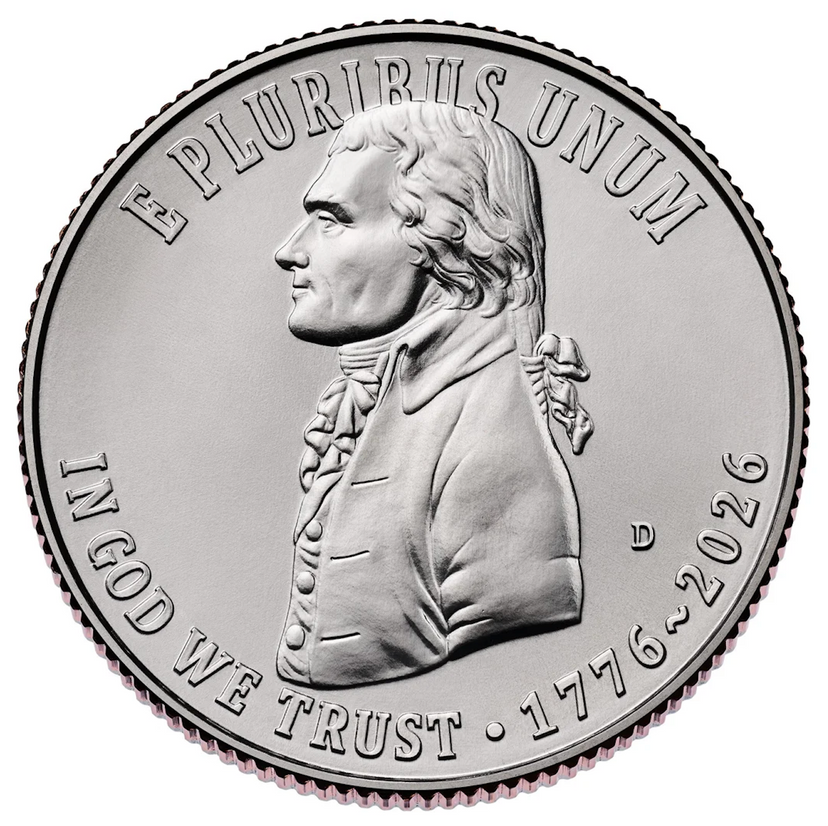
On the obverse (heads side), you will find a beautifully rendered portrait of Thomas Jefferson, the primary author of the Declaration of Independence and the third President of the United States. This portrait choice is a departure from the traditional George Washington obverse used on quarters since 1932, highlighting Jefferson's monumental role in drafting the document that defined the birth of American liberty. Alongside Jefferson's portrait, the obverse features the inscriptions "IN GOD WE TRUST," "E PLURIBUS UNUM," and the historic dual date "1776 ~ 2026."
The reverse (tails side) of the quarter is dedicated to one of the most enduring symbols of American freedom: the Liberty Bell. The design depicts the Liberty Bell suspended and ringing, with its iconic crack clearly visible. According to the U.S. Mint, the inclusion of the visible crack is highly intentional, serving as a poignant symbol of the fragility of a young nation at its founding and a reminder of the continuous effort required to preserve liberty.
The reverse also carries the essential inscriptions: "UNITED STATES OF AMERICA," "QUARTER DOLLAR," and "DECLARATION OF INDEPENDENCE." For a complete breakdown of the coin's physical measurements and composition, you can refer to the official Numista Reference.
The Five-Coin Semiquincentennial Quarter Program
The Declaration of Independence design does not stand alone. It is part of a larger, carefully curated five-coin series designed to honor the foundational milestones of the American story. The quarters are released sequentially in a specific order:
- Mayflower Compact: Commemorating the early roots of self-governance in America.
- Revolutionary War: Honoring the struggle and sacrifice for independence.
- Declaration of Independence: Celebrating the formal announcement of American liberty.
- U.S. Constitution: Marking the creation of our enduring framework of government.
- Gettysburg Address: Remembering the preservation of the Union and the rededication to freedom.
Each of these designs offers a unique artistic window into our past. To keep track of the entire sequential release schedule and to make sure you do not miss a single coin, be sure to check out our detailed guide on the 2026 Quarters.
The Rare July 4th Privy-Mark Treasure Hunt
While the standard 2026 quarters are exciting on their own, the U.S. Mint has added an incredible element of surprise for collectors and the general public alike: a nationwide treasure hunt.
To mark this historic milestone, the Mint is producing a highly limited-edition version of the 2026 Declaration of Independence quarter featuring a special "July 4th" privy mark. Only 250,000 of these special privy-mark quarters will be made. Instead of selling them directly through the U.S. Mint website, the Mint has randomly mixed these coins into standard shipments of circulating quarters and distributed them to banks and financial institutions nationwide.
As detailed in the official US Mint Press Release, these coins were distributed to banks just in time for the Fourth of July holiday. Because they are mixed directly into standard boxes and rolls of quarters, anyone—from a professional bank roll hunter to a child buying a snack at a local convenience store—has a chance to find one. This clever release strategy has turned everyday pocket change into a thrilling national treasure hunt, as highlighted by the CoinWeek Article on the event.
How to Identify the July 4th Privy-Mark 2026 Declaration of Independence Quarter
Spotting one of these rare quarters in your change requires a quick and careful inspection of both the obverse and reverse. Here is exactly what you need to look for:
- The Obverse Privy Mark: Look directly to the left of Thomas Jefferson's portrait on the obverse. You will see a small, beautifully detailed privy mark depicting the date "JULY 4".
- The Absence of a Mint Mark: Unlike standard quarters minted in Philadelphia (which feature a "P" mint mark) or Denver (which feature a "D" mint mark), the special July 4th privy-mark quarters bear no mint mark at all.
- The Reverse Design: Ensure the reverse features the Liberty Bell with the visible crack and the "DECLARATION OF INDEPENDENCE" inscription.
Because standard quarters will also be circulating heavily, keeping a close eye on the area next to Jefferson's portrait is key. For more tips on identifying the design elements and appreciating the historical background of the release, you can read the Smithsonian Magazine Report.
Collector Value and the NGC Bounty
The incredibly low mintage of 250,000 coins makes the July 4th privy-mark quarter an instant rarity. To put this in perspective, the famous 2020-W America the Beautiful quarters (which featured the "W" mint mark for West Point) had a mintage of 2 million coins per design. The 2026 July 4th privy-mark quarter is eight times rarer than a 2020-W quarter!
This extreme scarcity has driven immense collector demand and sent secondary market values soaring. To fuel the excitement, the Numismatic Guaranty Company (NGC) officially announced a $2,500 cash bounty for the very first authentic July 4th privy-mark quarter submitted to them for grading.
For collectors looking to maximize the value of their find, professional grading is highly recommended. A coin's grade—ranging from heavily circulated to Gem Brilliant Uncirculated—greatly impacts its market value. If you are lucky enough to pull one of these from a bank roll, handle it only by the edges and place it immediately into a protective holder to avoid scratches or finger oils.
Whether you are looking to add standard issues to your collection or hoping to find a rare error, you can explore our wide selection of historical Washington quarters to see how this new release fits into the broader legacy of U.S. quarter collecting.
Standard vs. Privy-Mark Quarters: Production and Products
It is important to understand the structural differences between the standard quarters you can buy directly and the rare privy-mark quarters hidden in circulation.
The standard 2026 Declaration of Independence quarter is produced in massive quantities for general commerce at both the Philadelphia Mint (P) and the Denver Mint (D). These coins are designed to meet the everyday transactional needs of the country.
To help collectors secure pristine, uncirculated examples of these coins without searching through dirty pocket change, the U.S. Mint offers standard quarters in official rolls and bags. These can be purchased directly from the Mint's online catalog or through trusted coin distributors. You can find more information about these collector programs in our guides on America 250th Coin Programs and the Semiquincentennial Silver Proof Quarters.
The table below highlights the key differences between these two versions:
| Feature | Standard 2026 Quarter | July 4th Privy-Mark Quarter |
|---|---|---|
| Mints | Philadelphia (P) & Denver (D) | Philadelphia (No Mint Mark) |
| Mintage | Hundreds of millions (common) | Limited to exactly 250,000 |
| Obverse Markings | "P" or "D" mint mark | "JULY 4" privy mark, no mint mark |
| How to Obtain | Pocket change, bank rolls, or direct U.S. Mint sales | Circulation only (cannot be bought from the Mint) |
| Collector Premium | Face value (unless high-grade or proof) | High collector premium (highly valuable) |
Official US Mint Products for Collectors
For those who want to guarantee they own beautiful, uncirculated copies of the standard P and D quarters, the U.S. Mint has released several popular product formats:
- Two-Roll Sets: Containing one 40-coin roll from Philadelphia and one 40-coin roll from Denver (80 coins total) for $56.
- 100-Coin Bags: Available from either the Philadelphia or Denver mint for $63 per bag.
- Proof and Silver Proof Sets: Featuring mirror-like finishes and struck on specialized coin presses for maximum visual appeal.
These products are highly favored by collectors because they preserve the coins in Gem Brilliant Uncirculated condition, free from the dings and scratches that occur when coins bump together in bank transport trucks. If you want to add these beautifully preserved pieces to your collection, you can browse our inventory of official proof coin sets.
Frequently Asked Questions about the 2026 Declaration of Independence Quarter
How many July 4th privy-mark quarters were made?
The U.S. Mint produced exactly 250,000 of the special July 4th privy-mark quarters. These were mixed randomly into standard shipments of quarters and sent to banks across the United States.
Where is the mint mark on the 2026 Declaration of Independence quarter?
On standard quarters, the "P" (Philadelphia) or "D" (Denver) mint mark is located on the obverse side, just to the right of Thomas Jefferson's portrait. On the rare July 4th privy-mark version, there is no mint mark at all; instead, you will find the "JULY 4" privy mark on the left side of the portrait.
Can I buy the July 4th privy-mark quarter directly from the US Mint?
No. The U.S. Mint is not selling the July 4th privy-mark quarters directly to the public through its website or retail shops. The only way to obtain one is to find it in circulation, purchase it from another collector on the secondary market, or buy bank rolls to search through them yourself.
Conclusion
The 2026 Declaration of Independence quarter is a magnificent tribute to 250 years of American liberty. With its beautiful depiction of Thomas Jefferson and the symbolic Liberty Bell, it serves as a tangible piece of history that we can carry in our pockets.
For casual observers, finding a standard version in change is a fun way to connect with America's Semiquincentennial celebration. For dedicated collectors, the hunt for one of the 250,000 rare July 4th privy-mark quarters represents a once-in-a-lifetime opportunity to find a genuine modern rarity in everyday change.
Here at Coins Online LLC, we are proud to support your collecting journey. Whether you are searching for the latest 2026 releases, classic quarters, or specialized coin supplies, we offer competitive prices, low shipping rates, and a hassle-free 14-day return policy on our massive inventory of over 5,000 products.
Happy hunting, and may the odds of finding a July 4th privy mark be ever in your favor! If you have any questions about these coins or need help completing your 2026 quarter collection, please do not hesitate to Contact USSQ.
Recent Posts
-

Walking Liberty Half Dollar Value Guide: Key Dates, the 1921 Problem, and What Yours Is Really Worth
Ask a room full of collectors to name the most beautiful U.S. coin and the Walking Liberty half doll
-
The 2026 Semiquincentennial Proof Set: What's in It, Why It Costs $107, and Whether to Buy One
On October 6 at noon Eastern, the U.S. Mint puts the 2026 Semiquincentennial Proof Set on sale at $1