Jefferson Nickel Value Guide: Key Dates, War Nickels, and What Your 5 Cents Is Really Worth
The Jefferson nickel is the coin everyone owns and almost no one looks at. It's been in production since 1938 — Felix Schlag won a public competition to design it — and because so many were struck, most are worth exactly five cents. But "most" is doing a lot of work in that sentence. A handful of dates, a wartime silver composition, and one strike-quality designation separate pocket change from coins collectors genuinely compete for.
The key dates: 1939-D and 1950-D
Two dates anchor every serious Jefferson set:
- 1950-D — the king of the series. Just 2.63 million struck, the lowest mintage of any Jefferson nickel. Here's the twist: because collectors knew it was scarce immediately, huge numbers were hoarded in uncirculated rolls. The result is a coin that's genuinely hard to find worn but plentiful in mint state — grading-service price guides put typical uncirculated examples in the range of a modest dinner out, not a mortgage payment. It's the most affordable "key date" in American coinage, which makes it a great first key for new collectors.
- 1939-D — 3.5 million struck, and unlike the 1950-D, nobody was saving them. Mid-grade circulated examples carry a real premium, and choice uncirculated pieces are the sleeper of the series.
Honorable mentions: the 1939-S, the 1938-D and 1938-S first-year issues, and the 1943-P 3-over-2 overdate — a wartime die error where a 1943 date was punched over a 1942, visible with a loupe on the 3.

War nickels: the 35% silver years (1942–1945)
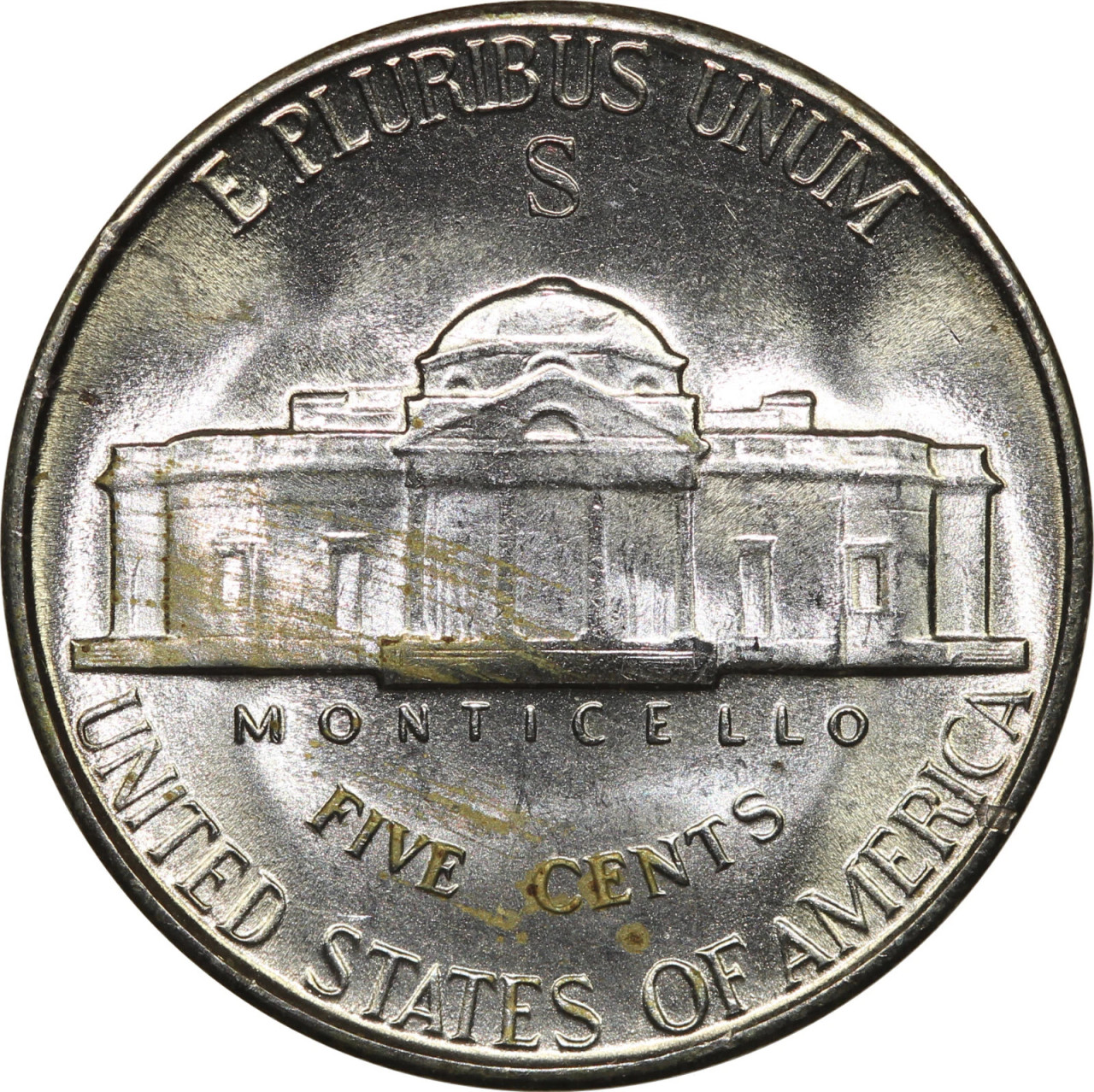
When nickel became a strategic war metal, the Mint switched the five-cent piece to an alloy of 56% copper, 35% silver, and 9% manganese. These silver war nickels are the only nickels with meaningful melt value — each contains about 0.056 troy ounces of silver, so their floor moves with the silver spot price rather than sitting at five cents.
Identifying them takes two seconds: war nickels carry a large mint mark above Monticello's dome on the reverse — P, D, or S. The Philadelphia "P" matters historically: it was the first time a P mint mark appeared on any U.S. coin. Any nickel dated 1942–1945 with that large reverse mint mark is silver (1942 came both ways, so check that year carefully).
A jar of inherited nickels is worth sorting for exactly this reason — war nickels turn up in old accumulations constantly, and a full set of all eleven date-and-mint combinations is an achievable, satisfying project.
Full Steps: the condition game
For uncirculated Jeffersons, value concentrates in the Full Steps designation — five or six complete, unbroken steps visible at the base of Monticello. Weak strikes were chronic in this series, especially from Denver in the 1950s–60s, so common dates that are cheap in ordinary mint state can command strong premiums with Full Steps. If you're buying certified coins, PCGS and NGC both designate it ("FS"), and it's where the serious money in this series lives.
What to do with what you have
A realistic sorting rule for a pile of nickels: pull anything dated before 1960, anything with the large mint mark over Monticello, and anything so fresh it looks like it never circulated. The rest is spending money. And if a date run grabs you — this is one of the few classic series still cheap enough to collect from circulation — our Jefferson nickel collection covers the keys, the war years, and uncirculated rolls to fill the gaps circulation won't.
One honest caveat: condition claims matter more than date claims. A "rare" nickel in a flea-market flip is usually a common date in worn condition; verify against grading-service price guides (PCGS and NGC publish theirs free) before paying a premium. That habit alone will save you more than any single coin will earn you.
Recent Posts
-

Walking Liberty Half Dollar Value Guide: Key Dates, the 1921 Problem, and What Yours Is Really Worth
Ask a room full of collectors to name the most beautiful U.S. coin and the Walking Liberty half doll
-
The 2026 Semiquincentennial Proof Set: What's in It, Why It Costs $107, and Whether to Buy One
On October 6 at noon Eastern, the U.S. Mint puts the 2026 Semiquincentennial Proof Set on sale at $1