Why Collectors Go Crazy for Morgan and Peace Silver Dollars
Morgan Dollar vs Peace Dollar: Two Icons, One Classic Choice
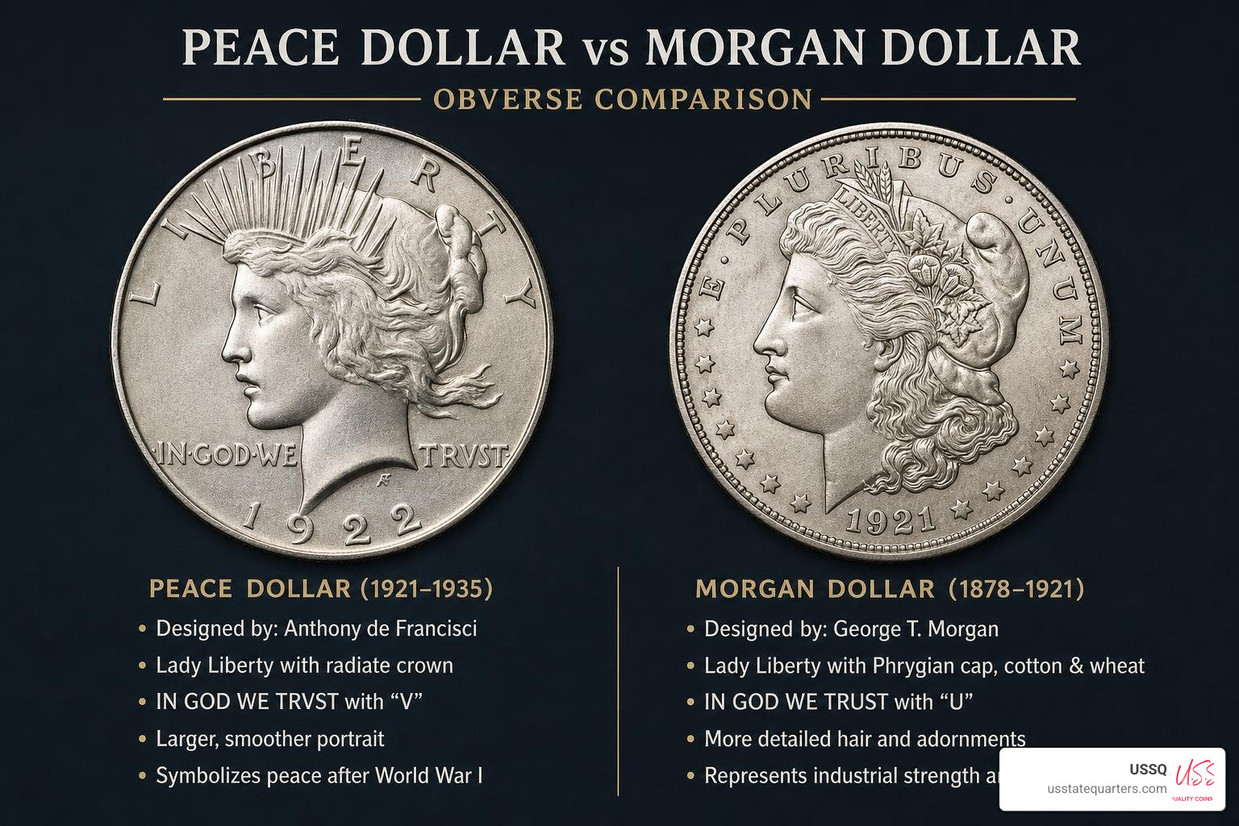
The debate over peace dollar vs morgan dollar is one of the most common — and most enjoyable — conversations in American numismatics. Both are 90% silver U.S. dollars. Both feature Lady Liberty. And both have passionate fans who will argue their favorite is the superior coin.
Here's a quick breakdown to help you compare them at a glance:
| Feature | Morgan Dollar | Peace Dollar |
|---|---|---|
| Minted | 1878-1904, 1921 | 1921-1928, 1934-1935 |
| Designer | George T. Morgan | Anthony de Francisci |
| Silver content | 0.7734 troy oz (90%) | 0.7734 troy oz (90%) |
| Total mintage | ~657.7 million | ~190.8 million |
| Mint locations | Philadelphia, San Francisco, New Orleans, Carson City, Denver | Philadelphia, San Francisco, Denver |
| Design style | Classical, Victorian | Art Deco, modern |
| Typical circulated value | $30-$50 (common dates) | $40-$300 (common dates) |
| Best for | Collectors, stackers, variety hunters | Stackers, investors, Art Deco fans |
Both coins share the same weight, diameter, and silver content — so the choice often comes down to history, aesthetics, and collecting goals.
Morgan Silver Dollars dominated American commerce for decades. The Peace Dollar series was born from a very different moment — the quiet after one of history's deadliest wars. For related product categories and collector resources, you can also browse our Peace silver dollars.
Image note: the images in this guide are intended to show the specific Morgan Dollar and Peace Dollar designs, dates, or comparison points being discussed; generic silver-dollar substitutions are not used.
In the sections below, we break down everything: the history, the designs, the rare dates, and which coin makes more sense for your collection or stack.
By The USSQ Numismatics Team, experienced numismatists at US State Quarters, Coins Online LLC, serving collectors since 1999.
Historical Origins and Legislative Background
Morgan and Peace dollars are easy to compare because they look similar at first glance: large silver dollars, reeded edges, Liberty on the front, eagle on the back. But historically, they come from very different American moods.
The Morgan Dollar belongs to the age of western mining, railroad expansion, and political arguments over silver. It was first struck in 1878 after the Bland-Allison Act required the U.S. Treasury to buy large amounts of silver and coin it into dollars. In plain English: the government had a lot of silver to turn into money, and the Morgan Dollar became the workhorse.
The Peace Dollar arrived after World War I. Its purpose was more symbolic. The United States needed to replace silver dollars melted under the Pittman Act, and many Americans wanted a coin that marked the end of the war. The result was a bold new dollar with a name that said the quiet part out loud: peace.
This is why collectors often see them as bookends:
- Morgan Dollars represent the 19th-century silver boom, western expansion, and hard-money politics.
- Peace Dollars represent the postwar 20th century, modern design, and a national hope for stability.
Were they both practical coins? Yes. Were they also miniature political billboards? Also yes. Coins have never been shy.
Historical Context: Peace Dollar vs Morgan Dollar Origins
The Morgan Dollar was designed by George T. Morgan, an English-born engraver who joined the U.S. Mint and later became Chief Engraver. His Liberty was modeled in part after Anna Willess Williams, a Philadelphia schoolteacher, giving the design a distinctly American face rather than a purely classical Greek or Roman look.
The Peace Dollar was designed by Anthony de Francisci, a young Italian-American sculptor. His Liberty was modeled after his wife, Teresa de Francisci, with wind-swept hair and a radiate crown. The design was selected during a period when the nation wanted a coin that felt fresh, hopeful, and modern.
A quick note on the 1933 Confiscation Act: collectors sometimes mention pre-1933 coins because older numismatic coins are generally discussed differently than modern bullion. Morgan and most Peace dollars are collectible U.S. coins with historical and numismatic value, not just silver rounds. That does not mean every coin is automatically rare or exempt from every possible rule, but it does explain why many collectors prefer classic U.S. silver dollars over generic bullion.
Design and Aesthetic Comparison
The biggest emotional divide between Morgan and Peace dollar fans usually comes down to design.
The Morgan Dollar looks traditional, formal, and almost architectural. Liberty wears a Phrygian cap, a symbol of freedom, with wheat and cotton woven into her hair. Around her are the inscriptions "E PLURIBUS UNUM" and the date. The stars give it a balanced, 19th-century frame.
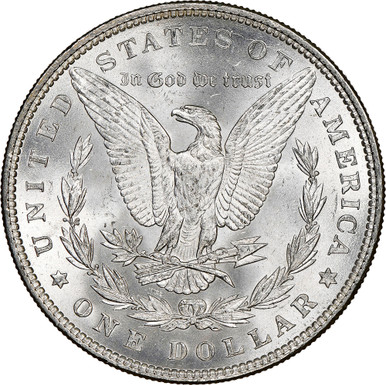
On the reverse, a slender bald eagle holds arrows and an olive branch, surrounded by a laurel wreath. The eagle has a narrower, older style than many modern U.S. coin eagles. Some collectors love that. Others think the bird looks like it skipped lunch. Either way, it is instantly recognizable.
Morgan design highlights:
- Obverse: Liberty facing left, wearing a Phrygian cap and agricultural wreath
- Reverse: Eagle with outstretched wings, arrows, olive branch, and wreath
- Style: Classical American, Victorian, highly detailed
- Collector appeal: Date and mint mark varieties, cameo-like Liberty portrait, Old West connection
The Peace Dollar, by contrast, feels open and modern. It has fewer small details and more dramatic visual space. It looks like it belongs to the 1920s because it does.
The Peace Dollar's Art Deco Elegance
The Peace Dollar is one of the most recognizable Art Deco-influenced U.S. coins. Liberty faces left with a radiate crown, similar in spirit to the Statue of Liberty but softer and more human. Teresa de Francisci was the model, and the result is a design that feels less formal than Morgan's Liberty.
The reverse shows an eagle perched on a mountain or rock, holding an olive branch, with rays of a rising sun behind it. Instead of a fighting eagle clutching arrows, the Peace Dollar eagle sits calmly. The message is not conquest. It is watchful peace.
There is also a famous design controversy. The original Peace Dollar concept included a broken sword, intended to symbolize the end of war. Critics argued that a broken sword could suggest defeat rather than peace, so the element was removed before release. Good call. A coin called the Peace Dollar probably should not look like it just lost a duel.
Another detail collectors notice is the word "TRVST" instead of "TRUST" in "IN GOD WE TRVST." That "V" is not an error. It reflects classical Latin styling, where V was used in place of U in inscriptions.
Peace design highlights:
- Obverse: Liberty with radiate crown and flowing hair
- Reverse: Eagle at rest with olive branch, rising sun in background
- Style: Art Deco, symbolic, open fields
- Collector appeal: Modern look, peace symbolism, high-relief 1921 issue
Minting History, Specifications, and the 1921 Transition
Morgan Dollars were struck from 1878 through 1904, then returned for one final year in 1921. Peace Dollars began in 1921 and continued through 1928, then returned for 1934 and 1935.
Here is the big production picture:
| Category | Morgan Dollar | Peace Dollar |
|---|---|---|
| Original circulation years | 1878-1904, 1921 | 1921-1928, 1934-1935 |
| Total mintage | 657,718,390 | 190,777,279 |
| Production span | 27 minting years | 24 minting years |
| Composition | 90% silver, 10% copper | 90% silver, 10% copper |
| Silver weight | 0.7734 troy oz | 0.7734 troy oz |
| Total weight | 26.73 grams | 26.73 grams |
| Diameter | 38.1 mm | 38.1 mm |
| Edge | Reeded | Reeded |
| Mint locations | Philadelphia, San Francisco, New Orleans, Carson City, Denver | Philadelphia, San Francisco, Denver |
Morgan Dollars were made at five mints:
- Philadelphia: no mint mark
- New Orleans: O
- San Francisco: S
- Carson City: CC
- Denver: D, only in 1921
Peace Dollars were made at three mints:
- Philadelphia: no mint mark
- Denver: D
- San Francisco: S
That difference matters. Carson City Morgan Dollars, for example, have an almost legendary following because of their connection to western silver mining and their lower mintages compared with many other Morgan issues.
Physical Specifications: Peace Dollar vs Morgan Dollar Silver Content
The silver content is one of the simplest parts of this comparison: original Morgan and Peace dollars contain the same amount of silver.
Each original coin contains:
- 90% silver
- 10% copper
- 0.7734 troy ounces of pure silver
- 26.73 grams total weight
- 38.1 mm diameter
- Reeded edge
So if your main question is, "Which has more silver?" the answer is neither. They are equal. We cover this same point in our silver dollar resource, Do Morgan and Peace dollars contain the same amount of silver?.
The copper was included for durability. Pure silver is soft, and coins meant to circulate needed to survive pockets, cash drawers, saloons, bank bags, and who knows how many kitchen jars.
Because the physical specs match, Morgan and Peace dollars can often be stored together in the same style of tubes, flips, albums, or holders. For stackers, that is convenient. For collectors, however, we recommend organizing them separately by series, date, mint mark, and grade.
The Pivotal 1921 Transition Year
The year 1921 is the dramatic handshake between the two series.
In 1921, the Morgan Dollar came back for one last production run after a long pause. More than 86 million 1921 Morgan Dollars were struck across Philadelphia, San Francisco, and Denver. It was also the only year a Morgan Dollar was made at the Denver Mint.
The Peace Dollar also debuted in 1921, but in a much smaller quantity. Only 1,006,473 were struck, all at Philadelphia. Even more importantly, the 1921 Peace Dollar was made in high relief. The design looked beautiful, but it was difficult to strike well for mass production. In 1922, the design was lowered to make coinage more practical.
That is why 1921 values differ so much:
| 1921 Issue | Mintage | Typical circulated range |
|---|---|---|
| 1921 Morgan Dollar, Philadelphia | 44,690,000 | About $30-$50 |
| 1921 Morgan Dollar, San Francisco | 21,695,000 | About $30-$50+ |
| 1921 Morgan Dollar, Denver | 20,345,000 | About $30-$50+ |
| 1921 Peace Dollar, Philadelphia | 1,006,473 | About $100-$300 |
Higher-grade examples can climb much more. A 1921 Peace Dollar in Mint State can be significantly more expensive because collectors want the first-year, high-relief type. By comparison, 1921 Morgan Dollars are often accessible, making them popular entry points for new collectors.
For a deeper look at that one-year showdown, see our 1921 Morgan vs. Peace Silver Dollar Guide: Key Differences.
Peace Dollar vs Morgan Dollar: Stacking and Investment Strategies
Collectors and stackers often approach these coins differently.
If you are building a numismatic collection, Morgan Dollars offer more date, mint mark, and variety hunting. There are more coins, more mints, and more famous key dates. Carson City issues, better-date San Francisco coins, and high-grade common dates all have strong collector demand.
If you are stacking silver, common-date Peace Dollars can sometimes offer a slightly better price-per-ounce because they may sell for a bit less than comparable Morgan Dollars in circulated grades. That is not always true, but it is common enough that silver stackers pay attention.
Morgan Dollar advantages:
- Larger collector base
- Strong name recognition
- More mint mark variety
- Carson City appeal
- Excellent crossover between collecting and stacking
- Many affordable circulated examples, especially 1921 issues
Peace Dollar advantages:
- Lower total mintage as a series
- Often lower premiums for common circulated coins
- Shorter set to complete
- Distinct Art Deco design
- Strong appeal for collectors who like 20th-century coinage
- First-year 1921 high-relief issue offers major collector interest
Factors to consider before buying either series:
- Condition: A cleaned coin, damaged coin, or heavily worn coin may trade close to silver value, while a problem-free coin can carry a stronger premium.
- Grade: Mint State coins, especially with strong luster, are much more collectible.
- Mint mark: CC, S, O, D, or no mint mark can make a major difference depending on the date.
- Rarity: Mintage matters, but survival rate and demand matter too.
- Eye appeal: Toning, strike sharpness, marks, and luster all affect desirability.
- Authenticity: Buy from reputable sources and be cautious with unusually cheap "deals."
- Goal: Are you stacking silver, building a date set, buying a type coin, or investing in better grades?
For many collectors, the best answer is not Morgan or Peace. It is both. One gives you the classic 19th-century silver dollar experience; the other gives you the clean, symbolic design of the 1920s and 1930s.
For product-category browsing, start with our Morgan Silver Dollars category, or visit our Peace silver dollars collection to browse additional coin categories, collector supplies, and related silver-dollar options.
Modern Reissues and Commemoratives
Modern Morgan and Peace dollars are not the same as the original circulation coins.
The classic coins from 1878-1935 are 90% silver and 10% copper. Modern commemorative and tribute issues, beginning with the 2021 centennial releases, are generally struck in 99.9% fine silver. They may come in proof, uncirculated, or reverse proof finishes, depending on the year and product.
Key differences between originals and modern issues:
| Feature | Original Morgan and Peace Dollars | Modern Morgan and Peace Issues |
|---|---|---|
| Metal purity | 90% silver | 99.9% fine silver |
| Intended use | Circulation coinage | Collectible numismatic products |
| Dates | 1878-1935 range | 2021 and later issues |
| Wear | Often circulated | Usually sold as collector-quality pieces |
| Value drivers | Date, mint mark, grade, rarity, originality | Finish, mintage, packaging, collector demand |
Modern issues are beautiful, but collectors should not confuse them with originals. A 2021 or 2025 Morgan-style dollar may honor the old design, but it did not jingle around in a 19th-century cash drawer. Original coins carry historical wear, minting quirks, and survival stories that modern coins simply cannot replicate.
That said, modern pieces can be excellent additions for collectors who enjoy the designs but want high-purity silver and pristine finishes. If you like the classic motifs, our Morgan silver dollars are a helpful starting point for comparing collectible options.
Frequently Asked Questions about Silver Dollars
Which coin is better for beginner collectors?
For most beginners, a common-date Morgan Dollar or a common-date Peace Dollar is a great start. If we had to choose one first coin, the 1921 Morgan Dollar is often the most approachable because so many were made. It is historic, affordable in circulated grades, and easy to recognize.
Common-date Peace Dollars are also excellent for beginners, especially if you like the Art Deco design or want a shorter series to explore. A circulated 1922, 1923, or 1925 Peace Dollar can be a satisfying type coin without jumping straight into expensive key dates.
Beginner-friendly approach:
- Start with one attractive circulated Morgan Dollar.
- Add one common-date Peace Dollar.
- Compare the designs in hand.
- Learn mint marks and grading basics.
- Move into better dates only after you understand condition and pricing.
If you want a fun side-by-side collection, buy one of each in similar grades. Then decide which design makes you smile more. That is not a technical grading standard, but it is surprisingly useful.
Why does the Peace Dollar have a "V" in "TRUST"?
The Peace Dollar uses "TRVST" instead of "TRUST" because the designer used a classical Latin-style lettering convention. In Latin inscriptions, V often served the role of U.
So no, it is not a mint error. It is not rare because of the spelling. And unfortunately, it does not mean you found a secret million-dollar variety in Grandpa's coin box.
Anthony de Francisci used the style intentionally as part of the coin's artistic design. It fits the Peace Dollar's symbolic, sculptural look.
Are Morgan and Peace dollars protected from government confiscation?
Collectors often discuss Morgan and Peace dollars in connection with old U.S. coinage and historical exemptions, especially because most were struck before 1933. However, the topic can be misunderstood.
Morgan and Peace dollars are collectible silver coins with numismatic value. Their value is not based only on silver melt. That collectible status is one reason many people prefer them over generic bullion.
However, laws and regulations can be complex, and silver dollars should not be purchased based only on assumptions about confiscation protection. We suggest treating Morgan and Peace dollars as historic collectibles first and silver assets second.
In practical terms, their advantages are clearer:
- They are widely recognized.
- They contain known silver content.
- They have legal tender status.
- They offer collector demand beyond melt value.
- They are easy to store, trade, and organize.
Conclusion
Morgan and Peace silver dollars remain collector favorites because they offer something modern coins often cannot: real history you can hold.
Morgan Dollars bring western silver, 19th-century commerce, Carson City mystique, and classic Liberty design. Peace Dollars bring postwar optimism, Art Deco style, and one of the most meaningful names ever placed on a U.S. coin.
So which is better?
Choose Morgan Dollars if you want:
- More varieties and mint marks
- Stronger collector crossover
- Carson City and Old West appeal
- A larger, more established market
Choose Peace Dollars if you want:
- A shorter series
- Lower total mintage
- Art Deco design
- Often attractive silver value in common circulated grades
Choose both if you want the full story of America's classic silver dollar era. That is usually our favorite answer.
At USSQ, we have served collectors since 1999 with competitive prices, low shipping, 14-day returns, and thousands of collectible coin products and supplies. You can browse our full coin catalog or reach our team through Contact USSQ.
Recent Posts
-

Walking Liberty Half Dollar Value Guide: Key Dates, the 1921 Problem, and What Yours Is Really Worth
Ask a room full of collectors to name the most beautiful U.S. coin and the Walking Liberty half doll
-
The 2026 Semiquincentennial Proof Set: What's in It, Why It Costs $107, and Whether to Buy One
On October 6 at noon Eastern, the U.S. Mint puts the 2026 Semiquincentennial Proof Set on sale at $1