The 1892 Liberty Dime Value and History Guide
The 1892 Liberty Dime: First-Year Issue of an American Classic
The 1892 liberty dime marks the beginning of one of the most collected silver coin series in American numismatic history. Struck in 90% silver and designed by Chief Engraver Charles E. Barber, this coin replaced the long-running Seated Liberty design and launched a series that would run for 25 years, from 1892 to 1916.
Here is a quick snapshot of what you need to know:
| Feature | Details |
|---|---|
| Coin Type | Barber (Liberty Head) Dime |
| Year | 1892 (first year of series) |
| Designer | Charles E. Barber |
| Composition | 90% Silver, 10% Copper |
| Weight | 2.50 grams |
| Diameter | 17.90 mm |
| Mint Varieties | Philadelphia (no mark), New Orleans (O), San Francisco (S) |
| Philadelphia Mintage | 12,120,000 |
| New Orleans Mintage | 3,841,700 |
| San Francisco Mintage | 990,710 |
| Proof Mintage | 1,245 |
| Value Range (circulated) | ~$7 (Good) to ~$80+ (Uncirculated) |
| Value Range (MS63) | ~$200–$925 depending on mint |
| Auction Record | $43,200 for MS68 (May 2024) |
Three mint facilities struck 1892 Barber Dimes. The Philadelphia issue is the most common. The San Francisco issue, with fewer than one million struck, is the scarcest of the three and commands significantly higher prices in all grades.
Being the first-year issue of the Barber series adds an extra layer of collector appeal. Type collectors, series builders, and silver coin enthusiasts all compete for quality examples — especially in higher grades, which are genuinely rare across all three mint varieties.
History and Design of the 1892 Liberty Dime
The birth of the 1892 liberty dime was not without its fair share of drama. By the late 1880s, the Seated Liberty design had been in circulation for over fifty years. The public was, quite frankly, bored. Under the 1890 Mint Act, the Treasury was finally allowed to change coin designs that had been in use for at least 25 years without needing a specific act of Congress.
Mint Director Edward Leech originally wanted a public competition to find the next great American coin design. He invited ten of the nation's most famous artists, but they balked at the terms (mostly because the prize money was low and they didn't want to compete against each other). Leech then opened the competition to the general public. We received nearly 300 entries, but to Leech’s dismay, they were all rejected as being of poor quality.
Frustrated and facing a deadline, Leech turned to the Mint’s own Chief Engraver, Charles E. Barber. Barber, who held the position from 1880 until 1917, was known for his technical skill rather than artistic flair. He created a unified design for the dime, quarter, and half dollar, emphasizing a "low relief" that allowed the coins to be struck efficiently and stack easily. While critics at the time called it unimaginative, the design proved to be a workhorse for American commerce. You can learn more about the 1892 10C (Regular Strike) History and how it paved the way for the 20th-century "Renaissance" of American coinage.
Key Features of the 1892 Liberty Dime Obverse
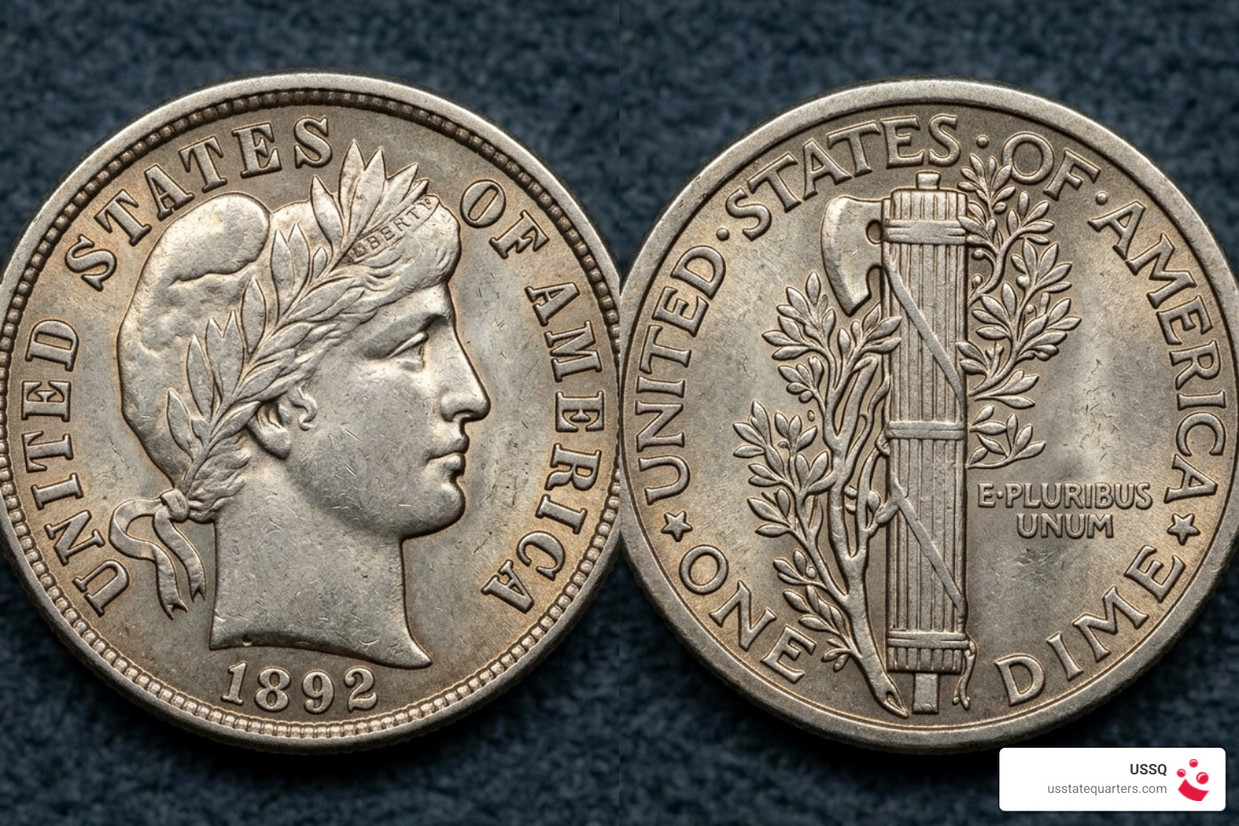
The obverse (the "heads" side) of the 1892 liberty dime features a classical Roman-style head of Liberty facing right. She wears a Phrygian cap, a symbol of freedom, adorned with a laurel wreath that signifies victory. If you look closely at the truncation of her neck, you will see a tiny "B"—the initial of Charles E. Barber.
Surrounding Liberty are 13 stars, representing the original colonies, with the motto "IN GOD WE TRUST" positioned above her head. The date "1892" is centered at the bottom. This design was consistent across the dime, quarter, and half dollar, making the Barber series one of the most uniform "families" of coins in U.S. history.
Reverse Design and Mint Mark Locations
Flip the coin over, and you’ll find a design that actually looks quite familiar to fans of the previous Seated Liberty series. It features a lush agricultural wreath composed of corn, wheat, maple, and oak leaves. This wreath encircles the denomination "ONE DIME."
The most important detail for collectors is located just below the bow or knot of the wreath. This is where the mint mark is found.
- Philadelphia: No mint mark.
- New Orleans: An "O" mint mark.
- San Francisco: An "S" mint mark.
In 1892, these three mints were the only ones producing dimes. The Denver mint (D) wouldn't start striking Barber dimes until 1906.
Technical Specifications and Mintage Figures
The 1892 liberty dime was built for heavy circulation. It is composed of 90% silver and 10% copper, a standard that remained until 1965. With a diameter of 17.90 mm and a weight of 2.50 grams, it feels substantial in the hand despite its small size. The reeded edge was a security feature designed to prevent people from "clipping" or shaving silver off the edges of the coin.
| Mint | Mintage | Rarity Rating |
|---|---|---|
| 1892 (Phila) | 12,120,000 | Common |
| 1892-O | 3,841,700 | Scarce |
| 1892-S | 990,710 | Rare |
| 1892 Proof | 1,245 | Very Rare |
Mintage Breakdown by Mint Facility
As the table shows, the Philadelphia Mint did the heavy lifting, producing over 12 million coins. These were the "workhorses" of the East Coast. The New Orleans Mint produced a respectable 3.8 million, making the 1892-O a semi-key date that is still obtainable for most collectors.
However, the San Francisco Mint struck fewer than one million coins. This makes the 1892-S a genuine rarity, especially in higher grades. For those interested in current market trends, you can check the 1892 Barber Dime Values - Live Pricing to see how these mintage numbers translate into today’s dollars.
Survival Rates and Rarity
Mintage numbers only tell half the story. The "survival rate" is what truly determines value. Because these coins were made of 90% silver, millions were melted down during the silver price spikes of the 1970s and 1980s. When silver hit nearly $50 an ounce, many common-date Barber dimes were sent to the refinery.
Today, experts estimate that only about 40,000 examples of the Philadelphia 1892 dime survive in all grades. For the 1892-S, the number is much lower. Finding an 1892-S in "Uncirculated" condition is a major win for any collector. The 1892-O Barber Dime Values and Rarity also highlight how difficult it is to find New Orleans issues with original mint luster.
1892 Liberty Dime Value and Grading Standards
As of April 2026, the market for the 1892 liberty dime remains robust. Because it is a first-year issue, demand comes from both series collectors and "Type" collectors who just want one beautiful example of the Barber design. Values are heavily influenced by the spot price of silver (currently around $25–$30 per ounce), but the numismatic premium for rare dates and high grades far exceeds the melt value.
For a comprehensive look at the series, refer to our Barber Dime (1892-1916) Value Guide.
Determining the 1892 Liberty Dime Value by Grade
Grading is the process of determining how much wear a coin has sustained. Here is how we break down the values for a standard Philadelphia 1892 dime:
- Good (G-4): The coin is heavily worn. The "LIBERTY" on the headband is gone, but the date is readable. Value: ~$7–$8.
- Fine (F-12): At least three letters of "LIBERTY" are visible. The wreath on the reverse shows some detail. Value: ~$18–$20.
- Extremely Fine (XF-45): "LIBERTY" is sharp and clear. There is only light wear on the highest points of the design. Value: ~$30–$40.
- Uncirculated (MS-63): No wear at all. The coin looks just like it did the day it left the mint, with "mint luster" (that shiny, cartwheel effect). Value: ~$200–$275.
- Proof (PR-63): Specially struck for collectors with mirror-like surfaces. Value: ~$450–$550.
If you have an 1892-S, those prices skyrocket. Even a "Good" condition 1892-S can fetch $80 or more, while an uncirculated example can easily top $1,000.
Rare Varieties and Condition Factors
Beyond the standard mint marks, there are "varieties" that drive collectors wild. The most famous for this year are the Repunched Date (RPD) varieties, cataloged as FS-301 and FS-302. In these cases, the person at the mint literally punched the date into the die twice, leaving a slight "ghost" or shadow of the numbers. These varieties carry a significant premium over standard coins.
When we evaluate a 1892 liberty dime, we look for:
- Luster: Is the original shine still there?
- Surface Marks: Are there big scratches or "bag marks" from the coins hitting each other?
- Headband Detail: Can you read all the letters in "LIBERTY"? This is the first place wear shows.
Collecting and Authenticating Barber Dimes
Collecting Barber dimes is a rewarding hobby, but it requires a careful eye. Because the 1892 liberty dime is a silver coin, it is often subject to "cleaning" by well-meaning but ill-informed owners. Never clean your coins! A cleaned coin loses up to 50% of its numismatic value. We always prefer a coin with original, dark "toning" over one that has been scrubbed bright.
For high-value coins like the 1892-S or any uncirculated example, we highly recommend using third-party grading services like NGC (Numismatic Guaranty Company) or PCGS (Professional Coin Grading Service). These services verify the coin is authentic and assign it a numeric grade, which makes it much easier to buy and sell. You can find more 1892 Dime Value and Identification tips to help you spot a winner before you send it off for grading.
Building a Barber Dime Series Set
Many of our customers at USSQ enjoy building a complete set of Barber dimes. This involves finding one example of every date and mint mark from 1892 to 1916.
- The First-Year Hook: Starting with the 1892 is the logical first step.
- The Challenges: You’ll eventually run into the "Big Three" rarities: the 1895-O, the 1901-S, and the 1903-S.
- The Legend: No set is truly complete without mentioning the 1894-S, though with only 9 known to exist, most of us have to settle for a hole in the album!
We recommend using a high-quality archival album, like those from Littleton, to keep your coins safe from moisture and fingerprints. These albums have labeled slots for every year and mint, which makes the hunt even more exciting.
Frequently Asked Questions about the 1892 Dime
Where is the mint mark on an 1892 Barber Dime?
The mint mark is located on the reverse (back) of the coin. Look at the bottom, just below the bow of the wreath. If you see an "O," it was minted in New Orleans. If you see an "S," it's from San Francisco. If there is no letter at all, it was minted in Philadelphia.
How much silver is in an 1892 Liberty Dime?
The 1892 liberty dime contains 0.07234 troy ounces of pure silver. It is composed of 90% silver and 10% copper. To find the "melt value," multiply the current price of silver by 0.07234. For example, if silver is $30/oz, the melt value is roughly $2.17.
What makes the 1892-S dime more valuable than the Philadelphia issue?
It’s all about the numbers! Philadelphia minted over 12 million dimes in 1892, while San Francisco minted only 990,710. Because there are far fewer 1892-S dimes in existence, collectors are willing to pay a much higher premium to own one.
Conclusion
The 1892 liberty dime is more than just a piece of pocket change from the past; it is a silver monument to a transitional era in American history. As the first-year issue of the Barber series, it carries a numismatic legacy that continues to fascinate collectors in April 2026. Whether you are looking for a low-cost circulated example to start your collection or a high-grade MS65 gem as an investment, this coin offers a unique blend of beauty and rarity.
At USSQ, we have been helping collectors find authentic, high-quality coins since 1999. We take pride in our competitive prices and our commitment to the numismatic community. Explore our collection of historic silver coins today to find the perfect addition to your set, or Contact our numismatic experts for assistance if you have questions about grading or authentication. Happy collecting!
Recent Posts
-

Walking Liberty Half Dollar Value Guide: Key Dates, the 1921 Problem, and What Yours Is Really Worth
Ask a room full of collectors to name the most beautiful U.S. coin and the Walking Liberty half doll
-
The 2026 Semiquincentennial Proof Set: What's in It, Why It Costs $107, and Whether to Buy One
On October 6 at noon Eastern, the U.S. Mint puts the 2026 Semiquincentennial Proof Set on sale at $1