Buffalo Nickel Guide for Serious Collectors
What Is the Buffalo Nickel? A Collector-Focused Overview
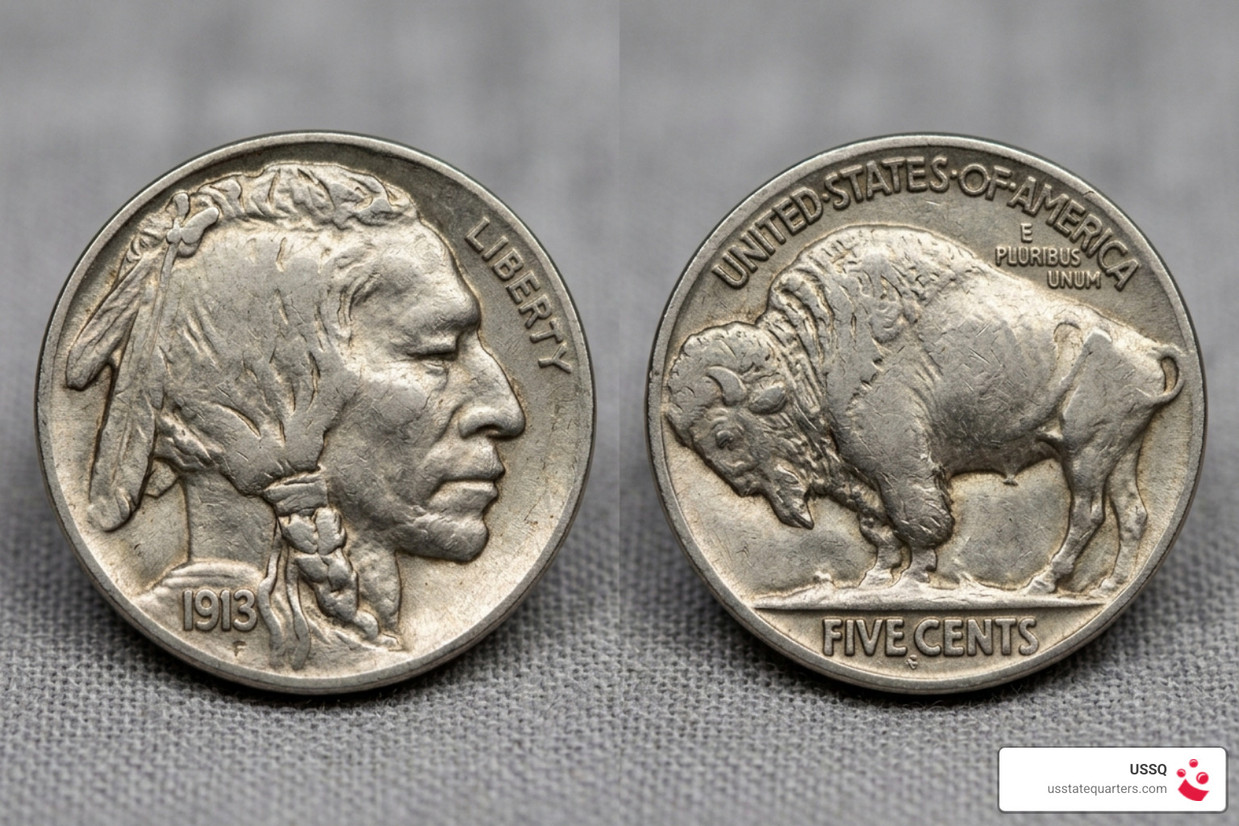
The Buffalo nickel—officially the Indian Head five-cent piece—is one of the most studied and widely collected U.S. type coins of the 20th century. Struck from 1913 through 1938, it combines exceptional sculptural character with the practical challenges collectors know well: weak strikes, rapid date wear, difficult grading, and a handful of legendary varieties. Collectors seeking examples for type, date-and-mintmark sets, or advanced variety holdings can review our Buffalo Nickels category for available coins.
| Feature | Detail |
|---|---|
| Official name | Indian Head Nickel |
| Common name | Buffalo Nickel |
| Designer | James Earle Fraser |
| Years produced | 1913–1938 |
| Composition | 75% copper, 25% nickel |
| Weight | 5.000 grams |
| Diameter | 21.21 mm |
| Mints | Philadelphia, Denver (D), San Francisco (S) |
| Obverse | Composite Native American portrait |
| Reverse | American bison |
Fraser described his intent in direct terms: "I felt I wanted to do something totally American — a coin that could not be mistaken for any other country's coin."
That objective was achieved. The Buffalo nickel replaced the Liberty Head nickel during the broader early-20th-century effort to improve American coinage, and its high-relief design gave the denomination a presence rarely matched in circulating coinage. For collectors, however, the same artistic strength that makes the series desirable also created its complications. Dates wore quickly, denominations were vulnerable on early strikes, and many branch-mint issues are notoriously difficult to locate with strong detail.
As a result, the Buffalo nickel series rewards experience. A common 1930s Philadelphia coin in lower circulated grade is one thing; a sharply struck branch-mint coin, a problem-free key date, or a certified major variety is quite another. The series offers accessible entry points for newer collectors while still providing enough nuance—strike, luster, die state, surfaces, and authenticity—to challenge advanced numismatists.
History and Design of the Buffalo Nickel
The Buffalo nickel belongs to the period often called the “Renaissance of American Coinage,” when U.S. coin designs moved away from static 19th-century conventions toward more sculptural, nationally distinctive imagery. President Theodore Roosevelt’s influence on American coinage is most closely associated with the Saint-Gaudens gold pieces, but the same artistic momentum helped shape the redesign of the five-cent piece.
James Earle Fraser, a former assistant to Augustus Saint-Gaudens, was commissioned in 1911 to redesign the nickel. Fraser’s background gave him a natural command of the subject matter: he had spent part of his youth in the Dakota Territory, and his best-known sculpture, End of the Trail, already reflected his interest in the American West. Rather than returning to a classical Liberty motif, Fraser selected images native to the continent: a Native American portrait on the obverse and an American bison on the reverse.
This is why the coin occupies a special place in U.S. numismatics. It is not merely a “type coin” with a memorable animal reverse; it is a compact piece of early-20th-century American sculpture. Collectors who specialize in the series often evaluate more than date and mintmark. Eye appeal, strike definition, horn detail, date strength, luster quality, and surface originality all matter, especially in the higher circulated and Mint State grades. For related inventory, see our dedicated Buffalo Nickels category.
The Models Behind the Buffalo Nickel Portrait
The identity of the Native American portrait has been discussed for generations. Fraser generally described the obverse as a composite rather than a portrait of one specific sitter. The names most often associated with the design are:
- Iron Tail, an Oglala Lakota leader known to the American public through Buffalo Bill’s Wild West show.
- Two Moons, a Cheyenne leader associated with the Battle of the Little Bighorn.
- John Big Tree, a Seneca figure who later promoted his connection to the coin.
For the collector, the important point is that Fraser was not attempting a literal portrait medal. He was creating a symbolic national design, and the result is one of the most recognizable obverses in American circulating coinage.
Inspiration for the Reverse Bison
The reverse bison is traditionally associated with “Black Diamond,” a well-known bison in New York. The exact zoo attribution has been debated, but Fraser’s recollections emphasize the practical difficulty of observing and modeling the animal. The finished reverse captures the mass and tension of the bison in profile, giving the coin much of its enduring visual power.
From a grading standpoint, the reverse is also central. The horn, shoulder, hip, and upper body are key areas for assessing strike and wear. On many circulated examples, a full or nearly full horn can make a meaningful difference in desirability, while on Mint State pieces the quality of strike can separate an ordinary coin from a premium example.
Technical Specifications and Minting Details
Authenticating and evaluating a Buffalo nickel begins with its physical specifications. The series used the standard five-cent copper-nickel alloy of the period and maintained consistent dimensions throughout production.
- Weight: 5.000 grams
- Diameter: 21.21 mm
- Edge: Plain
- Composition: 75% copper, 25% nickel
Production came from Philadelphia, Denver, and San Francisco. Philadelphia issues carry no mint mark, while Denver and San Francisco coins are identified by a small D or S on the reverse below “FIVE CENTS.” Branch-mint Buffalo nickels are a major part of the series’ appeal, particularly because many Denver and San Francisco issues are far more challenging in attractive, original condition than their mintages alone might suggest.
The Mint also struck Matte Proof Buffalo nickels from 1913 through 1916. These proofs do not resemble modern brilliant proofs; they have a fine-grained, satin-to-matte texture that reflects the aesthetic preferences of the period. Their low production figures and distinctive finish make them a specialized area of the series.
Identifying Mint Marks on a Buffalo Nickel
The mint mark appears on the reverse, beneath “FIVE CENTS” and above the rim.
- No mint mark: Philadelphia.
- D: Denver.
- S: San Francisco.
Mint mark identification is especially important on key and semi-key issues. The 1926-S, for example, is the lowest-mintage regular-issue Buffalo nickel and is highly desirable even in well-circulated condition when problem-free. Collectors building a complete set should pay close attention to surfaces, readability of the date, and whether any apparent rarity has been altered, acid-treated, or otherwise impaired.
Type 1 vs. Type 2: The 1913 Design Revision
The first-year Buffalo nickel exists in two major reverse types. This distinction is basic to the series, but it remains important because 1913 Type 1 and Type 2 coins are collected separately by date-and-mintmark specialists.
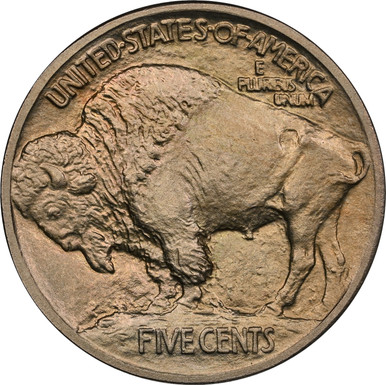
The original Type 1 reverse shows the bison standing on a raised mound. The denomination “FIVE CENTS” is placed on that mound, where it was exposed to rapid wear. The design was visually strong but mechanically vulnerable.
Later in 1913, the Mint adopted the Type 2 reverse. Chief Engraver Charles E. Barber modified the ground line and recessed the denomination into a protected area below the bison. This change improved durability and remained in use for the rest of the series.
| Feature | Type 1, Early 1913 | Type 2, Late 1913–1938 |
|---|---|---|
| Reverse ground | Bison on raised mound | Bison on flatter ground line |
| Denomination | Raised on the mound | Recessed below the ground line |
| Primary concern | Rapid wear to “FIVE CENTS” | Improved protection of denomination |
| Collector note | First-year type coin | Standard long-running reverse |
The release of the coin was also complicated by objections from the Hobbs Manufacturing Company, which supplied equipment connected with vending-machine use. The Treasury ultimately proceeded without redesigning the coin around the demands of a single company. For collectors today, the episode is part of the series’ charm: the Buffalo nickel was both a work of art and a circulating industrial object, and the tension between those roles is visible throughout its production history.
Key Dates, Major Varieties, and Collecting Value
The Buffalo nickel series is approachable, but it is not simplistic. Common later-date coins remain readily available, while key dates, overdates, doubled dies, and high-grade branch-mint coins can command substantial premiums. Collectors looking to fill holes or upgrade examples can browse our Buffalo Nickels category for subject-specific listings.
Value depends on more than rarity. Grade, strike, originality, certification, eye appeal, and the absence of problems all influence market demand. A cleaned key date or acid-restored dateless coin is a very different proposition from a problem-free, naturally worn example. Likewise, a Mint State coin with soft detail may be less desirable than the assigned grade suggests if the issue is known for weak strikes.
Major Buffalo Nickel Issues to Know
- 1937-D Three-Legged Buffalo: The best-known Buffalo nickel variety. It resulted from excessive die polishing that removed most of the bison’s front right leg. Authentication is essential because altered normal coins are common.
- 1916 Doubled Die Obverse: A major rarity with visible doubling on the date. Genuine examples are scarce and highly prized.
- 1918/7-D Overdate: One of the classic 20th-century U.S. overdates. The underlying 7 is visible beneath the 8 on genuine examples.
- 1926-S: The lowest-mintage regular issue of the series at 970,000 pieces and a key date in all grades.
- 1913-S Type 2: A significant first-year key that is much tougher than the more available Type 1 issues.
Advanced collectors often pursue the series in tiers: a type example, a circulated date-and-mintmark set, a higher-grade certified set, or a focused variety collection. Each approach has merit, but all benefit from careful attention to strike quality and surface condition.
Condition, Strike, and the End of the Series
Buffalo nickels demand careful grading because the design wears in ways that can mislead casual observers. The date is positioned on a raised area of the obverse and is often weak or completely worn away. On the reverse, horn detail, shoulder definition, and the bison’s body contours are important indicators of both strike and circulation wear.
Weak strikes are also common, particularly on certain branch-mint issues. A coin may show little actual wear yet lack full detail because it was never sharply struck. This distinction matters. Experienced collectors look for original surfaces, honest color, remaining luster where appropriate, and detail consistent with both the grade and the issue.
Dateless Buffalo nickels are plentiful. While they still have historical interest, they generally carry limited numismatic value unless a rare mintmark or variety can be reliably identified. Chemical date restoration may reveal information, but it also leaves the coin impaired and should be understood as a diagnostic process rather than an enhancement.
By 1938, the Buffalo nickel had satisfied the statutory 25-year minimum for a circulating coin design. The Mint replaced it with Felix Schlag’s Jefferson nickel, a design easier to strike and more practical for long-term circulation. The transition closed one of the most visually distinctive chapters in U.S. minor coinage.
Collectors interested in protecting better-date coins should consider proper holders, stable storage, and professional authentication for key varieties. For supplies and related collecting resources, visit our coin collecting supplies category.
Frequently Asked Questions About Buffalo Nickels
Why are so many Buffalo nickels dateless?
The date sits on a raised portion of the obverse and was exposed to heavy circulation wear. As these coins passed through pockets, cash drawers, and daily commerce, the date often disappeared before other major design elements.
How can I tell whether a 1937-D Three-Legged Buffalo nickel is genuine?
A genuine 1937-D Three-Legged Buffalo is not simply a normal coin with a leg removed. Diagnostic features include die-polishing evidence, specific weakness around the bison’s body, and other markers known to the variety. Because altered pieces are common, better examples should be purchased certified or submitted to a reputable grading service.
What is the rarest regular-issue Buffalo nickel?
The 1926-S is the lowest-mintage regular issue at 970,000 pieces and is a key date in any complete set. The 1913-S Type 2 is also a major key, and Matte Proofs from 1913–1916 occupy a separate, more specialized category.
What should an advanced collector look for when upgrading Buffalo nickels?
Beyond the numerical grade, look for original surfaces, natural color, strong date definition, solid reverse horn detail, and strike quality appropriate for the issue. On higher-grade coins, luster and eye appeal are critical. On key dates, problem-free surfaces often matter as much as the grade itself.
Conclusion
The Buffalo nickel remains one of the defining U.S. coin designs of the early 20th century. Its appeal is not limited to nostalgia or novelty. The series offers real numismatic depth: two first-year reverse types, challenging branch-mint issues, famous varieties, distinctive Matte Proofs, and a grading landscape that rewards close study.
For the sophisticated collector, the Buffalo nickel is a series where selectivity pays. A well-matched circulated set has a different character from a certified Mint State registry-quality set, but both require judgment. Strike, surfaces, originality, and authenticity should guide every purchase.
USSQ has served collectors since 1999, and we understand that experienced buyers want accurate descriptions, relevant categories, and coins that fit their collecting goals. To review available pieces, visit our dedicated Buffalo Nickels category.
Recent Posts
-

Walking Liberty Half Dollar Value Guide: Key Dates, the 1921 Problem, and What Yours Is Really Worth
Ask a room full of collectors to name the most beautiful U.S. coin and the Walking Liberty half doll
-
The 2026 Semiquincentennial Proof Set: What's in It, Why It Costs $107, and Whether to Buy One
On October 6 at noon Eastern, the U.S. Mint puts the 2026 Semiquincentennial Proof Set on sale at $1