The Clear S Mint Mark Guide for Collectors
What Is a Clear S Mint Mark — and Why Does It Matter to Collectors?
The Clear S mint mark is one of the most sought-after varieties in modern U.S. proof coinage — and knowing how to spot it can make a real difference to the value of coins in your collection. At USSQ, we specialize in helping collectors find these rare proof coins and varieties.
Here's the quick answer:
| Feature | Filled S (Type 1) | Clear S (Type 2) |
|---|---|---|
| Appearance | Blurry, clogged openings in the "S" | Sharp, open loops with clear definition |
| Serifs | Flat, poorly defined | Larger, bulbous serifs at the base |
| Cause | Worn mint mark punch (used since 1968) | New replacement punch introduced mid-1979 |
| Years affected | 1979-S and 1981-S proof sets | 1979-S and 1981-S proof sets |
| Rarity | Common | Scarcer — estimated 10–20% of 1981 proof production |
| Coins affected | All six proof denominations | All six proof denominations |
The difference between the two types comes down to the condition of the punch used at the San Francisco Mint to stamp the "S" mint mark onto proof dies. The old punch, in use since 1968, had worn down so much that the "S" it produced looked filled-in and blurry. When that punch broke midway through 1979, a new one took its place — and the result was the sharper, more defined Clear S that collectors prize today.
This variety appears across every denomination in the 1979-S and 1981-S proof sets, from the Lincoln Cent to the Susan B. Anthony Dollar. But not all Clear S coins are created equal — some are far rarer and more valuable than others, especially in top grades.
Understanding the History of the Clear S mint mark
To understand why the Clear S mint mark exists, we have to look back at the mechanical life of a mint mark punch. Research on U.S. Mint mark history shows that since 1968, the San Francisco Mint had been using the same punch to apply the "S" to proof coin dies. Over more than a decade of constant use, that steel punch began to deform. The internal curves of the "S" became shallow, and the serifs (the little feet at the ends of the letter) lost their sharpness.
By early 1979, this punch was essentially a "Filled S" punch. When it struck a die, the resulting coins looked like they had a blob of metal where the mint mark should be. This is what numismatists call the Type 1 variety. Midway through 1979, this venerable punch finally gave out and broke.
The U.S. Mint replaced it with a new punch, which we now call the Type 2 or Clear S mint mark. This new punch featured a much sharper design with open loops. However, history repeated itself quite quickly. By the time 1981 rolled around, the "new" 1979 punch had itself become worn and flattened. This led to a second transition in 1981, where a third, even more distinct punch was introduced late in the year.
This means that for both 1979 and 1981, collectors can find two distinct versions of the same proof coins. Because the transitions happened mid-year, the Clear S mint mark is generally the scarcer of the two varieties, as it was used for a shorter production window. At USSQ, we often see collectors hunting for these specific types to complete their modern proof sets. You can explore more info about our coin inventory to see these varieties in person.
Identifying Type 2 Varieties in 1979 and 1981 Proof Sets
Identifying a Clear S mint mark requires a good magnifying glass or a jeweler's loupe, but once you know what to look for, the differences are striking. The Type 2 variety is defined by its "bulbous" serifs and the clear field of the coin visible inside the loops of the letter "S."
When examining your 1979-S or 1981-S proof coins, look for these specific diagnostics:
| Characteristic | Type 1 (Filled S) | Type 2 (Clear S) |
|---|---|---|
| Definition | Indistinct, blurry edges | Sharp, crisp borders |
| Loops | Center of "S" appears clogged | Circular center loops are wide open |
| Serifs | Small, flat, or non-existent | Large, bulbous, and rounded |
| Field | Metal "bleeds" into the letter | Clear separation between letter and coin field |
Visual Identification of the Clear S mint mark
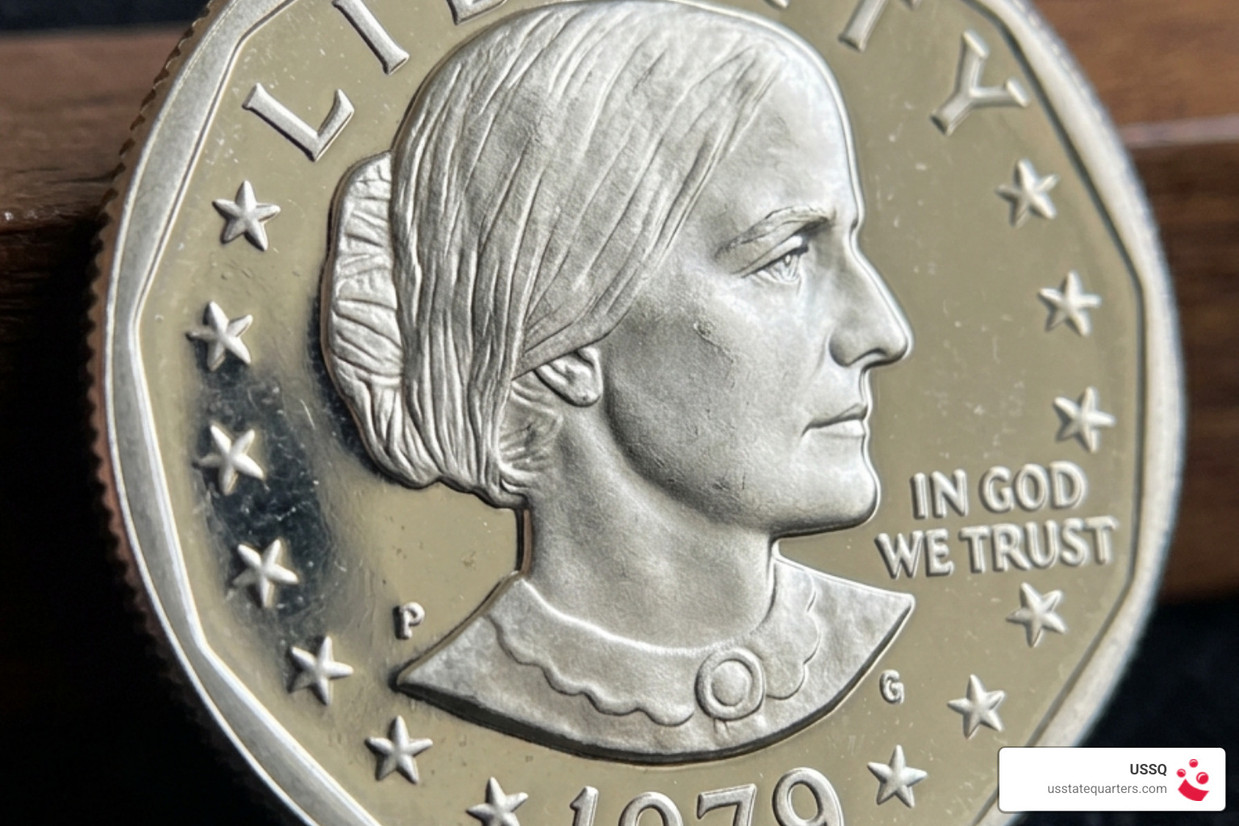
The most reliable diagnostic for the Clear S mint mark is the shape of the serifs. On a Type 2 coin, the top and bottom of the "S" end in very distinct, rounded points that almost look like tiny balls. This is particularly noticeable on the Susan B. Anthony Dollars, where the mint mark is located on the obverse, just above the date.
Another key feature is the "flatness" of the strike. The Type 1 Filled S often looks like a raised mound of metal. In contrast, the Type 2 Clear S has a flatter top surface with very vertical walls, giving it a three-dimensional, "blocky" appearance that stands out against the mirrored field of a proof coin.
The Scarcity of the 1981-S Clear S mint mark
While the 1979 Type 2 is certainly desirable, the 1981 Type 2 is often considered the "king" of the modern proof varieties. In 1981, the U.S. Mint produced approximately 4,063,083 proof sets. Research suggests that only about 10% to 20% of these sets contain the Type 2 Clear S mint mark across all denominations.
This scarcity affects every coin in the set:
- Lincoln Cent: The Type 2 cent is significantly scarcer than the Type 1. Detailed research on 1981 Type 1 and Type 2 Lincoln Cents highlights the specific punch transitions for this denomination.
- Jefferson Nickel: Often found with a "Flat S" variant, making the Clear Type 2 a prized find.
- Roosevelt Dime & Washington Quarter: These are frequently overlooked by casual collectors, meaning high-grade Type 2 examples can be sleeper hits.
- Kennedy Half Dollar: The large surface area of the half dollar makes the Clear S very easy to spot.
Because these were only issued in proof sets, you won't find them in your pocket change. They were minted specifically for collectors at the San Francisco Mint using specially polished dies and planchets.
Market Value and Population Reports for Proof Varieties
As we move through April 2026, the market for these varieties remains robust. The value of a Clear S mint mark is heavily dependent on its grade and whether it has earned a "Deep Cameo" (DCAM) or "Ultra Cameo" designation from grading services like PCGS or NGC. You can browse our current coin inventory to see how these grades affect pricing.
Population Data for 1981-S Anthony Dollars
The Susan B. Anthony (SBA) dollar provides an excellent case study in how the Clear S mint mark impacts value. Recent research on 1981-S Anthony dollar market analysis shows that because the SBA series was short-lived (1979–1981 and a brief return in 1999), collectors are very focused on completing every possible variety.
According to PCGS population reports:
- 1981-S Clear S (Type 2): There are approximately 1,100 examples in Proof 68 Deep Cameo, 3,635 in Proof 69 Deep Cameo, and a mere 265 in the perfect Proof 70 Deep Cameo.
- 1981-S Filled S (Type 1): By comparison, there are 12,818 examples in Proof 69 Deep Cameo and 951 in Proof 70.
The scarcity of the Type 2 in a perfect PR70 grade drives prices significantly higher. For instance, while a Type 1 PR70 might sell for under $100, a Type 2 Clear S mint mark in the same grade has been known to fetch between $340 and $425 at major auctions.
Value Trends for 1979-S Type 2 Proofs
For the 1979-S varieties, the "Clear S" also commands a premium, though it is slightly more common than the 1981 version.
- A 1979-S Type 2 Susan B. Anthony dollar in PR65 Ultra Cameo typically values around $35.
- In a perfect PR70 Ultra Cameo, that value can jump to $135 or more.
- For the Washington Quarter, a PR65 Type 2 usually sits around the $7 to $10 range, whereas the common Type 1 is often valued at just a few dollars.
Collectors often find that buying the 1979 and 1981 Type 2 coins as a pair is a great way to anchor a modern variety collection. These coins represent a specific moment in Mint history where mechanical failure led to numismatic treasure.
Frequently Asked Questions about Clear S Varieties
What caused the Clear S variety to appear in 1979?
The variety was caused by the breakage of a 13-year-old mint mark punch. The U.S. Mint had used the same "S" punch since 1968. By 1979, the punch was so worn that it produced "Filled S" marks. When it finally broke midway through the year, the Mint replaced it with a new, sharper punch that created the "Clear S" or Type 2 variety.
How can I tell the difference between a Filled S and a Clear S?
Look at the loops of the "S." On a Clear S mint mark, the center of the loops is open and shows the mirrored field of the coin. On a Filled S, the center looks clogged with frosted metal. Additionally, the Clear S has very distinct, bulbous serifs at the ends of the letter, while the Filled S serifs are flat and disappear into the rest of the mark.
Which Clear S coin is the most valuable for collectors?
Generally, the 1981-S Susan B. Anthony Type 2 (Clear S) in Proof 70 Deep Cameo is the most valuable. Due to its low population (only 265 certified by PCGS), it carries a significant scarcity premium. However, the 1981-S Type 2 Lincoln Cent is also highly prized by cent specialists and can fetch high prices in top grades. You can find these and other Lincoln Cents in our inventory.
Conclusion
The Clear S mint mark is a perfect example of why numismatics is so fascinating. What started as a simple equipment replacement at the San Francisco Mint ended up creating a decades-long hunt for collectors. Whether you are looking at a 1979-S Washington Quarter or a 1981-S Kennedy Half, these varieties add a layer of depth to any modern collection.
At USSQ, we believe that understanding these small details is what turns a casual hobby into a lifelong passion. Because the Type 2 varieties are estimated to make up only 10–20% of the 1981 production, finding them in original government packaging is always a thrill.
If you're looking to add these scarce varieties to your collection or need help identifying a coin you've found, check out more info about Susan B. Anthony Dollars or reach out to us directly for more info about contacting us. Happy hunting!
Recent Posts
-

Walking Liberty Half Dollar Value Guide: Key Dates, the 1921 Problem, and What Yours Is Really Worth
Ask a room full of collectors to name the most beautiful U.S. coin and the Walking Liberty half doll
-
The 2026 Semiquincentennial Proof Set: What's in It, Why It Costs $107, and Whether to Buy One
On October 6 at noon Eastern, the U.S. Mint puts the 2026 Semiquincentennial Proof Set on sale at $1