The Ultimate Indian Head Penny Value Guide for 20th Century Coins
What Is the Indian Head Penny Worth? Quick Answer for Collectors
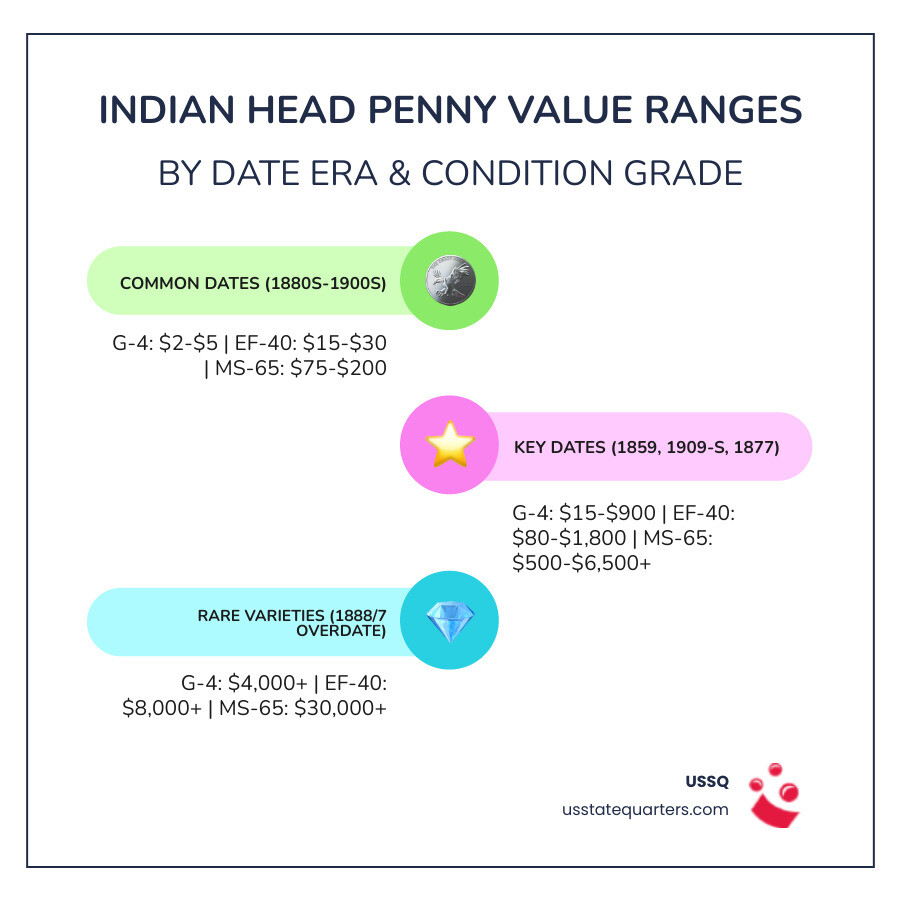
Indian head penny value ranges widely — from around $2 for common circulated dates to well over $100,000 for rare, high-grade specimens.
Here's a fast-reference snapshot to get you oriented:
| Coin | Good (G-4) | Extremely Fine (EF-40) | Uncirculated (MS-65) |
|---|---|---|---|
| Common dates (1880s-1900s) | $2 - $5 | $15 - $30 | $75 - $200 |
| 1859 (first year) | $15 | $80 | $500+ |
| 1909-S (rare branch mint) | $450 | $650 | $1,800+ |
| 1877 (key date) | $900 | $1,800 | $6,500+ |
| 1888/7 overdate (variety) | $4,000 | $8,000+ | $30,000+ |
Values reflect approximate retail for original, uncleaned coins. Red (RD) specimens command significant premiums above these figures.
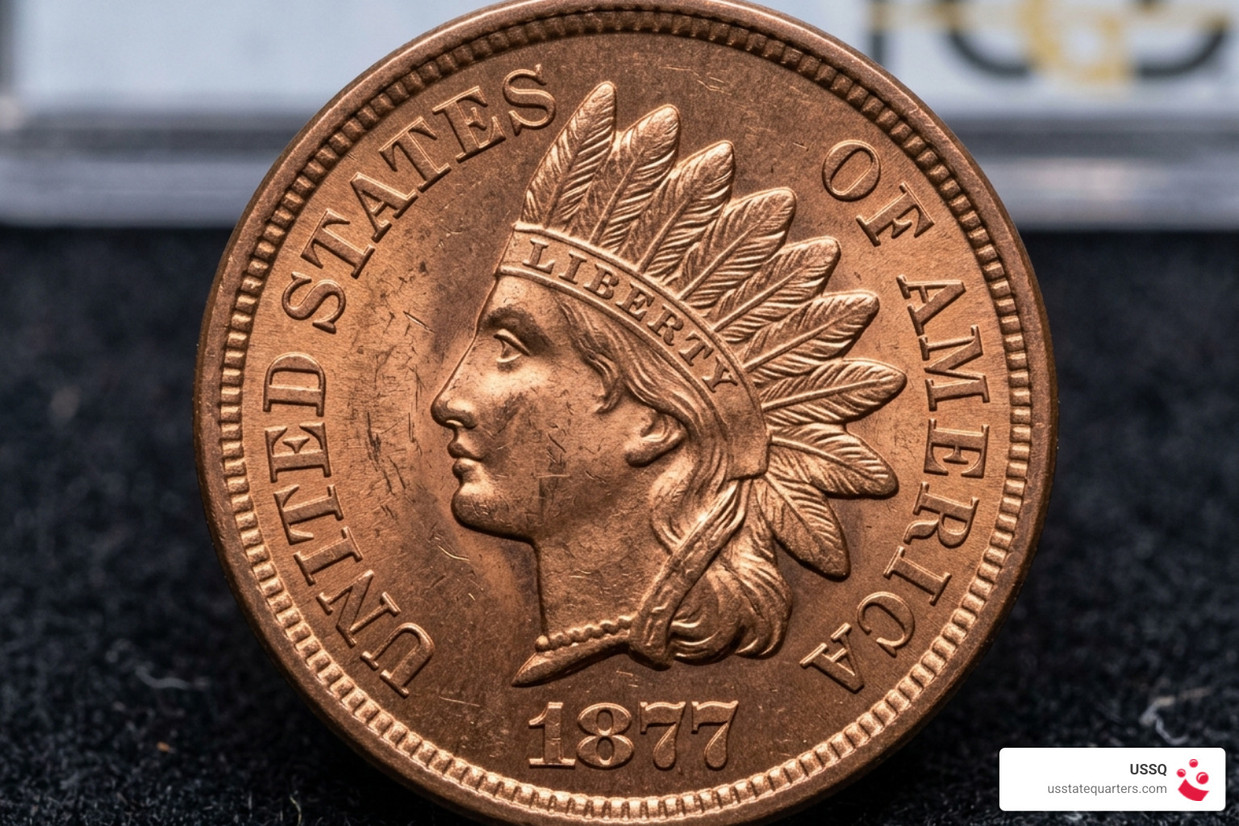
Few coins capture a collector's imagination quite like the Indian Head penny. Struck from 1859 to 1909, this one-cent coin witnessed the Civil War, Reconstruction, and the rise of American industry — all packed into a 19mm copper disc.
Designed by James Barton Longacre, Chief Engraver of the U.S. Mint, the coin depicts Miss Liberty wearing a Native American headdress. It's a distinctly American image, and it's driven collector demand for over a century.
Even a heavily worn example is at least 115 years old as of April 2026. That age alone gives every coin in the series a baseline collectible premium. But condition, date, mint mark, and color designation can push values dramatically higher.
Whether you've inherited a jar of old pennies or you're actively building a date set, understanding what drives Indian Head penny value is the first step to making smart decisions.
History and Design of the Indian Head Cent
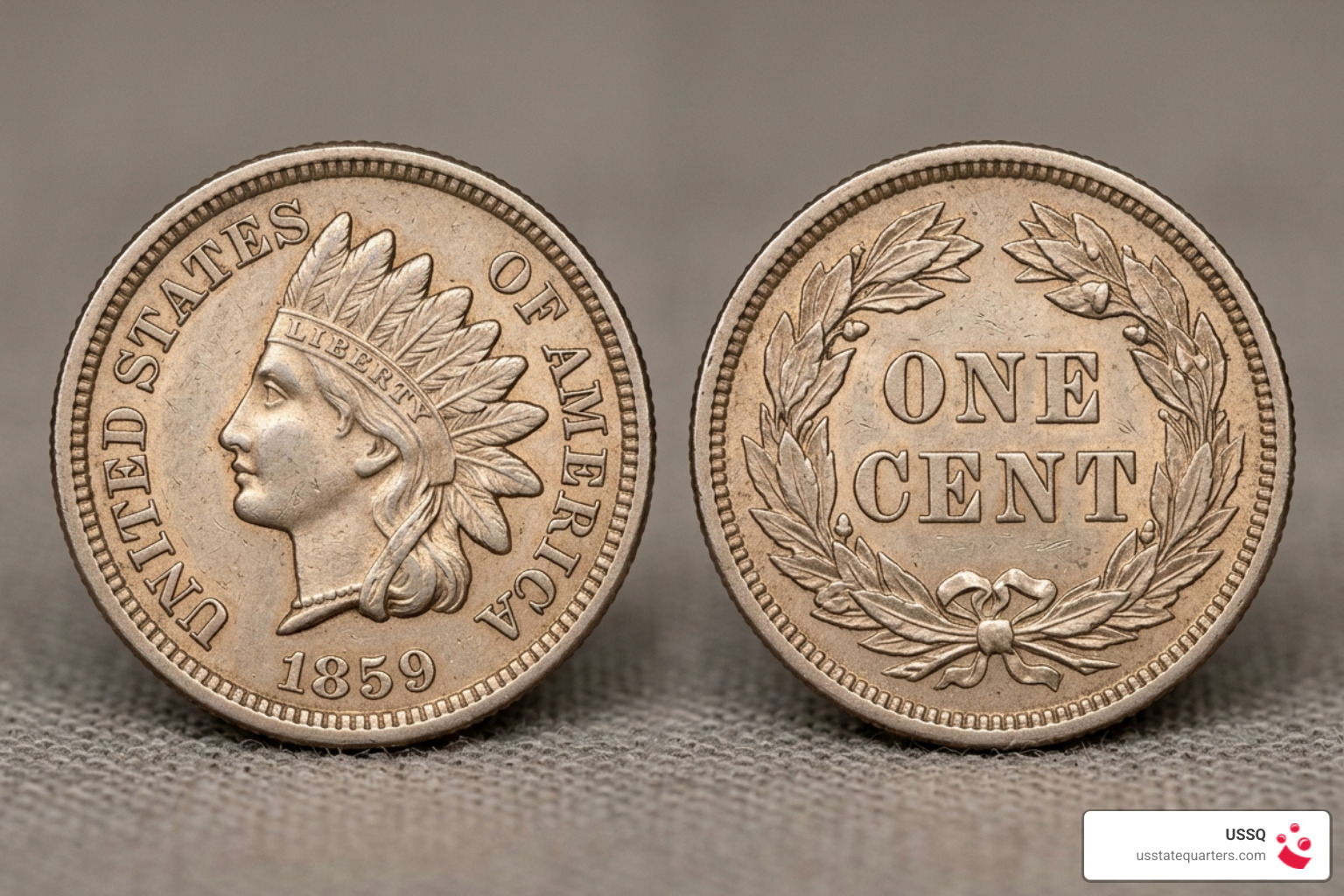
The story of the Indian Head penny begins with a need for change — literally. In the late 1850s, the price of copper was rising, making the old "Large Cents" expensive to produce. The U.S. Mint briefly tried the Flying Eagle cent (1856-1858), but it was difficult to strike clearly. In 1859, James Barton Longacre introduced the Indian Head design, which would remain the standard for half a century.
The design itself has been a point of friendly debate for decades. While it is called the "Indian Head" penny, the figure is actually Lady Liberty. Longacre chose to depict her in a Native American headdress to create a uniquely American emblem of liberty. A popular myth suggests that Longacre’s 12-year-old daughter, Sarah, modeled for the coin after a visiting Native American chief placed his headdress on her head. However, most historians agree this is just a charming story; Sarah was actually 30 years old at the time, and the facial features on the coin strongly resemble Longacre's other works, such as the $1 gold piece.
The reverse of the coin also saw an early evolution. The first year of issue, 1859, featured a laurel wreath. By 1860, the Mint updated the design to an oak wreath with a small Union Shield at the top. This design stayed consistent until the series ended in 1909. You can explore more about the historical design evolution to see how these subtle changes impact rarity today.
Composition Changes and Minting Eras
Collectors often divide the series into two distinct eras based on what the coins are made of. From 1859 to mid-1864, the pennies were "White Cents," made of 88% copper and 12% nickel. These coins are thicker, heavier, and have a pale, yellowish-white hue.
In 1864, due to metal shortages and hoarding during the Civil War, the Mint switched to a bronze composition (95% copper, 5% tin and zinc). These bronze pennies are thinner and weigh exactly 3.11 grams with a 19mm diameter. We always recommend checking the weight and thickness if you are unsure which variety you have from the 1864 transition year. For those looking to fill gaps in their albums, you can find more info about Indian Head Penny inventory on our dedicated category pages.
Key Factors Influencing Indian Head Penny Value
When we evaluate a collection, we look at several specific factors that dictate the indian head penny value. It isn't just about how old the coin is; it’s about how many were made and how many survived in great shape.
- Mintage Figures: Some years saw over 100 million coins struck (like 1907), while others saw fewer than one million (like 1877). Low mintage almost always equals high value.
- Survival Rates: During the Civil War and various economic panics, many coins were melted down or lost. This makes certain dates "condition rarities," meaning they are common in worn condition but nearly impossible to find in "Gem" uncirculated grades.
- The Sheldon Scale: We use a 1-to-70 scale to grade coins. A coin graded G-4 (Good) will show the basic design but be heavily worn, while an MS-65 (Mint State) coin will look like it just dropped off the press.
- Eye Appeal: Factors like "woodgrain" toning — which occurs when the copper alloy wasn't perfectly mixed — can actually add a premium for some collectors who love the unique, streaky look.
You can check live market pricing data to see how these factors are moving the needle this month.
Current Market Trends for Indian Head Penny Value
As of April 2026, the market for Indian Head pennies remains exceptionally robust. We have noticed that collector appetite for "key dates" like the 1877 and 1909-S has remained steady even during economic shifts. High-grade specimens, particularly those with original "Red" luster, are reaching record prices at major auctions.
While common dates from the early 1900s are still affordable for new hobbyists (often under $5 for a decent circulated example), the gap between a "Fine" coin and an "Uncirculated" coin is widening. This suggests that investors are focusing on quality and long-term preservation.
How Color Designations Impact Indian Head Penny Value
For copper coins, color is everything. Grading services like PCGS and NGC assign one of three color designations:
- Red (RD): The coin retains at least 95% of its original mint orange-red luster. These are the "holy grails" for collectors and command the highest premiums.
- Red-Brown (RB): The coin shows between 5% and 95% of its original color, often with a mix of chocolate brown and orange.
- Brown (BN): The coin has fully toned to a chocolate brown color. Most circulated Indian Head pennies fall into this category.
Be wary of coins that look "too bright" for their age; they may have been cleaned. Also, watch out for verdigris (green corrosion), which can eat away at the metal and permanently destroy the indian head penny value.
Rare Dates and High-Value Varieties
If you are hunting through a collection, these are the "lottery tickets" of the series. Some varieties are so rare that they can be worth thousands even in poor condition.
- The 1877 Key Date: With a mintage of only 852,500, this is the king of the series. Because most were used in daily commerce, finding one in high grade is a massive win.
- The 1909-S: This was the first year the San Francisco mint struck pennies. Only 309,000 were made, making it the lowest mintage of any business-strike Indian Head penny.
- 1888/7 Overdate: Look closely at the last "8" in the date. On rare specimens, you can see the top of a "7" peeking out from underneath. This is a highly sought-after mint error.
- 1873 Doubled Liberty: Look at the word "LIBERTY" on the headband. On this variety, the letters appear doubled, creating a blurred effect that collectors love.
Top 5 Most Valuable Indian Head Pennies (Auction Records):
- 1864-L on Ribbon (Proof): Over $160,000
- 1877 (MS-67 Red): Over $149,000
- 1902 (MS-68 Red): Over $144,000
- 1872 (MS-66 Red): Over $126,000
- 1899 (MS-68 Red): Over $108,000
Identifying the 1864-L and Other Varieties
In late 1864, James Longacre added a tiny "L" to the ribbon behind Liberty’s neck. This "1864-L" variety is much rarer than the standard 1864 bronze. To find it, look at the tip of the bust; the "L" version has a more pointed bust, whereas the standard version is rounded.
Other subtle variations include the "Bold N" vs. "Shallow N" on the reverse of pennies from the early 1870s, and the "Open 3" vs. "Closed 3" in 1873. These tiny details can mean a difference of hundreds of dollars in value!
Grading and Authenticating Your Collection
Before you sell or buy a high-value coin, professional grading is a must. Services like PCGS and NGC provide an unbiased opinion on the grade and, more importantly, guarantee that the coin is genuine.
Here is a quick guide to what we look for in different grades:
- Good-4 (G-4): The date is readable, but "LIBERTY" on the headband is completely worn away.
- Fine-12 (F-12): At least three letters of "LIBERTY" are visible.
- Extremely Fine-40 (EF-40): All letters of "LIBERTY" are sharp, and there is only slight wear on the tips of the feathers.
- Mint State (MS-60+): No wear at all. The coin has its original luster, though it may have some small "bag marks" or scratches from being in a bin at the Mint.
If you have a coin you believe is a key date, please contact our experts for appraisal help. We love helping collectors discover the true worth of their treasures.
Detecting Counterfeits and Alterations
Because the indian head penny value for certain dates is so high, counterfeits are unfortunately common. Here is how we verify them:
- Weight Test: A bronze Indian Head should weigh 3.11 grams. If it's significantly off, it’s a red flag.
- Magnetism: Genuine pennies are not magnetic. If it sticks to a magnet, it’s a fake.
- The "S" Mint Mark: On the 1909-S, check the mint mark under a magnifying glass. Counterfeiters sometimes glue an "S" onto a common 1909 Philadelphia penny. Look for seams or "blobs" around the letter.
- Date Alteration: Some fakes are made by tooling the date (for example, turning an 1871 into an 1877). Professional authentication is the only way to be 100% sure.
Frequently Asked Questions
What is the most valuable Indian Head Penny?
The 1877 Indian Head penny is widely considered the most valuable regular-issue coin in the series due to its incredibly low mintage of 852,500. While a 1909-S has a lower mintage, fewer 1877 coins were saved by collectors at the time, making them harder to find today. A top-tier MS-67 Red 1877 penny has sold for as high as $149,500!
Where is the mint mark on an Indian Head Penny?
Most Indian Head pennies have no mint mark, meaning they were struck in Philadelphia. However, in 1908 and 1909, the San Francisco mint also produced pennies. Look on the reverse side of the coin, at the very bottom, below the bow of the wreath. If you see a tiny "S," you've found a branch-mint rarity!
Should I clean my Indian Head Pennies?
No! Never clean your coins. This is the most important rule in numismatics. Cleaning a coin with polish, acid, or even a soft cloth creates microscopic scratches and gives the metal an "unnatural" shine that dealers can spot instantly. Cleaning a rare coin can reduce its value by 30% to 50% or more. Collectors prefer "original skin" — the natural patina a coin develops over a century.
Conclusion
Investing in Indian Head pennies is more than just a financial move; it’s a way to hold a piece of American history in your hand. From the "White Cents" of the Civil War to the rare "S" mint marks of the early 20th century, this series offers something for every budget.
By following our preservation tips — like using Mylar flips and acid-free albums instead of PVC holders — you can ensure your coins continue to appreciate for decades to come. Avoid humidity and extreme temperatures to keep those "Red" coins from turning brown. For more tips on starting your numismatic journey, visit the USSQ homepage for more coin guides.
Start Your Collection Today
Ready to start your own set? At Coins Online LLC (USSQ), we’ve been helping collectors since 1999. We offer over 5,000 products, competitive pricing, and a 14-day return policy to ensure you’re happy with every addition to your collection. Whether you are looking for a common 1907 penny or a certified 1877 rarity, we are here to help. Shop our full Indian Head Penny selection today and see why we are a trusted name in the numismatic community!
Recent Posts
-

Don't Miss Out on These 2026 Dollar Coins and Gold Sets
America Is Marking 250 Years - And the Coins Show It The 2026 coin designs are unlike anything the U
-
A Guide to the Most Famous Historical Quarter Symbols
Why the Ohio Wright Brothers Are One of America's Greatest Quarter Symbols The Ohio Wright brothers