Mercury Dime Value Guide: Key Dates, Full Bands, and Why Weinman's Design Is Back in 2026
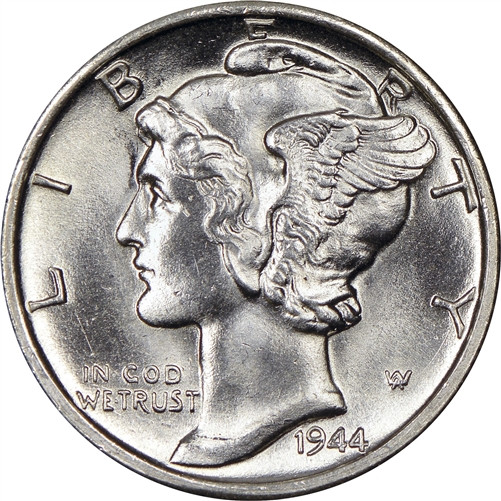
The U.S. Mint just put Adolph Weinman's Winged Liberty back on a coin. The 2026-W Palladium Eagle, released September 3 with a 5,000-coin limit and sold out in about eight minutes, borrows its obverse from the dime Weinman designed in 1916 — the coin everyone calls the Mercury dime. That's a good excuse to answer the question we get more than almost any other: what are Mercury dimes actually worth? The short version is that most of them are silver-value coins worth a couple of dollars, a handful of dates are worth real money, and one date is worth more than a used car. Here's how to tell which you have.
First, it isn't Mercury
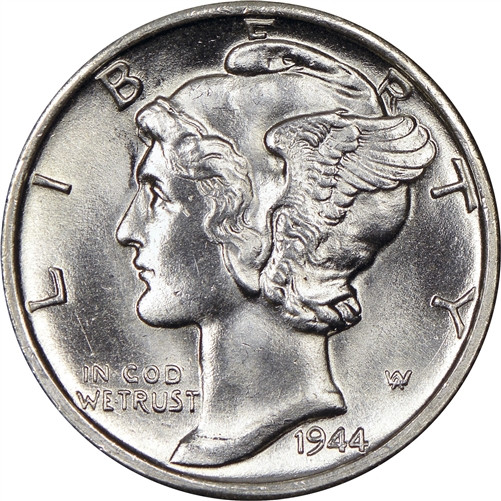
The figure on the obverse is Liberty wearing a winged cap, which Weinman intended to symbolize freedom of thought. The public saw the wings and decided it was the Roman god Mercury, and the nickname stuck so hard that the Mint itself uses it today. The reverse shows a fasces — a bundle of rods around an axe — wrapped with an olive branch, meant to pair strength with peace. The series ran from 1916 through 1945, after which the Roosevelt dime replaced it. Every Mercury dime is 90% silver and contains about 0.0723 troy ounces of the metal.
The floor: silver value
Because of that silver content, no Mercury dime is worth face value. A worn common date from the 1940s trades close to its melt value plus a small premium, which is why you'll see them offered in the $3 to $5 range at coin shows and a bit more from dealers who grade and guarantee them. Dates from 1934 through 1945 were struck by the hundreds of millions, so for those, condition matters more than date. A jar of them is silver, not rarities.
The dates that matter
1916-D
This is the key to the entire series. Denver struck only 264,000 dimes in 1916 before switching its presses to quarters, and most of those were spent and worn out. Even a heavily circulated, honestly worn 1916-D sells for four figures according to grading-service price guides, and uncirculated examples go well into five figures. It is also the most counterfeited coin in the series — the usual trick is adding a "D" to a common 1916 Philadelphia dime. Do not buy a raw 1916-D from anyone. Insist on a PCGS or NGC holder.
1921 and 1921-D
The post-war recession meant almost no dimes were needed in 1921. Philadelphia struck about 1.2 million and Denver about 1.08 million. Both are scarce in any grade and command strong premiums, typically in the tens of dollars for worn examples and hundreds for nicer ones.
1926-S and 1931-D/S
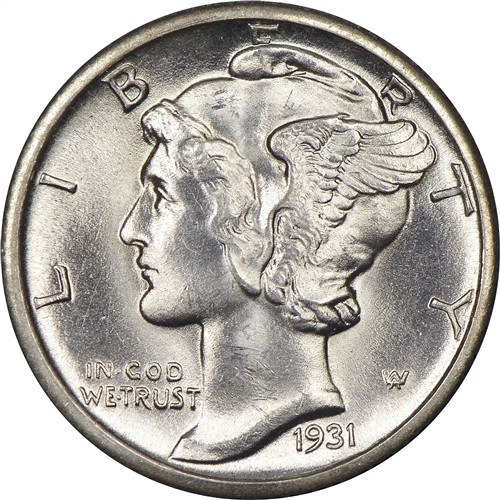
These semi-keys are the ones collectors most often overlook. The 1926-S had a mintage of just 1.52 million and is tough in higher grades. The 1931-D (1.26 million) and 1931-S (1.8 million) were struck during the Depression, when hardly any coinage was called for. They aren't 1916-D money, but a circulated example is still a $15 to $50 coin depending on wear, which is a nice find in a family accumulation.
1942/1 and 1942/1-D overdates
Two of the most famous error coins in U.S. numismatics. A 1941-dated die was re-punched with a 1942 date, and the underlying 1 shows clearly beneath the 2. Both the Philadelphia and Denver versions exist and both are worth hundreds of dollars even worn. Check every 1942 dime you own with a loupe; these still turn up.
Full Bands: the detail that multiplies value
Look at the fasces on the reverse. The rods are tied with horizontal bands, and the center pair is the last part of the design to strike up fully. When those two bands are completely separated with a clean line between them, grading services designate the coin "Full Bands" (FB). On common dates in mint state, FB can double the price. On dates that were notoriously weakly struck — the 1945 Philadelphia issue is the classic example — a Full Bands coin is worth many times a regular one. A 1945-P is one of the most common dimes in the series, yet in MS65 Full Bands it is one of the most expensive.
How to grade what you have
For circulated coins, look at Liberty's hair and wing feathers on the obverse and the bands on the reverse. Good-4 has a full rim but the hair and feathers have merged into a smooth surface; Very Fine shows most hair detail; Extremely Fine has only light wear on the high points. If the coin has been cleaned — unnatural brightness, fine parallel hairlines, a dull whitish surface — deduct heavily. Grading services won't assign a numerical grade to a cleaned coin.
Building a set
A complete circulated set of 77 date-and-mintmark combinations is one of the most achievable classic-coin goals, and most of the coins cost under $10 each. The 1916-D is the one purchase that requires a real budget; many collectors build the rest of the album first and treat the key as a graduation present. Start with common 1940s dates in a consistent grade, then work backward into the 1930s where the semi-keys live. We keep a rotating stock of individual dates by grade in our Mercury dimes category, from a 1944 Mercury dime in Good through Brilliant Uncirculated up to Depression-era dates like the 1931-S.
If you like Weinman's work, his other coin from 1916 is worth a look too: the Walking Liberty half dollar, whose obverse the Mint later reused on the American Silver Eagle. And if your jar turns out to be full of the dime that came next, our Roosevelt dime value guide covers the silver years from 1946 to 1964.
The honest summary
Check every dime for 1916-D, 1921, 1921-D, 1926-S, 1931-D, 1931-S, and the 1942/1 overdates. Everything else is worth its silver plus a modest premium unless it's uncirculated with Full Bands. For current numbers on any date and grade, use the price guides published by PCGS and NGC rather than a single online listing — and for the new palladium coin that borrowed Weinman's design, the details are on usmint.gov.
Recent Posts
-

Mercury Dime Value Guide: Key Dates, Full Bands, and Why Weinman's Design Is Back in 2026
The U.S. Mint just put Adolph Weinman's Winged Liberty back on a coin. The 2026-W Palladium Eagle, r
-
The 2026 Trump Dollar Sold Out in Hours: What Happened and What It Means for Value
It took one business day. The United States Mint opened sales on the 1776–2026 President Donald J. T