Presidential Dollar Value: Why Most Are Worth $1, and the Errors and Dates That Aren't

Every week someone emails us a photo of a golden dollar with George Washington or John Adams on it and asks whether it is rare. The honest answer is that a Presidential dollar pulled from a bank roll, a cash drawer or a coin jar is almost always worth exactly one dollar. There is no silver in it, the Mint struck them by the hundreds of millions for the first few years, and the public never wanted them. But the series does have a short list of coins that are worth real money, a famous error that still turns up, and five late years that most people have never seen in change for a good reason. Here is how to tell what you have.

The program in one paragraph
Congress authorized the Presidential $1 Coin Program in 2005, and the Mint issued four presidents a year from 2007 through 2016, in order of service, with Grover Cleveland appearing twice for his two non-consecutive terms. That makes 39 coins from the original run, plus a George H.W. Bush dollar added in 2020 after his death. The coins are manganese brass over a copper core, the same golden alloy as the Sacagawea dollar, and the reverse on every one is the Statue of Liberty. The distinctive feature is the edge: the date, mint mark and E PLURIBUS UNUM are incused around the rim rather than on the face. For 2007 and 2008 IN GOD WE TRUST was on the edge too, and that is where the trouble started.
The reason most are worth $1
Mintages for 2007 through 2011 ran from roughly 30 million to over 170 million per coin per mint. Banks could not move them, and by the end of 2011 the Federal Reserve was sitting on more than a billion unwanted dollar coins in vaults. That is why the Treasury halted production for circulation in December 2011. A circulated 2007 Washington, Adams or Jefferson dollar is a spendable coin, not a collectible, and a dealer will hand it back to you. Uncirculated examples from these years are worth a small premium, typically a dollar or two over face, because so many were saved in rolls that supply is not an issue.
The missing edge lettering error
This is the coin people are actually hoping they have. In 2007, edge lettering was applied in a separate step after striking, and a batch of Washington dollars from Philadelphia left the Mint with plain, blank edges: no date, no mint mark, no motto. The press nicknamed them Godless dollars, and the first examples sold for hundreds of dollars in the spring of 2007. Tens of thousands eventually surfaced, so prices settled, but a certified missing-edge-lettering Washington dollar still trades for a solid premium and higher-grade examples for considerably more; check PCGS and NGC price guides for current numbers. The same error exists on the 2007 Adams, Jefferson and Madison dollars in much smaller quantities and is worth more on those. Two cautions. First, the Mint later moved IN GOD WE TRUST to the obverse starting in 2009, so a 2009 or later coin with no motto on the edge is normal, not an error. Second, blank edges can be faked by grinding, so buy only certified examples and have raw finds authenticated before you price them.
Doubled and overlapped edge lettering
The 2007 John Adams dollar is known for doubled edge lettering, where the coin went through the edge-lettering machine twice. Look for overlapping letters or the motto appearing twice around the rim. These carry a modest premium, less than the missing-lettering coins, but they are a legitimate variety that collectors want.
The 2012 to 2016 coins: never released for circulation
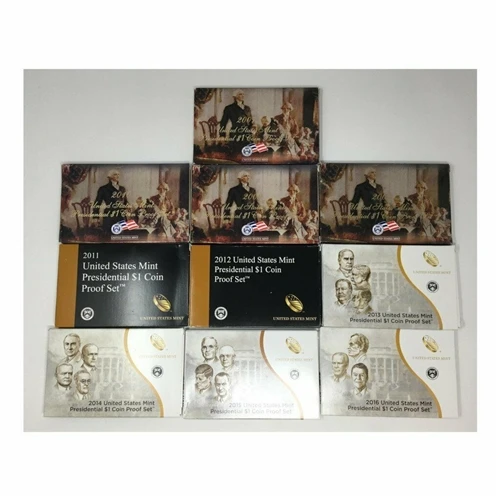
After the 2011 halt, the Mint kept the program going for collectors only. The 2012 through 2016 dollars, from Chester Arthur through Ronald Reagan, were struck in quantities of a few million each and sold only in rolls, bags, boxes and mint sets at a premium. They did not go to banks. That means you will not find them in change, and it means a nice uncirculated example is worth more than the early dates, usually a few dollars each rather than one, with the lower-mintage issues at the top of that range. If you are building the set from pocket change, these twenty coins are the ones you will have to buy. Our Presidential dollar rolls category is where most collectors fill those gaps, and complete sets in folders are in the main Presidential dollars category.
Proofs, satin finishes and mint sets
San Francisco struck proof versions of every coin, sold in annual four-coin sets and in the full Mint proof sets. Proof Presidential dollars are worth a few dollars each and the complete 2007 to 2016 proof run in original packaging is a popular, affordable set; we carry it in the Presidential dollar proof sets category. From 2007 through 2010 the Mint's uncirculated sets carried a satin finish, which grading services designate separately, and satin-finish coins in top grades bring a premium among registry-set collectors.
Position A and Position B
Because the edge lettering was applied after striking, the coin could go into the machine either way up. Hold the coin with the president's face upright: if the edge lettering reads correctly, it is Position A; if it reads upside down, Position B. Both are equally common and neither is worth more, despite what some online listings claim. Some collectors enjoy assembling both positions for every date, but it is a completeness pursuit, not a value one.
What to do with a jar of them
Sort out anything dated 2012 or later and set it aside. Check the edges of every 2007 coin for missing or doubled lettering. Everything else is spendable, and there is no shame in spending it; the same is true of the Susan B. Anthony dollars and most Sacagawea dollars that share the jar. If the series has caught your interest, the 2026 Semiquincentennial Trump dollar uses the same golden format and sold out at the Mint within a day, which tells you something about how much demand for a dollar coin depends on the person on it. For current values by date, grade and error type, the price guides at PCGS and NGC are the ones we use.
Recent Posts
-

DC & U.S. Territories Quarters (2009): Complete Set Guide
If you collected 50 State Quarters and wondered what came next, the answer arrived in 2009: six quar
-
Are 2023 Coins Worth Money? What to Keep and What to Spend
Search for "2023 coins worth money" and you will find plenty of headlines promising a fortune in you