Buying Guide for 1873 and 1874 Trade Dollars
The 1874 Trade Dollar: Quick Value and Buying Guide
The 1874 trade dollar is one of the most historically rich and collectible coins in American numismatics — and if you want a fast answer on value, here it is:
1874 Trade Dollar Values at a Glance (April 2026)
| Variety | Mintage | VF-20 | MS-63 | MS-65 |
|---|---|---|---|---|
| 1874 (Philadelphia) | 987,100 | ~$360 | ~$2,900 | ~$15,000+ |
| 1874-CC (Carson City) | 1,373,200 | Higher premium | ~$6,500 | ~$60,000 |
| 1874-S (San Francisco) | 2,549,000 | ~$334 | ~$2,100–$2,310 | ~$21,725 |
| 1874 Proof | 700 | — | PR-63: ~$3,000 | — |
- Silver melt value (all varieties): ~$63.34 based on ~$80.45/oz spot price
- Chopmarked examples typically sell at a discount to non-chopmarked coins of the same grade
- Key fact: Despite large mintages, surviving Mint State examples are extremely rare — especially for Philadelphia, where only an estimated 10 coins grade MS-65 or better
These coins were struck at three U.S. mints and sent mostly to Asia for trade. Most were spent, chopmarked, or melted — which is exactly why high-grade survivors command serious money today.
Whether you're buying your first trade dollar or hunting a gem Mint State example, understanding the variety, grade, and chopmark status will determine what you pay.
Historical Significance and Design of the Trade Dollar Series
The story of the 1874 trade dollar begins not in the pockets of American citizens, but in the bustling ports of the Orient. In the mid-19th century, the United States faced a unique "problem": we had too much silver. The discovery of the Comstock Lode in Nevada created a massive surplus of the white metal. Simultaneously, American merchants trading in China for tea and silk were at a disadvantage. Chinese merchants preferred the heavy Mexican silver dollars over standard U.S. coinage.
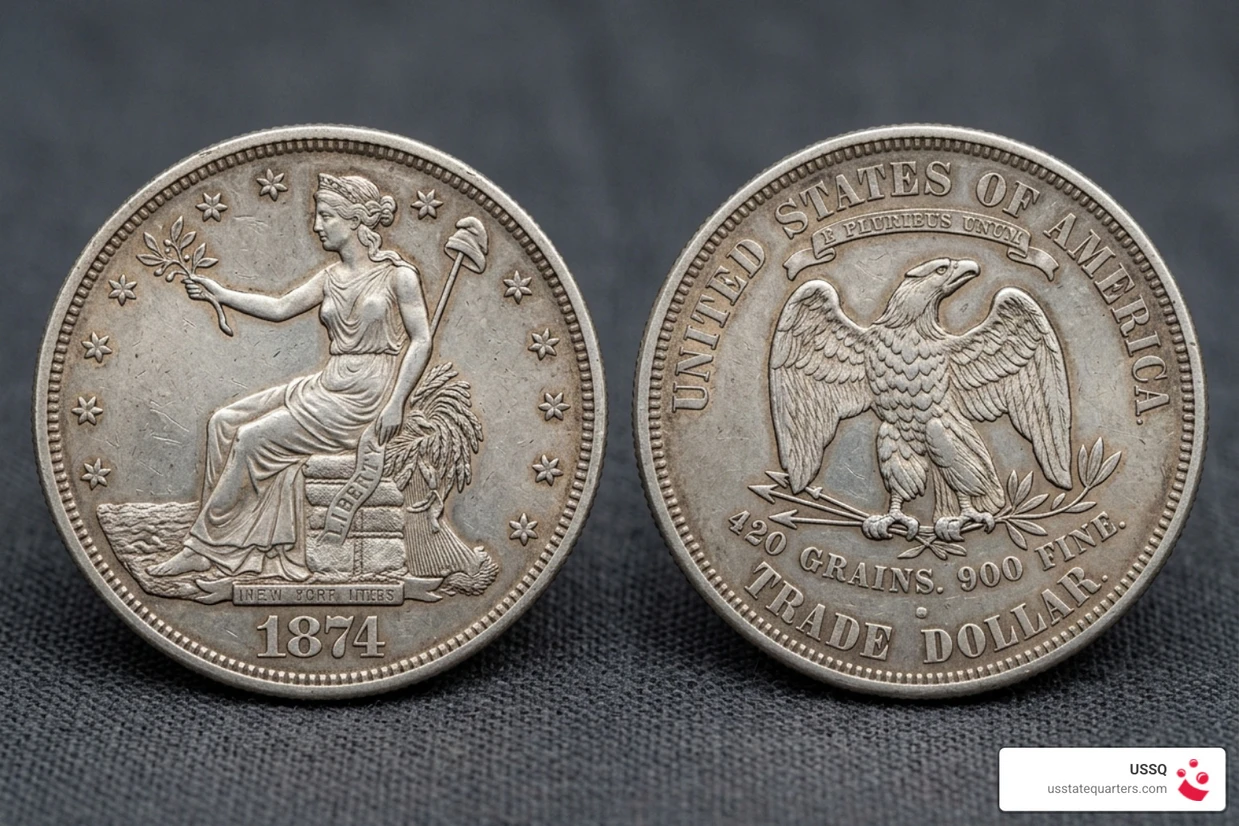
To solve both issues, the Coinage Act of 1873 authorized the creation of a specific export currency. Designed by Chief Engraver William Barber, the Trade Dollar was born. The design is a masterpiece of 19th-century engraving. The obverse features Lady Liberty seated on a bale of goods, her right hand extending an olive branch toward the sea — a symbolic gesture of peaceful trade toward China. The reverse depicts a defiant heraldic eagle clutching arrows and an olive branch, with the inscription "420 GRAINS 900 FINE" prominently displayed to prove its intrinsic worth to foreign assayers.
For those tracking market movements, 1874 Trade Dollar Values & Prices reflect the enduring legacy of this short-lived series, which saw its final circulation strikes in 1878. You can explore our full collection of Trade Dollars to see how these coins fit into the broader series.
The Purpose of the 1873 and 1874 Issues
In 1873 and 1874, the primary mission of these coins was to outshine the Mexican dollar. By making the U.S. version slightly heavier (420 grains vs. the standard 412.5 grains of a domestic silver dollar), the government hoped to dominate Asian commerce.
However, a legislative "glitch" occurred. While intended for export, these coins were technically legal tender in the U.S. for up to $5. When silver prices plummeted, bullion dealers realized they could buy these "export" coins for cheap and dump them into domestic circulation at face value. This caused a monetary headache, leading to the demonetization of the series in 1876. Suddenly, the 1874 trade dollar became the only coin in U.S. history that was legally "not money" while still looking exactly like it.
Key Specifications and Varieties of the 1874 Trade Dollar
If you are looking to add an 1874 trade dollar to your collection, you need to know where it was born. Mint marks are located on the reverse, just above the "D" in "DOLLAR."
- Philadelphia (No Mint Mark): These were the "home base" strikes. Despite a mintage of nearly a million, they are shockingly rare in high grades because almost the entire production was shipped overseas.
- Carson City (CC): Struck in the heart of silver country, these carry the legendary "CC" mark. They are highly sought after by "Wild West" collectors.
- San Francisco (S): Located on the coast, the San Francisco mint produced the most Trade Dollars to facilitate direct shipping to China.
1874 Trade Dollar Comparison Table (April 2026)
| Mint | Mintage | Survival Estimate (All Grades) | Survival Estimate (MS-60+) |
|---|---|---|---|
| Philadelphia | 987,100 | ~1,000 | ~175 |
| Carson City | 1,373,200 | ~1,500 - 2,250 | ~185 - 225 |
| San Francisco | 2,549,000 | ~3,500+ | ~450+ |
The 1874-CC Carson City Mint Variety
The 1874-CC trade dollar is a favorite among our collectors in New Orleans and across the U.S. for its rugged history. Collectors often pair these with other Carson City silver coins to complete a regional set. In 1874, the Carson City mint was under the leadership of James Crawford. To keep up with the massive influx of silver from the Consolidated Virginia Mine, the mint actually had to expand its refinery capacity and even petitioned to raise its chimney by 100 feet to handle the smoke!
Because most of these were immediately bagged and sent to the Orient, finding one in Mint State is like finding a needle in a haystack. A famous example from the "Battle Born" collection, graded MS-65, recently highlighted just how elusive these gems are. For a deep dive into the technical specs of this variety, the 1874-CC T$1 (Regular Strike) Trade Dollar - PCGS CoinFacts is an essential resource.
The 1874-S San Francisco Mint Variety
The 1874-S trade dollar was the workhorse of the series. With a mintage of over 2.5 million, it is the most "accessible" variety for collectors today. However, "accessible" is a relative term. Because these coins were used heavily in trade, most surviving examples are in About Uncirculated (AU) or lower grades.
We often see these retail for around $895 in AU condition. If you are hunting for a San Francisco strike, be prepared for "chopmarks" (which we will cover shortly), as these coins saw the most action in Chinese marketplaces. You can find more population data at 1874-S T$1 (Regular Strike) Trade Dollar - PCGS CoinFacts.
Determining the Value of an 1874 Trade Dollar
When we value an 1874 trade dollar, we look at three main pillars: Grade, Rarity, and Metal Content.
As of April 2026, the silver spot price is roughly $80.45 per ounce. Since a Trade Dollar contains .7874 oz of pure silver, the "melt value" is approximately $63.34. But let’s be honest — you aren't buying an 1874 trade dollar for the melt value. You are buying the history.
Professional grading by PCGS or NGC is mandatory for high-value specimens. A single grade point can mean a difference of thousands of dollars. For instance, an 1874-S in MS-63 might fetch $2,310, while an MS-65 can soar past $21,000. You can track these fluctuations using the 1874 Trade Dollar Values guide.
Rarity of the 1874 Trade Dollar in Mint State
Why are Mint State (MS-60 and above) 1874 Trade Dollars so expensive? Imagine a coin minted in Philadelphia, hauled across the country by train, loaded onto a humid ship, sailed across the Pacific, and then spent in a market in Canton. The survival rate for a coin to stay in "Brand New" condition through that journey is nearly zero.
For the Philadelphia strike, the PCGS population report is staggering: only about 10 coins are estimated to exist in MS-65 or better. The current condition census #1 is a PCGS MS-67. When these rare birds hit the auction block, records shatter — like the MS-66 that once realized $74,750. You can view the registry details for top-tier examples at PCGS Set Registry: 1874 T$1 #45114109.
The Impact of Chopmarks on the 1874 Trade Dollar
One of the most fascinating aspects of the 1874 trade dollar is the "chopmark." When these coins arrived in China, local merchants didn't just take the U.S. government's word for the silver content. They would stamp the coin with their own unique character (a chop) to certify its weight and purity.
For decades, American collectors viewed these as "damaged" coins. However, modern numismatists have embraced them as "travel scars" that prove the coin actually did the job it was designed for.
- Value Impact: Generally, a chopmarked coin is worth less than a "clean" one of the same grade.
- Rarity: Some dates, like the 1878-CC, are incredibly rare with chopmarks.
- Authentication: Chopmarks are a great sign of authenticity, as counterfeiters rarely took the time to add them historically (though modern fakes do exist).
Check out the 1874-S T$1 Chopmarked (Regular Strike) for examples of how these marks appear on the coin's surface.
Authentication and Tips for Buying Trade Dollars Online
Buying an 1874 trade dollar online requires a "trust but verify" approach. Because these coins were so popular in Asia, they are among the most counterfeited coins in the world. Some fakes are over 100 years old, made of base metal and plated in silver.
At USSQ, we recommend the following when shopping:
- Buy Graded: Stick to PCGS or NGC certified coins. This guarantees both the grade and the authenticity.
- Check the Weight: An authentic 1874 trade dollar should weigh 27.22 grams. Most fakes are significantly lighter.
- Examine the Edge: The reeding on the edge should be sharp and consistent.
- Return Policy: Only buy from dealers (like us!) who offer a clear return policy. We offer a 14-day return window because we want you to be 100% happy with your investment.
If you're looking for more professional numismatic assistance, you can browse our extensive inventory of Silver Dollars on our main site.
Identifying Varieties and Counterstamps
Beyond the standard mint marks, there are subtle varieties to look for. The 1874 issues use the "Type I" obverse (where the sash ends on Liberty point down).
There are also rare "counterstamps" that aren't Chinese chopmarks. The most famous is the "SAGE'S CANDY COIN" stamp. Only about 4 to 6 of these are known to exist on Trade Dollars. These were merchant advertisements stamped onto the coins back in the States. While technically "mutilated," these are highly collectible oddities that tell a story of 19th-century American marketing.
Frequently Asked Questions about the 1874 Trade Dollar
What is the silver melt value of an 1874 Trade Dollar in 2026?
As of April 2026, with silver spot prices around $80.45, the melt value is approximately $63.34. However, the numismatic value of even a heavily circulated 1874 trade dollar starts around $200–$300, so you should never sell one for just its silver weight!
Why are 1874-CC Trade Dollars so expensive in high grades?
The Carson City mint was primarily used to strike coins for immediate export. Very few people in the 1870s thought to save a "brand new" coin from the Nevada mint. Most were shipped to China and either melted or heavily circulated. This leaves a tiny "population" of high-grade survivors for thousands of eager collectors.
Do chopmarks increase or decrease the value of the coin?
In the general market, chopmarks decrease the price compared to a "clean" specimen. However, there is a dedicated community of "Chopmark Collectors" who will pay premiums for rare dates or particularly beautiful merchant stamps. It’s all about the "story" the coin tells!
Conclusion
The 1874 trade dollar is more than just 27 grams of silver; it is a survivor of a global trade war and a relic of the American West. Whether you are hunting for a "CC" mint mark to complete your Carson City set or looking for a chopmarked San Francisco strike that actually traveled the Silk Road, these coins offer a tangible connection to history.
Planning your collection is half the fun. We recommend starting with a nice, circulated "S" mint to get a feel for the series before moving into the rarer Philadelphia or Carson City issues. When you're ready to add this piece of history to your vault, Visit USSQ to browse Trade Dollars and other rare silver issues. Happy collecting!
See our Morgan silver dollars for current prices.
Recent Posts
-

Walking Liberty Half Dollar Value Guide: Key Dates, the 1921 Problem, and What Yours Is Really Worth
Ask a room full of collectors to name the most beautiful U.S. coin and the Walking Liberty half doll
-
The 2026 Semiquincentennial Proof Set: What's in It, Why It Costs $107, and Whether to Buy One
On October 6 at noon Eastern, the U.S. Mint puts the 2026 Semiquincentennial Proof Set on sale at $1