The Ultimate Guide to the Barber Liberty Head Dime
History and Design of the barber head dime
The story of the barber head dime (part of the broader Barber coinage history) begins not with a stroke of artistic genius, but with a failed bureaucratic experiment. By the late 1880s, the Seated Liberty design had been in circulation for over fifty years. Mint Director Edward O. Leech felt it was time for a change, believing the American public deserved more "artistic" coinage. In 1891, he launched a grand public competition to find a replacement, inviting ten of the nation's most famous artists to submit designs.
The artists, however, had a different idea. They balked at the terms, which offered no compensation for losing entries and gave the Mint full rights to the winning work. When the public portion of the contest opened, over 300 entries flooded in, but Leech found them all "inept." Frustrated and facing a legislative deadline, Leech turned to the man already on the payroll: Chief Engraver Charles E. Barber.
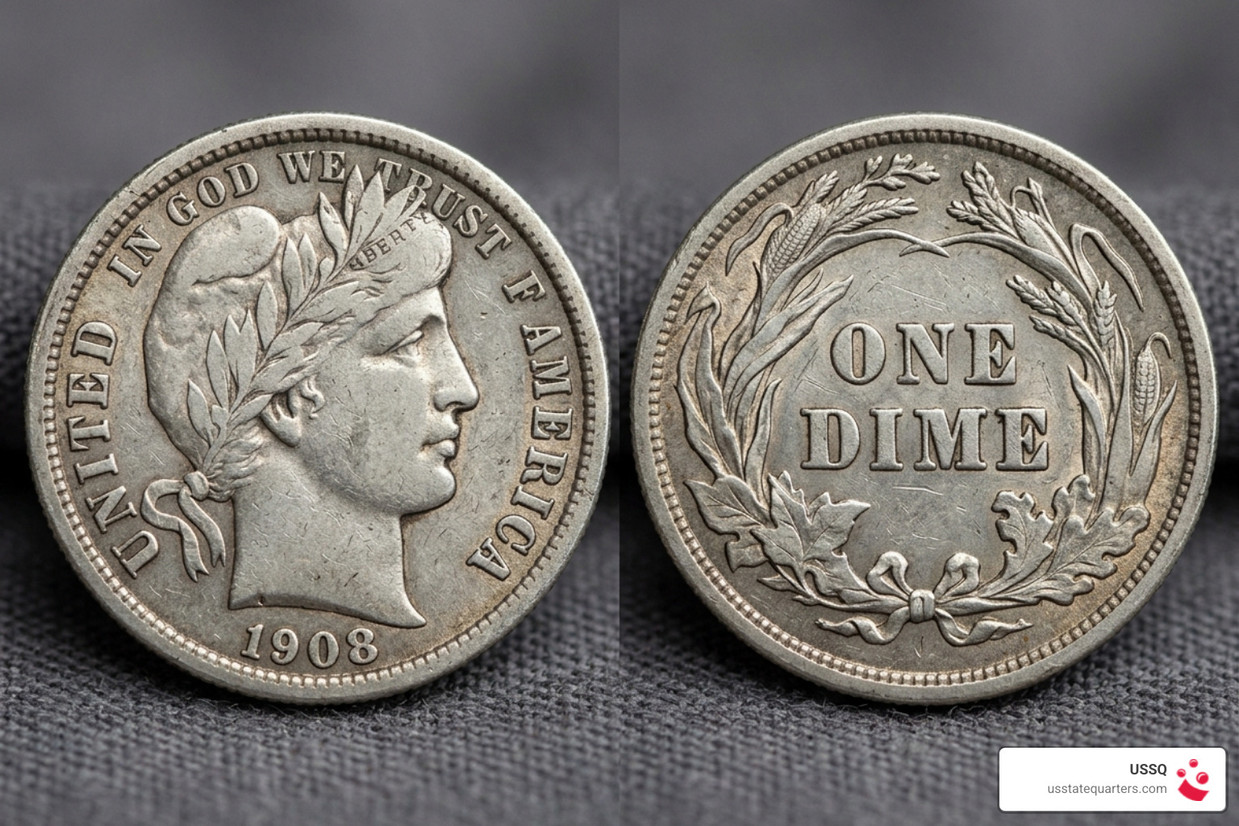
Barber was a traditionalist. His design for the barber head dime (officially the Liberty Head dime) featured a stoic, right-facing Lady Liberty. She wears a Phrygian cap (a symbol of freedom), a laurel wreath, and a headband inscribed with "LIBERTY." If she looks familiar, it’s because Barber used essentially the same obverse for the quarter and the half dollar, creating a unified look across silver denominations.
The reverse of the dime was a carryover from the previous era. It features an agricultural wreath made of corn, wheat, maple, and oak leaves, encircling the words "ONE DIME." Interestingly, unlike the quarter and half dollar, the barber head dime does not feature stars on the obverse. This was a practical choice to prevent the design from looking "crowded" on the smaller 17.9 mm planchet.
Identifying the barber head dime Mint Marks
For collectors, the "where" of a coin's birth is just as important as the "when." During the production run from 1892 to 1916, four different mints produced these silver beauties. Identifying the mint mark is crucial because it can mean the difference between a $5 coin and a $5,000 coin.
You can find the mint mark on the reverse side, located at the bottom, just below the bow of the wreath.
- Philadelphia (No Mint Mark): The "mother mint" produced the largest quantities. If there is no letter below the wreath, it was born in Philly.
- New Orleans (O): This historic mint produced dimes from the start of the series in 1892 until 1909. These are highly sought after, especially the 1895-O.
- San Francisco (S): Known for lower mintages, the "S" mark is found on some of the series' greatest rarities, including the legendary 1894-S.
- Denver (D): The Denver Mint didn't start striking the barber head dime until 1906.
If you are looking to fill a hole in your album or start a new set, you can Shop Barber Dimes at competitive prices through our online store.
Artistic Reception and Legacy
While we appreciate them as classics today, the barber head dime wasn't exactly a "critics' choice" winner in 1892. Famous sculptor Augustus Saint-Gaudens was particularly harsh, reportedly saying the design looked like it had been "designed by a young lady of sixteen." Other critics called the design "Germanically stolid" and "prosy."
Despite the mixed reviews from the art world, the public used them heavily. They were the workhorses of the American economy for a quarter-century. By 1916, however, the tide of artistic taste had shifted. The Mint moved toward more neoclassical, fluid designs, leading to the transition to the "Winged Liberty" or Mercury Dime. Today, we view Barber’s work as a dignified representation of the Gilded Age—conservative, solid, and undeniably American.
The Legendary 1894-S and Key Date Rarities
In numismatics, the 1894-S barber head dime is the "Great White Whale." Its existence is shrouded in mystery. In 1894, the San Francisco Mint was in the middle of a financial audit. To account for a $2.40 discrepancy in silver bullion, the Mint Superintendent, John Daggett, ordered exactly 24 proof dimes to be struck.
As the story goes, Daggett gave three of these dimes to his young daughter, Hallie, telling her to keep them until she was older. Being a child in search of a treat, she immediately spent one on a dish of ice cream. That single dime—now known as the "Ice Cream Specimen"—is one of only nine known to survive today.
The 1894-S is so rare that it has become a "millionaire's coin." In 2016, a PCGS PR66 specimen sold at auction for $1,997,500. Another sold in 2019 for $1.32 million. While most of us won't find an 1894-S in a junk bin, there are other "Key Dates" that are more attainable but still highly valuable. You can Shop Barber Dimes to find these key dates:
- 1895-O: With a mintage of only 440,000, this is the toughest "business strike" to find. An MS64 example can command upwards of $25,000.
- 1896-S: Another low-mintage San Francisco issue that is scarce in all grades.
- 1901-S: This date is a "condition rarity." While common in low grades, finding one in Mint State is an expensive challenge for any collector.
- 1893/2 Overdate: A fascinating variety where the '3' was punched over a '2' in the die.
Grading and Market Valuation
When we talk about the value of a barber head dime, condition is everything. Because these coins circulated heavily, they are often found "slick" (meaning the design is almost worn away). Collectors use the PCGS grading scale to determine value, ranging from G4 (Good) to MS65 (Choice Uncirculated).
One unique challenge with this series is the "LIBERTY" headband. On the obverse, the word "LIBERTY" is inscribed on Lady Liberty's crown. This is the highest point of the design and the first thing to wear away. In many cases, the headband wears down much faster than the rest of the coin, making high-grade examples (where all seven letters are visible) disproportionately rare and valuable. For more detailed pricing, see USSQ's Barber Dime Value Guide.
| Date/Mint | G4 (Good) | VF20 (Very Fine) | AU50 (About Unc) | MS63 (Uncirculated) | MS65 (Gem Unc) |
|---|---|---|---|---|---|
| Common Date | $5 - $8 | $20 - $35 | $85 - $110 | $180 - $250 | $500+ |
| 1895-O | $350 | $1,200 | $5,500 | $12,500 | $40,000+ |
| 1896-S | $65 | $325 | $1,100 | $2,400 | $5,500+ |
| 1901-S | $50 | $275 | $1,250 | $5,500 | $14,000+ |
| 1894-S | Rare | Rare | Rare | Rare | $1.9M+ (Proof) |
Note: Prices are based on April 2026 PCGS Price Guide estimates and vary by market demand.
Factors Influencing barber head dime Value
Beyond the date and mint mark, several technical factors influence what a buyer will pay:
- Silver Spot Price: Every barber head dime contains 0.07234 oz of pure silver. Even if the coin is completely worn out, it will always be worth its "melt value."
- Population Reports: Professional grading services like PCGS maintain "Pop Reports" showing how many coins exist in a certain grade. If a coin is one of only 11 graded MS68 (like some 1892 specimens), the price can skyrocket to $30,000 or more.
- CAC Approval: Coins with a green CAC sticker have been verified for exceptional quality within their grade, often fetching a 10% to 20% premium.
- Proof Strikes: The Mint produced a small number of Proof coins each year for collectors. These have mirror-like backgrounds and are highly prized.
- Varieties: Look out for the "Micro O" variety (found on some 1892-O, 1905-O, and 1899-O dimes). These feature a tiny mint mark intended for the quarter, making them rare and valuable errors.
Frequently Asked Questions about Barber Dimes
What is the rarest Barber Dime?
Without question, the 1894-S is the rarest. Only 24 were minted, and only 9 are known to exist today. All known survivors are Proof strikes. It is considered one of the "Big Three" of American numismatic rarities.
How much silver is in a Barber Dime?
Every barber head dime is composed of 90% silver and 10% copper. This results in 0.07234 troy ounces of pure silver per coin. In the current April 2026 market, this silver content provides a solid "floor" for the coin's value, regardless of its numismatic rarity. Shop our silver Barber Dime collection.
Where is the mint mark on a Barber Dime?
The mint mark is located on the reverse side, at the bottom of the coin. It is positioned directly below the bow that ties the agricultural wreath together. Philadelphia coins have no mark; others will show an 'O', 'S', or 'D'.
Conclusion
The barber head dime is more than just a piece of old silver; it is a window into the late 19th and early 20th centuries. From the political drama of the 1891 design competition to the legendary "Ice Cream" dime of 1894, this series offers something for every level of collector.
At USSQ, we have been helping collectors build their legacies since 1999. Whether you are looking for a bulk bag of circulated silver for your "junk silver" stack or a high-grade key date to anchor your collection, our 5,000+ product inventory is here to serve you. As we move through April 2026, the market for classic silver remains robust, making now an excellent time to explore the Barber series.
If you have questions about grading your coins or finding a specific date, please Contact us for expert coin advice. We offer competitive prices, low shipping, and a 14-day return policy to ensure you are 100% satisfied with every addition to your collection. Happy hunting!
Recent Posts
-

Walking Liberty Half Dollar Value Guide: Key Dates, the 1921 Problem, and What Yours Is Really Worth
Ask a room full of collectors to name the most beautiful U.S. coin and the Walking Liberty half doll
-
The 2026 Semiquincentennial Proof Set: What's in It, Why It Costs $107, and Whether to Buy One
On October 6 at noon Eastern, the U.S. Mint puts the 2026 Semiquincentennial Proof Set on sale at $1