Barber Quarter Value Guide: The 1896-S, 1901-S and 1913-S Keys, and What a Worn One Is Worth
The Barber quarter is one of the most honest series in American coinage. Most of the coins that survive are worn nearly smooth, because they spent decades in cash registers before anyone thought to save them, and in that condition they are worth their silver plus a modest collector premium. But the series also holds three of the toughest twentieth-century coins a quarter collector will ever chase, plus a handful of dates that quietly stay missing from albums for years. Here is how to tell the difference.

The basics
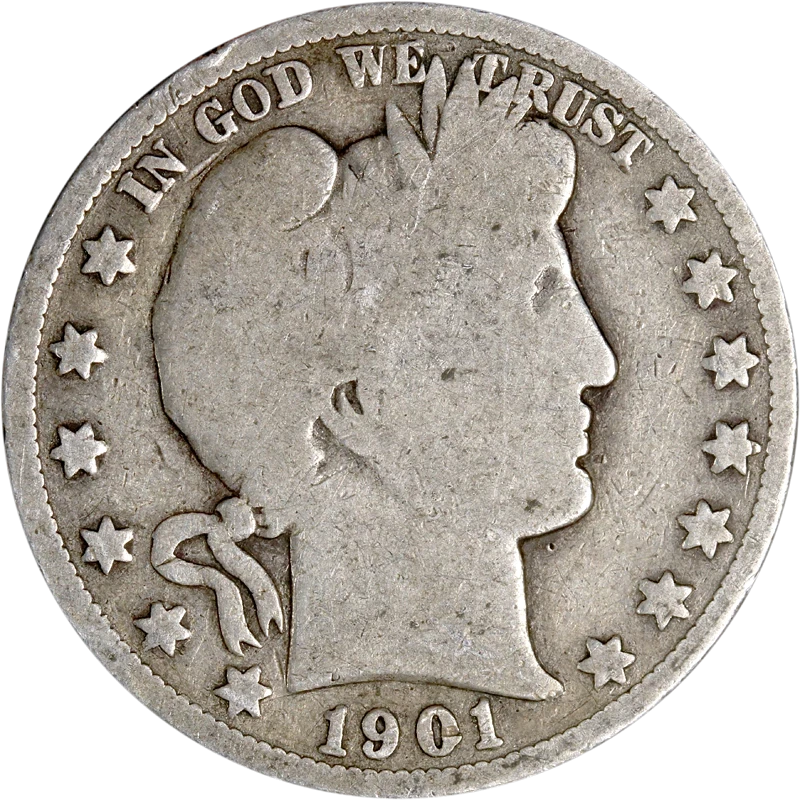
Chief Engraver Charles E. Barber designed the quarter, along with the matching dime and half dollar, and it was struck from 1892 through 1916, when the Standing Liberty quarter replaced it. Liberty faces right wearing a laurel wreath and a headband inscribed LIBERTY; the reverse carries a heraldic eagle. Every Barber quarter is 90% silver, weighs 6.25 grams and holds about 0.18 troy ounces of silver, so even the most worn example has a value floor well above face.
Four mints struck them. Philadelphia coins have no mint mark. New Orleans (O) struck quarters until the mint closed in 1909, San Francisco (S) struck most years, and Denver (D) joined in 1906. The mint mark sits on the reverse, just below the eagle's tail.
Why almost every Barber quarter you find is worn
Quarters were real money when these were made, and the low-relief design wore quickly. Barber quarters stayed in circulation for decades after the design was retired, until rising silver prices in the 1960s pulled silver coins out of change for good. By then most were in About Good or Good condition, with the rims worn into the lettering and LIBERTY long gone from the headband. That is why a Barber quarter in Very Fine or better is genuinely scarce for almost every date, and why the jump in price from Good to Fine to Very Fine is so steep.
The three keys
1901-S
Often called the queen of the series. San Francisco struck only 72,664, and very few were saved. It is the most famous Barber quarter and one of the great twentieth-century rarities in any denomination, priced in the thousands of dollars even in low circulated grades. Because it is so valuable, altered dates and added mint marks exist; buy this one certified by PCGS or NGC and nowhere else.
1896-S
A mintage of 188,039, and PCGS estimates only about 2,000 survive across all grades, with perhaps 80 in mint state. In PCGS's published price guide even a heavily worn Good-4 example has been listed in the high hundreds of dollars, and nice circulated pieces climb quickly from there.
1913-S
The lowest business-strike mintage of the series at just 40,000. Worn examples in Good to Very Good are the realistic target for most collectors; problem-free coins in Extremely Fine and About Uncirculated are extremely rare and priced accordingly.

Semi-keys and better dates
Below the big three, a group of dates carries a real premium and tends to be the last holes filled in an album. The most commonly cited are the 1896-O, 1901-O, 1909-O and 1914-S, with the 1899-S and 1908-S close behind in the middle grades. None of these is a four-figure coin in low grade, but each sells at a clear premium over a common date, and all of them get much harder to find in Very Fine and up with original surfaces. If you are going through an inherited group of Barber quarters, these are the mint marks to check first, along with any S-mint coin from 1896, 1901 or 1913.
What a common-date Barber quarter is worth
For the common Philadelphia dates and most of the plentiful branch-mint issues, a coin in About Good or Good is essentially a silver coin with a small collector premium. Value rises steadily once LIBERTY on the headband starts to show, and a common date in Extremely Fine or About Uncirculated is worth many times a Good one. Uncirculated common dates are scarce enough that they bring solid premiums; the grading-service price guides at PCGS and NGC are the best current reference for any specific date and grade.
How to grade one quickly
Like the Barber dime and half, the quick check is the word LIBERTY on the headband above Liberty's forehead.
- Good: date and lettering readable, rims mostly complete, LIBERTY on the headband worn away.
- Very Good: a few letters of LIBERTY visible.
- Fine: all seven letters of LIBERTY readable, though worn.
- Very Fine and up: LIBERTY sharp, leaves in the wreath separated, and the eagle's feathers and shield lines showing clearly on the reverse.
Watch for cleaning, which is common on silver coins this old and shows as fine parallel scratches or an unnaturally bright surface. A cleaned coin is worth noticeably less than an original one in the same grade, and the grading services will not give it a straight numerical grade.
Building a set
A complete date-and-mint set runs to 74 coins, from the 1892 trio through the 1916-D. Most collectors build it in Good to Very Good, where the common dates are affordable and the set is achievable, then decide later whether to chase the 1896-S, 1901-S and 1913-S or leave those three spaces for a lucky day. A matched set in Fine or better is a serious long-term project, because the coins simply did not survive in that condition. A Barber quarter is also an essential type coin for anyone building a twentieth-century quarter collection, alongside the Standing Liberty quarter that replaced it in 1916.
Shop Barber quarters at USSQ
We keep Barber quarters by date and grade across the full 1892–1916 run, including the key 1901-S, 1896-S and 1913-S as they become available. The same design runs across the Barber dimes and Barber half dollars, and our Barber half dollar value guide covers the big brother of this coin. For current prices by date and grade, the guides at PCGS and NGC are the references we use, and the American Numismatic Association is a good place to learn grading standards.
Recent Posts
-

DC & U.S. Territories Quarters (2009): Complete Set Guide
If you collected 50 State Quarters and wondered what came next, the answer arrived in 2009: six quar
-
Are 2023 Coins Worth Money? What to Keep and What to Spend
Search for "2023 coins worth money" and you will find plenty of headlines promising a fortune in you