Franklin Half Dollar Value Guide: Full Bell Lines, the 1949-S, the Bugs Bunny, and Why Silver Sets the Floor
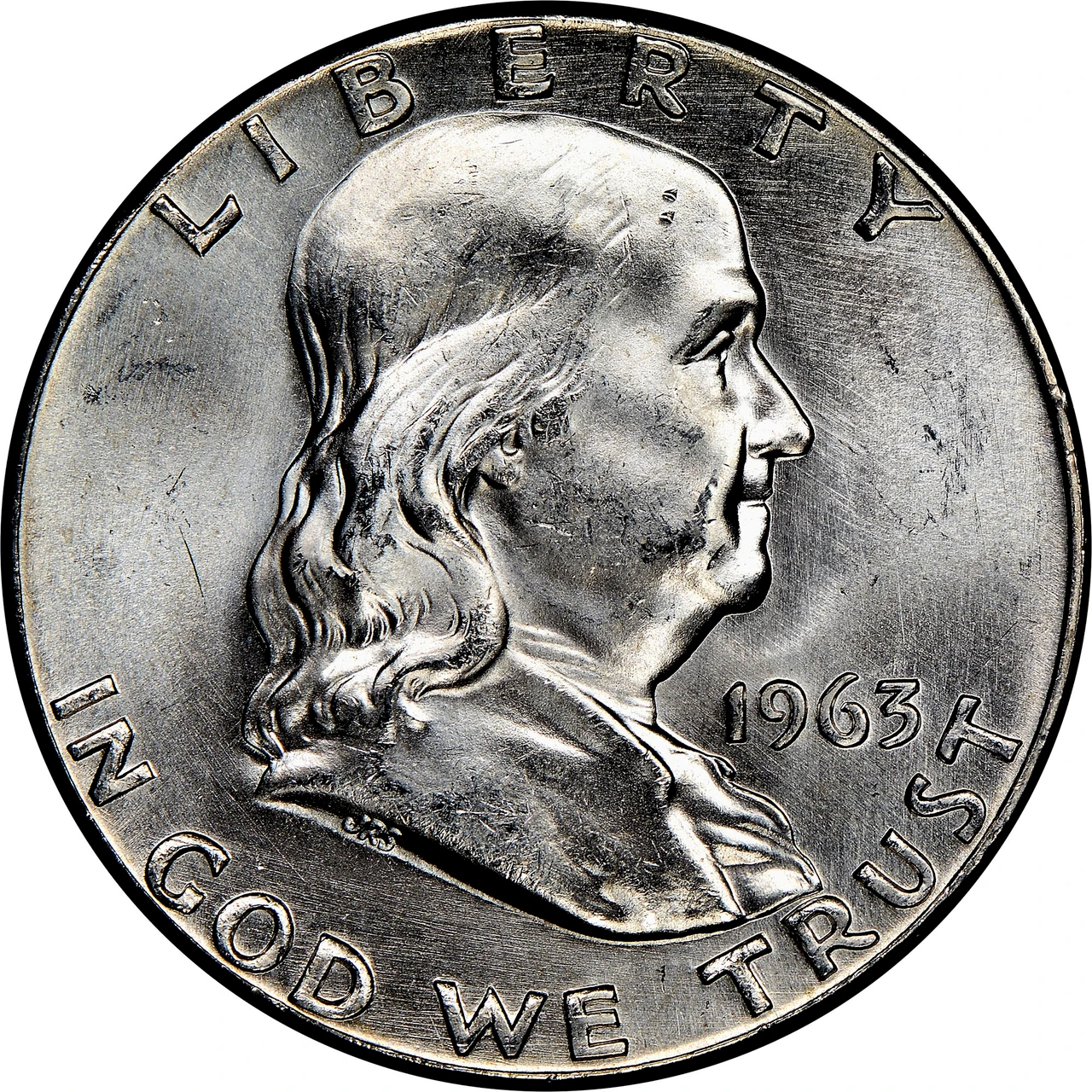
The Franklin half dollar is the coin collectors underrate and non-collectors overrate. Non-collectors see a big silver coin from the 1950s and assume it is rare; it is not, and a worn one is worth its silver. Collectors dismiss the series because it has no rarities at all in circulated grades; that is true, but it ignores the fact that in mint state, with a fully struck Liberty Bell, some of these coins are hard to find and priced accordingly. Sixteen years, thirty-five date-and-mintmark combinations, no impossible coins, one famous die clash and a strike designation that does most of the work: here is how the series actually prices out.

The basics
John R. Sinnock's portrait of Benjamin Franklin ran from 1948 through 1963, when Congress replaced it with the Kennedy half within weeks of the assassination. The reverse shows the Liberty Bell with a small eagle to the right, added because law required an eagle on the half dollar. Every Franklin is 90% silver with about 0.36 troy ounces of the metal, so even the most common date is a silver coin first. That floor is why you will never see a Franklin half offered at face value, and why a roll of worn ones is a bullion purchase rather than a numismatic one.
Circulated coins: it is all silver value
Here is the part that disappoints people. There is no Franklin half dollar that is scarce in circulated condition. The lowest business-strike mintages, the 1955 at about 2.5 million and the 1953 at about 2.7 million, were saved in quantity because collectors knew they were low, and the 1949-S at 3.7 million is plentiful in circulated grades. A worn 1955 sells for a couple of dollars over silver, not a couple of hundred. If you have inherited a folder of circulated Franklins, the folder is worth roughly thirty-five times the silver value of one coin, and the dates barely move that number. That is not nothing, and silver has been a good place to hold value, but it is not a treasure.
Mint state: where the dates start to matter
In uncirculated grades the picture changes. The 1949-S is the recognized key of the series in mint state and the toughest to find with a sharp strike. The 1948 and 1949 Philadelphia and Denver coins, the 1952-S and the 1953-S are all scarcer in gem condition than their mintages suggest, because the early years were not saved the way the 1955 was. Late dates from 1957 through 1963 were struck in huge numbers and saved by the bag, so uncirculated examples are cheap and this is where most collectors start.
Full Bell Lines: the designation that drives prices
Turn the coin over and look at the bottom of the Liberty Bell. There are two sets of horizontal lines running across the bell, and on a fully struck coin every line in both sets is complete and unbroken from left to right. Grading services call this Full Bell Lines (FBL), and it separates the ordinary from the expensive across the whole series. On common late dates an FBL coin carries a modest premium. On the dates that were struck weakly, an FBL example can be worth many times a regular one. The 1953-S is the classic case: a common coin in mint state, and one of the most expensive in the series with Full Bell Lines because almost none were struck that well. If you are buying uncirculated Franklins, the FBL designation is the single most important thing on the label after the grade.
The 1955 Bugs Bunny
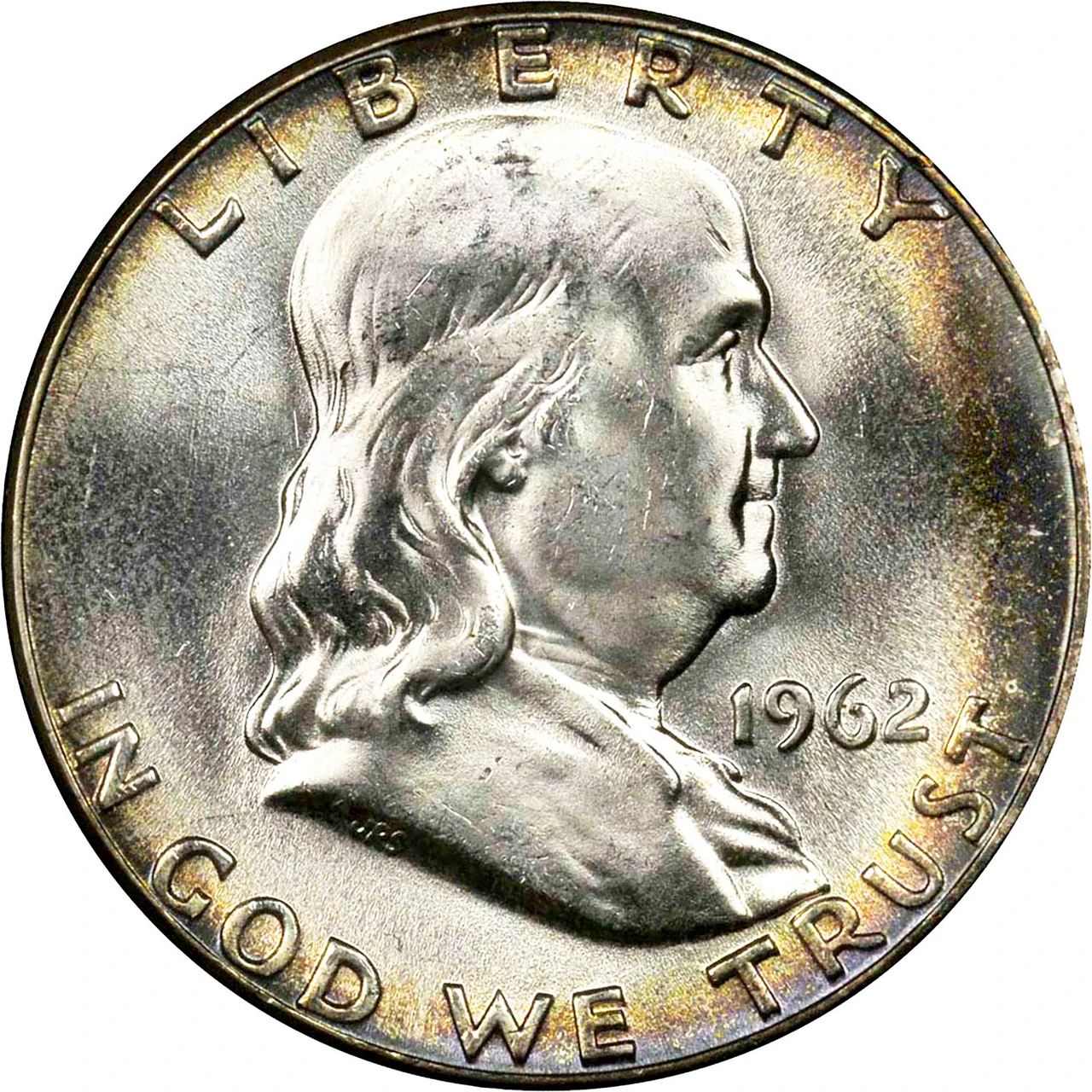
The one variety everybody asks about. On some 1955 halves, the obverse and reverse dies clashed together without a planchet between them, and the eagle's wing feathers from the reverse left marks on Franklin's mouth on the obverse. The result looks like buck teeth, and the Bugs Bunny nickname has stuck for seventy years. It is not rare, since a large share of the 1955 mintage shows some degree of clashing, but a clear example in mint state brings a premium over a regular 1955, and it is a fun coin to own. Look for lines crossing Franklin's lips and chin. Weak clashes are common and worth little extra; strong, obvious ones are what collectors pay for.
Proof Franklins
Philadelphia struck proofs from 1950 through 1963. The 1950 proof had a mintage of only 51,386 and is the key of the proof run, worth a substantial premium in any condition and much more with cameo contrast. Cameo and deep cameo Franklin proofs, where frosted devices stand out against mirror fields, are scarce for the early 1950s and command strong premiums; by the 1960s they are common. Proofs from 1956 onward often turn up still in Mint packaging and are affordable entry points to the series.
Grading and what to avoid
Wear shows first on Franklin's cheek and the hair above his ear on the obverse, and on the bell lines and the lettering on the bell on the reverse. Because the fields on this design are large and open, cleaning is easy to spot: fine parallel hairlines, an unnatural bright-white surface, or a dull haze that does not match the original luster. A cleaned Franklin is worth silver, full stop. Also watch for coins that were once part of jewelry, since Franklins were popular for money clips and bracelets; look for solder marks, rim damage or a flattened edge.
Building a set
Thirty-five coins, no impossible dates, and a design that rewards a matched, well-struck set. Most collectors go for uncirculated coins with Full Bell Lines on the dates where that is affordable and accept regular strikes on the tough ones, or build a circulated set as a silver holding with numismatic upside. We keep individual dates by grade in our Franklin half dollars category, with the Walking Liberty halves that came before it and the Kennedy halves that replaced it. If you are sorting a mixed batch of half dollars, our Kennedy half dollar value guide and Walking Liberty value guide cover the other two.
The honest summary
Circulated Franklins are silver with a small premium, whatever the date. Uncirculated 1949-S, 1948, 1949, 1952-S and 1953-S are the ones to look for, and Full Bell Lines is the difference between an ordinary coin and an expensive one across the series. Check every 1955 for the Bugs Bunny clash. For current numbers by date, grade and FBL status, use the price guides at PCGS and NGC, and for the series history the American Numismatic Association is the place to read more.
Recent Posts
-

DC & U.S. Territories Quarters (2009): Complete Set Guide
If you collected 50 State Quarters and wondered what came next, the answer arrived in 2009: six quar
-
Are 2023 Coins Worth Money? What to Keep and What to Spend
Search for "2023 coins worth money" and you will find plenty of headlines promising a fortune in you