Liberty Head V Nickel Value Guide: Key Dates, the No CENTS Swindle, and the $4.5 Million 1913
The Liberty Head nickel, better known to collectors as the V nickel for the big Roman numeral on its back, was struck from 1883 to 1912 and stayed in pocket change long after that. Most of the ones still turning up today are heavily worn, which makes the series one of the most affordable ways to own a genuine 19th-century American coin. A few dates are truly scarce, one variety started life as a con, and one date is a multimillion-dollar coin the Mint never officially made. Here is how to tell which is which.

The basics
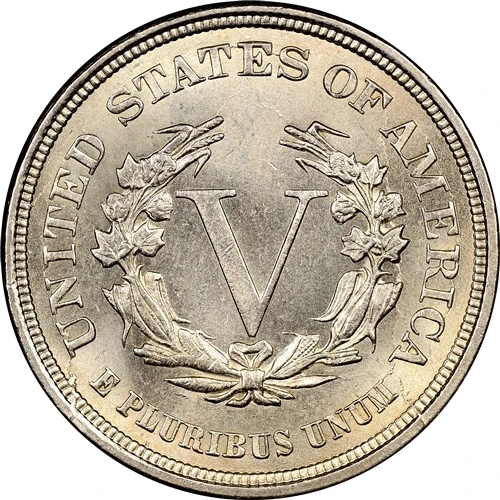
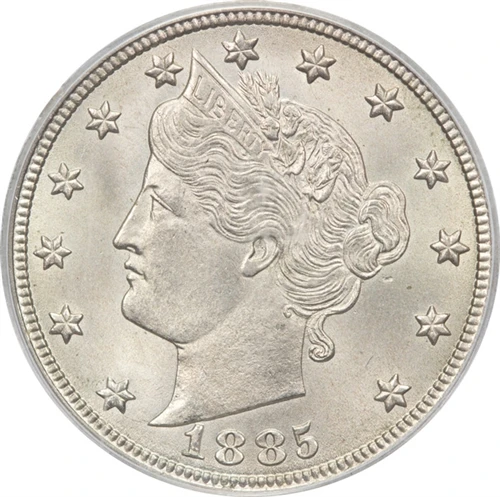
Chief Engraver Charles E. Barber designed the Liberty Head nickel to replace the Shield nickel in 1883. It uses the same 75% copper, 25% nickel alloy as the nickel in your pocket today. The obverse shows Liberty facing left wearing a coronet inscribed LIBERTY, surrounded by thirteen stars; the reverse carries a large V inside a wreath. Every regular-issue date from 1883 through 1911 was struck at Philadelphia only, with no mint mark. In 1912 the Denver and San Francisco mints struck nickels for the first time, and those two coins, the 1912-D and 1912-S, carry a small mint mark on the reverse to the left of the dot before CENTS.
1883 No CENTS: the nickel that fooled people
The first Liberty nickels of 1883 had a design flaw. The reverse showed only the V, with no word telling you what it was worth, and the coin was close in size to the $5 gold half eagle. Swindlers noticed. Some gold-plated the new nickels, a few even added reeded edges to mimic gold coins, and passed them off as five dollars. The Mint fixed the problem within months by adding the word CENTS below the wreath and moving E PLURIBUS UNUM above it.
About 5.47 million No CENTS nickels were struck before the change, compared with roughly 16 million of the revised "With CENTS" 1883. Because the public saved the No CENTS version as a novelty, and because type collectors have wanted one ever since, it is actually the most plentiful Liberty nickel in grades above Very Fine. That makes it an excellent, affordable type coin rather than a rarity. Gold-plated survivors are collected as "racketeer nickels," though gold plating is easy to add at any time, so treat a racketeer piece as a fun curiosity rather than a premium coin.
The key dates
1885
The toughest date in the regular series. Philadelphia struck only about 1.47 million, and PCGS estimates around 5,000 survive across all grades. In PCGS's published price guide, even a heavily worn Good-4 example has been listed in the hundreds of dollars, and choice uncirculated coins run well into four figures. Because it is the date everyone needs, it is also a target for altered dates, so buy it certified.
1886
With a mintage of about 3.3 million, the 1886 is the third-lowest business-strike mintage in the series and the usual semi-key. It sits a clear step below the 1885 in price but well above the common dates in every grade.
1912-S
The lowest mintage of the entire series at just 238,000, lower even than the famous 1909-S VDB cent (484,000) or the 1916-D Mercury dime (264,000). Worn examples cost less than a worn 1885, but higher grades are scarce and priced accordingly. Check the S carefully: added mint marks on ordinary 1912 Philadelphia nickels are a known alteration.
Semi-keys worth watching: 1894 and 1912-D
The 1894 (about 5.4 million struck) and the 1912-D (about 8.5 million) carry modest premiums over the common dates, especially from Fine upward. They are not expensive in low grades, but they are the coins that tend to go missing from an otherwise complete album.
The 1913 Liberty nickel: five coins, millions of dollars
The Buffalo nickel replaced the Liberty design in 1913, and no 1913 Liberty nickels were authorized. Five exist anyway. They surfaced in 1920 when Samuel W. Brown, a former Mint employee, displayed all five at the American Numismatic Association convention, and how they were made has been debated ever since. Two are now permanently held by the Smithsonian Institution and the ANA. The finest-known Eliasberg example sold for $4.56 million at a Stack's Bowers auction in 2018, still the public auction record for the coin, and another, the "Hawaii Five-O" specimen, sold privately for more than $4 million in 2021.
Since all five are accounted for, any 1913 Liberty nickel offered to you is a fake or an altered date. That has not stopped people from trying.
What a common-date Liberty nickel is worth
Most dates in the series had mintages in the tens of millions, and decades of circulation wore most of them down to About Good or Good. In those grades, common dates trade for a few dollars each. Value climbs steadily with detail: coins in Fine to Extremely Fine are noticeably harder to find than the worn pieces, and uncirculated common dates typically run into three figures per PCGS and NGC price guides. Original, uncleaned surfaces matter a lot. Nickel alloy shows harsh cleaning clearly, and a cleaned coin sells at a meaningful discount to an original one in the same grade.
How to grade one quickly
The fastest check is the word LIBERTY on Liberty's coronet, because it is one of the highest points of the design and wears early.
- Good: outline clear, but LIBERTY on the coronet is worn away.
- Very Good: at least a few letters of LIBERTY are visible.
- Fine: all seven letters of LIBERTY are readable.
- Very Fine and up: LIBERTY is bold, hair detail returns above the forehead, and the details of the wreath on the reverse sharpen.
Use good light and a 5x to 10x loupe, and grade both sides. For key dates, let PCGS or NGC do the final call; a certified coin is easier to sell later and protects you from the alterations described above.
Building a set
A date set of Liberty nickels, 1883 through 1912, is 33 coins including both 1883 varieties and the 1912-D and 1912-S. It is very achievable in Good to Very Good except for the three keys, and many collectors start with a single 1883 No CENTS as a type coin and get pulled in from there. The series also fits neatly between the Shield nickel before it and the Buffalo nickel after it, so it is a natural next step if you already collect Buffalos or Jeffersons. Our Jefferson nickel value guide and our look at the most valuable Buffalo nickels cover the series that followed.
Shop Liberty nickels at USSQ
We carry Liberty Head V nickels by date and grade across the whole 1883–1912 run, including the 1883 No CENTS, the key-date 1885 and the low-mintage 1912-S, plus the Buffalo nickels that replaced them. For current values by grade, the price guides at PCGS and NGC are the references we trust, and the American Numismatic Association is a good place to learn grading standards.
Recent Posts
-

DC & U.S. Territories Quarters (2009): Complete Set Guide
If you collected 50 State Quarters and wondered what came next, the answer arrived in 2009: six quar
-
Are 2023 Coins Worth Money? What to Keep and What to Spend
Search for "2023 coins worth money" and you will find plenty of headlines promising a fortune in you