How to Turn Your Post-1958 Pennies Into Real Cash
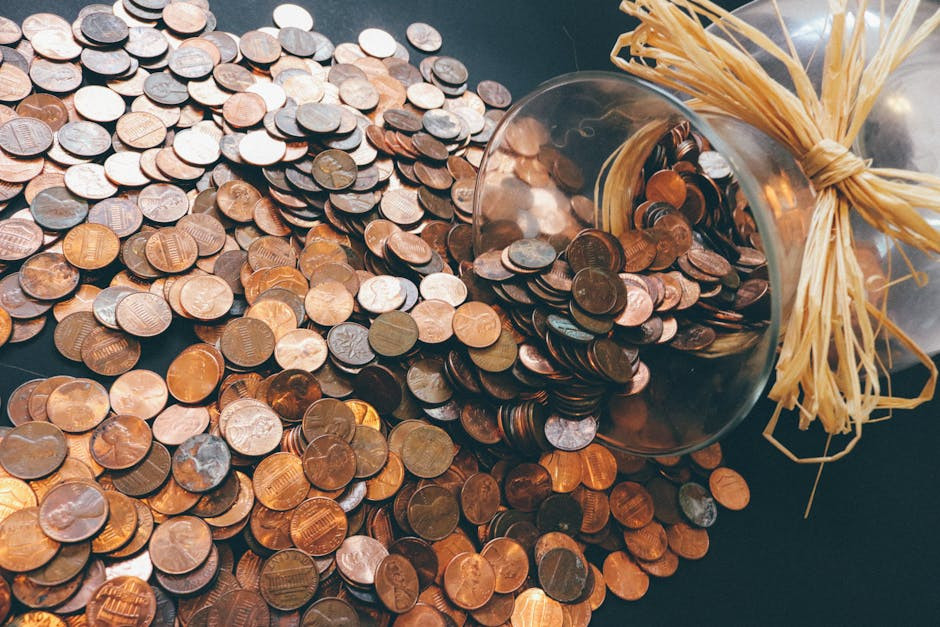
That Jar of Pennies on Your Shelf Could Be Worth More Than You Think
The penny values chart 1959 to 2011 shows that most Lincoln Memorial cents are worth face value in circulated condition — but a small number of dates and varieties can be worth hundreds or even thousands of dollars.
Here's a quick reference to get you started:
| Category | Typical Value Range |
|---|---|
| Common circulated penny (1959-2011) | Face value to $0.30 |
| Common Mint State (MS60-MS64 RD) | $0.50 - $5 |
| High-grade gem (MS65-MS67 RD) | $10 - $600 |
| Key date varieties (DDO, Wide AM, etc.) | $25 - $4,000+ |
| Ultra-rare errors (1969-S DDO, 1990-S No S) | $4,000 - $605,000 |
The story of these coins is fascinating. When the Lincoln Memorial reverse design debuted on February 12, 1959 — the 150th anniversary of Lincoln's birth — nobody imagined that some of those brand-new pennies would one day sell for more than a car. Designer Frank Gasparro's reverse even includes a tiny statue of Lincoln inside the memorial, meaning Lincoln technically appears on both sides of the coin.
Over the next 52 years, billions of pennies poured out of the Philadelphia, Denver, and San Francisco mints. Most are worth exactly one cent. But hidden among them are doubled dies, composition errors, and spacing varieties that serious collectors actively hunt for.
This guide breaks it all down — condition by condition, year by year.
The 1982 Composition Shift: Copper vs. Zinc
If you want to understand the penny values chart 1959 to 2011, you have to start with the year 1982. This was a "transitional year" that changed the penny forever. Before 1982, pennies were made of 95% copper and 5% zinc (often called bronze). These "copper pennies" weigh 3.11 grams.
However, as the price of copper rose, the U.S. Mint realized it was costing more than a cent to make a cent! In 1982, they switched the composition to 97.5% zinc with a very thin copper plating. These "zinc pennies" weigh only 2.5 grams.
While it is currently illegal to melt these coins for their metal content, many "metal heads" and survivalist collectors hoard pre-1982 pennies because their copper melt value is often nearly three times their face value. A $25 box of copper pennies can have a raw metal value of $35 to $45!
The most exciting part of this shift is the 1982-D Small Date bronze transitional error. In 1982, the Mint used both Large Date and Small Date hubs. While billions of zinc pennies were made in both styles, only one 1982-D Small Date struck on a copper planchet (the 3.11g version) was discovered years later. That single coin sold for a staggering $18,800 in 2017!
You can find more details on these variations in our Lincoln Penny Key Dates & Values (1959-Present) guide.
1982 Variety Comparison Table
| Variety | Composition | Weight | Estimated Value (Uncirculated) |
|---|---|---|---|
| 1982-P Large Date | Copper | 3.11g | $0.20 - $0.50 |
| 1982-P Small Date | Copper | 3.11g | $0.50 - $2.00 |
| 1982-D Large Date | Copper | 3.11g | $0.20 - $0.50 |
| 1982-D Small Date | Copper | 3.11g | $10,000+ (Extreme Rarity) |
| 1982-P Large Date | Zinc | 2.50g | $0.10 - $0.30 |
| 1982-P Small Date | Zinc | 2.50g | $0.10 - $0.30 |
| 1982-D Large Date | Zinc | 2.50g | $0.10 - $0.30 |
| 1982-D Small Date | Zinc | 2.50g | $0.10 - $0.30 |
Penny Values Chart 1959 to 2011: Standard vs. Mint State
When we look at the penny values chart 1959 to 2011, we see a massive divide between coins that have been rattling around in pockets and those that were tucked away in mint sets.
Most pennies you find in circulation from the Philadelphia (no mint mark), Denver (D), or San Francisco (S) mints are worth exactly one cent. However, if you find a coin that looks like it just popped out of the mint—with full "Red" (RD) luster and no scratches—the value starts to climb.
For example, a standard 1959-P penny in average condition is worth face value. But in a high grade like MS67 RD, that same penny can fetch $600 or more. If you're lucky enough to find a "perfect" MS69 or MS70 specimen, the price can skyrocket into the thousands because collectors competing for "Registry Sets" need the highest possible grade to win.
For real-time market updates on these high-end grades, we recommend checking the Lincoln Cent (Modern) (1959 to Date) Values - PCGS Price Guide.
Understanding the Penny Values Chart 1959 to 2011 for Circulated Coins
If you are sorting through a jar of "pocket change," you are looking at "circulated" coins. These are graded as Good (G), Fine (F), or Extremely Fine (XF). In these conditions, almost every penny from 1959 to 2011 is worth face value to $0.05.
The exceptions are early dates with specific mint marks. A 1960-D Small Date or a 1970-S Small Date in nice condition might be worth $0.10 to $0.50 to a collector filling a hole in their album. While that's not "retirement money," it is still 10 to 50 times the coin's face value!
High-Grade Gems in the Penny Values Chart 1959 to 2011
What makes a penny a "gem"? It’s all about the "Red" (RD) designation. When pennies are first minted, they have a bright, orange-red glow. Over time, oxygen turns them "Red-Brown" (RB) and eventually "Brown" (BN).
In the penny values chart 1959 to 2011, a 1959-P RD in MS66 condition is a beautiful coin worth about $25. But if that same coin is graded MS67+ RD, the price jumps to $3,000 because so few survived in that pristine state.
The 2009 Bicentennial pennies (featuring four different designs for Lincoln's 200th birthday) and the 2010 Shield Reverse pennies are also highly sought after in MS67 or higher grades. Because these were minted in the billions, only the absolute "best of the best" carry a premium.
Key Dates and Rare Varieties Worth Thousands
This is where the real treasure hunting begins. The "Key Dates" of the modern era aren't usually defined by low mintage, but by major errors known as "Doubled Dies."
A doubled die occurs when the coin die is struck twice by the hub at slightly different angles. This creates a clear "doubling" effect on the letters or numbers.
- 1969-S Doubled Die Obverse (DDO): This is the "Holy Grail" of modern pennies. You can see clear doubling on "LIBERTY" and "IN GOD WE TRUST." A high-grade MS70 RD specimen of this coin holds a record auction price of $605,000! Even in lower uncirculated grades, it is worth $30,000+.
- 1972 Doubled Die Obverse: One of the most famous errors. The doubling is so strong you can see it with the naked eye. In Mint State (MS65), these are worth about $700 to $1,000.
- 1983 Doubled Die Reverse (DDR): Check the back of your 1983 pennies! Look at the words "ONE CENT" and "E PLURIBUS UNUM." If they look doubled, you have a coin worth $400 to $500 in Mint State.
- 1984 Doubled Ear: Look at Lincoln’s ear. If he appears to have two earlobes, you’ve found a variety worth about $200.
- 1995-P Doubled Die Obverse: A more modern find. The doubling is most visible on the word "LIBERTY." These are common enough that you might actually find one in change, worth about $25 to $50.
- 1990-S No Mint Mark Proof: This is a major rarity. Proof coins are made for collectors and should have an "S" mint mark. A small number of 1990 proof sets were released without the "S." These are worth roughly $4,000.
Identifying Valuable Spacing and Date Errors
Beyond doubled dies, collectors look for "spacing" errors on the reverse of the coin. This involves the distance between the "A" and the "M" in "AMERICA."
- Wide AM vs. Close AM: On most pennies from 1998, 1999, and 2000, the "A" and "M" should be almost touching (Close AM). If there is a wide gap (Wide AM), the coin was struck with a proof die by mistake. The 1999 Wide AM is the most valuable of these, worth around $500 in high grade.
- 1992-D Close AM: This is the opposite error. In 1992, the "A" and "M" should have a wide gap. If they are touching, you’ve found a rarity worth $500 to $1,000.
- 1960 Small Date vs. Large Date: In 1960, the Philadelphia and Denver mints changed the size of the digits in the date mid-year. The "Small Date" is scarcer. A 1960-D Small Date over Large Date (an overdate error) can be worth $200 to $500.
At Coins Online LLC, we’ve been helping collectors identify these subtle differences since 1999. More info about our expertise can be found on our about page, where we detail our history in the numismatic industry.
How Condition and Color Affect Market Price
If you look at any penny values chart 1959 to 2011, you will see three sets of prices for uncirculated coins: RD, RB, and BN.
- Red (RD): The coin retains 95% or more of its original mint orange-red color. These are the most valuable.
- Red-Brown (RB): The coin has begun to tarnish, showing between 5% and 95% red color.
- Brown (BN): The coin has less than 5% red color remaining. These are generally the least valuable for modern collectors.
We use the Sheldon Scale (1 to 70) to determine exact value. A coin that is an MS63 (Mint State 63) might be worth $1, while an MS67 of the same year could be worth $100. Professional grading services like PCGS or NGC are the industry standards for authenticating these grades. Strike quality (how sharp the details are) and luster (how the light dances off the surface) are the two biggest factors we look for when evaluating a coin's potential.
Frequently Asked Questions about Modern Pennies
Which 1982 penny is the most valuable?
The most valuable 1982 penny is the 1982-D Small Date struck on a copper planchet. Because the mint was transitioning to zinc, a few copper planchets were accidentally fed into the machines using the new Small Date dies. If your 1982-D Small Date weighs 3.11 grams on a digital scale, you've found a coin worth over $10,000!
Are pennies from 1959 to 2011 still worth only one cent?
In circulated condition, yes—most zinc pennies (post-1982) are only worth face value. However, pre-1982 copper pennies have a "melt value" of about 2.5 to 3 cents. Furthermore, high-grade MS65 specimens and rare varieties like the 1972 or 1983 doubled dies are worth significantly more than their one-cent face value.
What is a 1990-S No Mint Mark penny?
This is a rare error found in 1990 Prestige Proof Sets. All proof pennies minted in San Francisco should have an "S" mint mark. Due to a mistake at the mint, a few dies were prepared without the "S." These coins are currently valued at approximately $4,000 in PR65 condition.
Conclusion
Whether you are a casual hobbyist or a serious investor, the penny values chart 1959 to 2011 proves that there is still "gold" to be found in your pocket change. From the high copper content of the early years to the rare doubled dies of the 80s and 90s, every penny has a story.
At Coins Online LLC, we are proud to be a part of your collecting journey. Since 1999, we have offered competitive prices, low shipping, and a massive inventory of over 5,000 products, including US state quarters, silver coins, and essential collecting supplies. We offer a 14-day return policy to ensure you are always happy with your investment.
Contact us for coin appraisals or to find that missing piece for your collection. Happy hunting!
Recent Posts
-

Walking Liberty Half Dollar Value Guide: Key Dates, the 1921 Problem, and What Yours Is Really Worth
Ask a room full of collectors to name the most beautiful U.S. coin and the Walking Liberty half doll
-
The 2026 Semiquincentennial Proof Set: What's in It, Why It Costs $107, and Whether to Buy One
On October 6 at noon Eastern, the U.S. Mint puts the 2026 Semiquincentennial Proof Set on sale at $1