The Hidden History of State Quarter Symbols and Landmarks
What the West Virginia Bridge on the State Quarter Really Represents
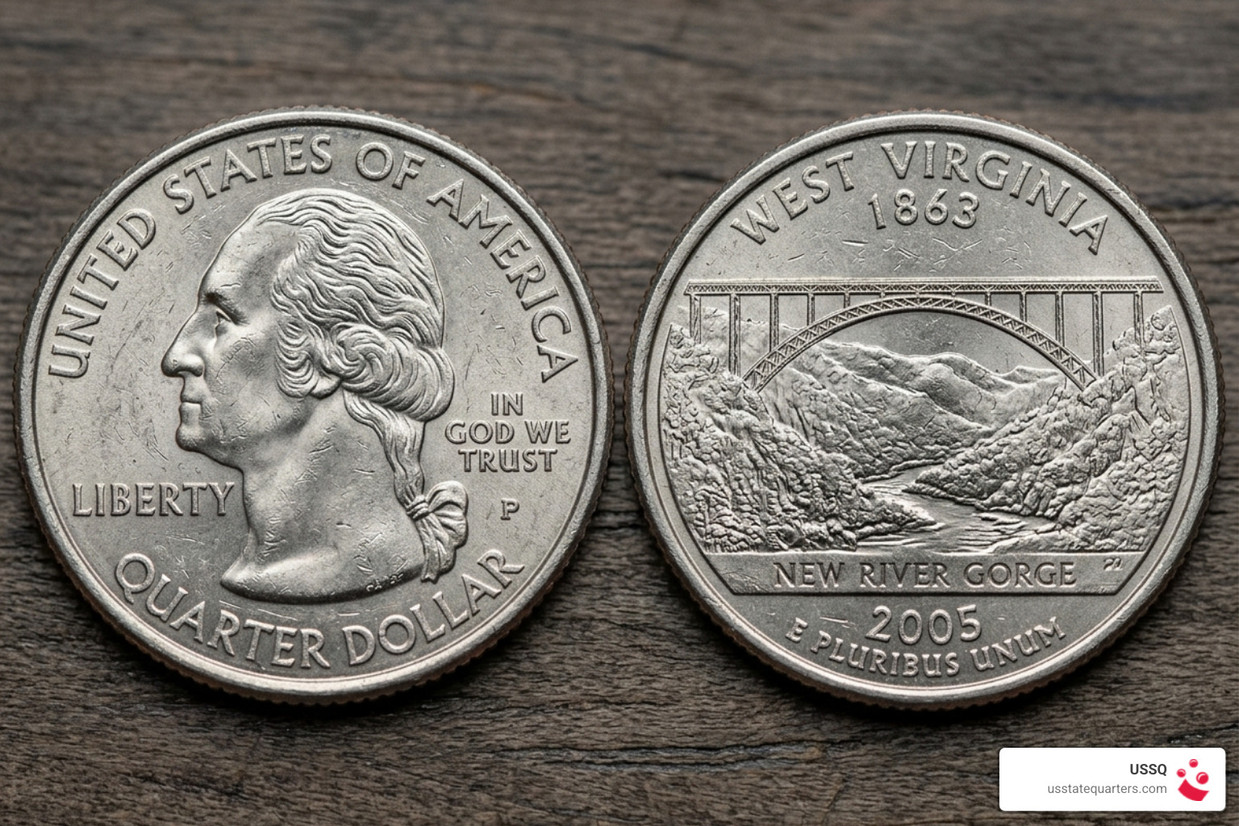
The west virginia bridge depicted on the 2005 West Virginia Statehood Quarter is one of the most recognizable landmarks ever featured on a U.S. coin — the New River Gorge Bridge, a steel arch spanning 1,700 feet above one of America's oldest rivers.
Here's a quick overview of what makes this landmark so significant:
| Feature | Detail |
|---|---|
| Bridge type | Steel arch |
| Height above river | 876 feet (267 m) |
| Total length | 3,030 feet (924 m) |
| Opened | October 22, 1977 |
| Travel time saved | 45 minutes → 45 seconds |
| Daily traffic | 16,200 vehicles |
| National recognition | National Register of Historic Places (2013) |
For coin collectors, the West Virginia quarter isn't just a pretty design. It's a window into a state shaped — literally and historically — by its bridges.
West Virginia is sometimes called "the land of bridges." With roughly 6,636 state-maintained bridges crossing rugged mountain terrain, bridges aren't just infrastructure here. They're the reason communities exist at all.
As historian Dr. Emory Kemp once noted, bridge construction in West Virginia must be understood as part of "a society bent on internal improvements, expansion and the exploitation of the nation's natural resources." That context makes the quarter's design far more meaningful than most collectors realize.
This guide unpacks the full story — the engineering, the history, the disasters, and the culture — behind West Virginia's most iconic spans.
The Engineering Marvel of the New River Gorge West Virginia Bridge
When we look at the 2005 West Virginia State Quarter, we are seeing more than just a bridge; we are viewing a masterpiece of 20th-century engineering. Located near Fayetteville, the New River Gorge Bridge is the centerpiece of the New River Gorge National Park & Preserve.
Designed by the Michael Baker Company and constructed by the American Bridge Division of U.S. Steel, this west virginia bridge was a massive undertaking. One of its most distinctive features is the use of COR-TEN steel. This "weathering" steel was chosen because it develops a natural, rust-like protective coating over time. This not only allows the bridge to blend into the rugged Appalachian landscape but also eliminates the need for costly, repetitive painting.
Standing 876 feet above the rushing New River, it held the title of the world's highest vehicular bridge for many years and remains the third-highest in the United States. Its total length of 3,030 feet makes it a giant among giants, and in 2013, it was officially listed on the National Register of Historic Places—an incredible feat for a structure that was only 36 years old at the time.
Construction Feats and the New River Gorge West Virginia Bridge
The construction of this west virginia bridge was a logistical puzzle solved 800 feet in the air. The most impressive part of the design is the single 1,700-foot long arch span. During construction, massive trolleys on cables were used to move pieces into place until the two sides of the arch finally met in the middle of the gorge.
The sheer scale is hard to wrap your head around: the bridge weighs a staggering 88 million pounds. However, for the locals, the most important number isn't the weight—it's the time. Before the bridge opened on October 22, 1977, crossing the gorge required a white-knuckle 45-minute drive down narrow, winding mountain roads. Today, that trip takes just 45 seconds.
This project was a major component of "Corridor L," a highway project funded in part by the Appalachian Regional Commission to boost the economy of a region that had seen a decline in the coal industry. By connecting these once-isolated communities, the New River Gorge Bridge became a literal and figurative lifeline for the state.
Historical Significance of the West Virginia Bridge Network
West Virginia’s geography is a beautiful but difficult terrain of steep mountains and deep valleys. This rugged landscape is the reason the state maintains approximately 6,636 bridges. In the early pioneer days, "bridges" were often just felled trees or crude rafts. As the state grew, the need for permanent structures became vital for resource exploitation—getting timber and coal out of the mountains and into the hands of the growing nation.
To understand how far we've come, it's helpful to look at the evolution of these spans.
| Feature | New River Gorge Bridge | Wheeling Suspension Bridge |
|---|---|---|
| Completion Year | 1977 | 1849 |
| Main Span Length | 1,700 feet | 1,010 feet |
| Material | COR-TEN Steel | Wire Cable / Iron |
| Primary Purpose | Modern Highway (US 19) | National Road Extension |
| Record Held | Longest steel arch (1977-2003) | World's longest suspension (1849-1851) |
Beyond the Quarter: Iconic Spans and Historical Lessons
While the New River Gorge Bridge gets the most fame, West Virginia is home to several other historically significant spans that have shaped American history and law.
The Wheeling Suspension Bridge, designed by Charles Ellet Jr., is a prime example. Completed in 1849, it was the first bridge to span a major river west of the Appalachian Mountains. It was a critical link for the National Road, the first major improved highway in the U.S. built by the federal government.
This bridge was so significant it even led to Supreme Court litigation. Nearby cities argued that the bridge was a nuisance because it blocked tall steamboats from passing underneath. The legal battles that followed helped establish federal authority over navigable waters. During the Civil War, the bridge was a strategic asset for Union forces, and today it remains the oldest vehicular suspension bridge still in use in the United States.
The Silver Bridge Collapse and Safety Evolution
Not all bridge history in West Virginia is celebratory. One of the most somber chapters in American engineering history occurred at Point Pleasant. The Silver Bridge—so named for its aluminum paint—was an eyebar chain suspension bridge that opened in 1928.
On December 15, 1967, during the height of rush hour, the bridge collapsed into the Ohio River in less than 20 seconds. The disaster claimed 46 victims and sent 32 vehicles into the icy water. An investigation by the NTSB found that a tiny cleavage fracture in a single eyebar (eyebar 330) had caused the entire structure to fail. The fracture was caused by stress corrosion and corrosion fatigue—phenomena that were largely unknown to rural bridge engineers in the 1920s.
This tragedy changed everything. It led to the creation of the National Bridge Inspection Standards and the first federal requirements for bridge safety inspections across the entire United States. While the loss was immense, the lessons learned from the Silver Bridge continue to keep us safe on the road today.
Modern Infrastructure: The Robert C. Byrd Bridge
Moving into the modern era, the Robert C. Byrd Bridge in Huntington represents the next generation of West Virginia infrastructure. Opened on November 6, 1994, this continuous truss bridge crosses the Ohio River, connecting Huntington to Chesapeake, Ohio.
The project cost $32.6 million, with the majority of the funding secured by U.S. Senator Robert C. Byrd. It replaced an aging 1926 bridge that featured distinctive gothic-style spires. In a nod to local history, those original 2-ton spires were saved during the old bridge's demolition and are now displayed as public monuments in both Chesapeake and Huntington.
Bridge Day and the Culture of West Virginia Tourism
Bridges in West Virginia aren't just for cars; they are for daredevils, too! Every third Saturday in October, the New River Gorge Bridge shuts down to traffic for "Bridge Day," the state's largest single-day festival.
According to Official Bridge Day Information, the event attracts hundreds of thousands of spectators. It is the only day of the year when pedestrians are allowed to walk across the bridge. The highlights of the day are the extreme sports:
- BASE Jumping: In 2023, 341 jumpers from 35 states and 4 countries made over 700 jumps from the bridge deck into the gorge 876 feet below.
- Rappelling: Hundreds of participants rappel from the bridge’s catwalk.
- High Line: A zip-line like experience from the bridge to the Fayette Station Road below.
This event has a massive economic impact on Fayette County and has turned the west virginia bridge into a global icon for adventure tourism.
Walking the Catwalk: The Bridge Walk Experience
If jumping off a bridge sounds a bit too intense, there is a middle ground. Bridge Walk Tours offers a unique way to see the structure from the inside out. Visitors are strapped into a safety cable and led on a 2.5-hour guided tour along the 24-inch wide maintenance catwalk located 25 feet beneath the bridge deck.
From this vantage point, you get panoramic views of the New River and the Appalachian mountains that you simply can't get from a car. It is a one-of-a-kind experience that highlights the bridge as the centerpiece of the National Park.
Innovative Engineering in the Mountain State
West Virginia continues to be a testing ground for new engineering technologies. A perfect example is the Robert C. Beach Bridge (formerly the West Buckeye Bridge) in Monongalia County.
Completed in 2004, this bridge is believed to be the world’s longest three-hinge timber arch bridge. It utilizes a fiber-reinforced polymer deck and a glue-laminated timber arch. Developed in cooperation with West Virginia University wood technology researchers, it proves that "the land of bridges" is still finding new ways to cross old gaps.
Historic Preservation of the Great Cacapon Bridge
Preservation is just as important as innovation. The Great Cacapon Bridge in Morgan County is a Parker through truss bridge built in 1937. Constructed with New Deal funding following a devastating flood, it represents the resilience of West Virginians during the Great Depression.
Recently dedicated as the Thurman W. Whisner Memorial Bridge, it was added to the National Register of Historic Places in 2025. Even as the state conducts studies for its eventual replacement, the bridge stands as a testament to the era of rolled steel girders and the engineering standards of the mid-20th century.
Frequently Asked Questions about West Virginia Bridges
How high is the New River Gorge Bridge?
The bridge stands 876 feet (267 meters) above the New River. This makes it the third-highest vehicular bridge in the United States and one of the highest in the world.
What caused the Silver Bridge to fall?
The collapse was caused by a cleavage fracture in a single eyebar (number 330) of the suspension chain. This was due to stress corrosion and corrosion fatigue, which were undetectable at the time. The 1967 disaster led to the implementation of modern national bridge inspection standards.
Can you walk across the New River Gorge Bridge?
Generally, no. The bridge carries four lanes of high-speed traffic on US Route 19. However, on "Bridge Day" (the third Saturday of October), the bridge is closed to vehicles, and pedestrians are allowed to walk across and watch BASE jumping events.
Conclusion
At USSQ and Coins Online LLC, we believe that every coin tells a story. The west virginia bridge on the 2005 state quarter isn't just a symbol of a road; it’s a symbol of human ingenuity, historical progress, and the unbreakable spirit of the Mountain State. Whether you are a seasoned numismatist or just starting your collection, understanding the engineering and history behind these landmark symbols adds a layer of value that goes far beyond the face value of the coin.
Since 1999, we have been proud to offer a massive selection of over 5,000 products, including these iconic state quarters. If you are looking to Explore the full US State Quarters catalog or need More info about state quarter collections, we are here to help. Our competitive prices, low shipping, and 14-day return policy ensure that your collecting experience is as smooth as a 45-second drive across the New River Gorge.
If you have questions about specific minting errors or rare finds, Contact us for rare coin inquiries. Happy collecting!
Recent Posts
-

Walking Liberty Half Dollar Value Guide: Key Dates, the 1921 Problem, and What Yours Is Really Worth
Ask a room full of collectors to name the most beautiful U.S. coin and the Walking Liberty half doll
-
The 2026 Semiquincentennial Proof Set: What's in It, Why It Costs $107, and Whether to Buy One
On October 6 at noon Eastern, the U.S. Mint puts the 2026 Semiquincentennial Proof Set on sale at $1