Rare Sacagawea dollar coins that are actually worth a fortune
One Dollar Face Value, Potentially Worth a Fortune: What You Need to Know
Rare Sacagawea dollar coins are some of the most exciting finds in modern American numismatics — and a handful of them have sold at auction for tens of thousands of dollars.
Most Sacagawea dollars are worth exactly $1. But a small number of specific varieties, errors, and special strikes are genuinely valuable. Here's a quick look at the most important ones:
| Coin | Why It's Rare | Approximate Value |
|---|---|---|
| 2000-P Cheerios Dollar | Prototype reverse die, only 5,500 made | $5,000 – $25,000+ |
| 2000-P Goodacre Presentation | Burnished planchet, 5,000 struck | $500 – $5,000+ |
| 2000-P Wounded Eagle | Die gouge variety, fewer than 200 known | $1,000 – $5,000+ |
| 2000-P/Washington Quarter Mule | Wrong die pairing error | $100,000+ |
| 2007 Edge Lettering Error | Only 1 known example | $17,000+ |
| 2000-W Gold Proof | Only 12 survived, space-flown | Extremely rare |
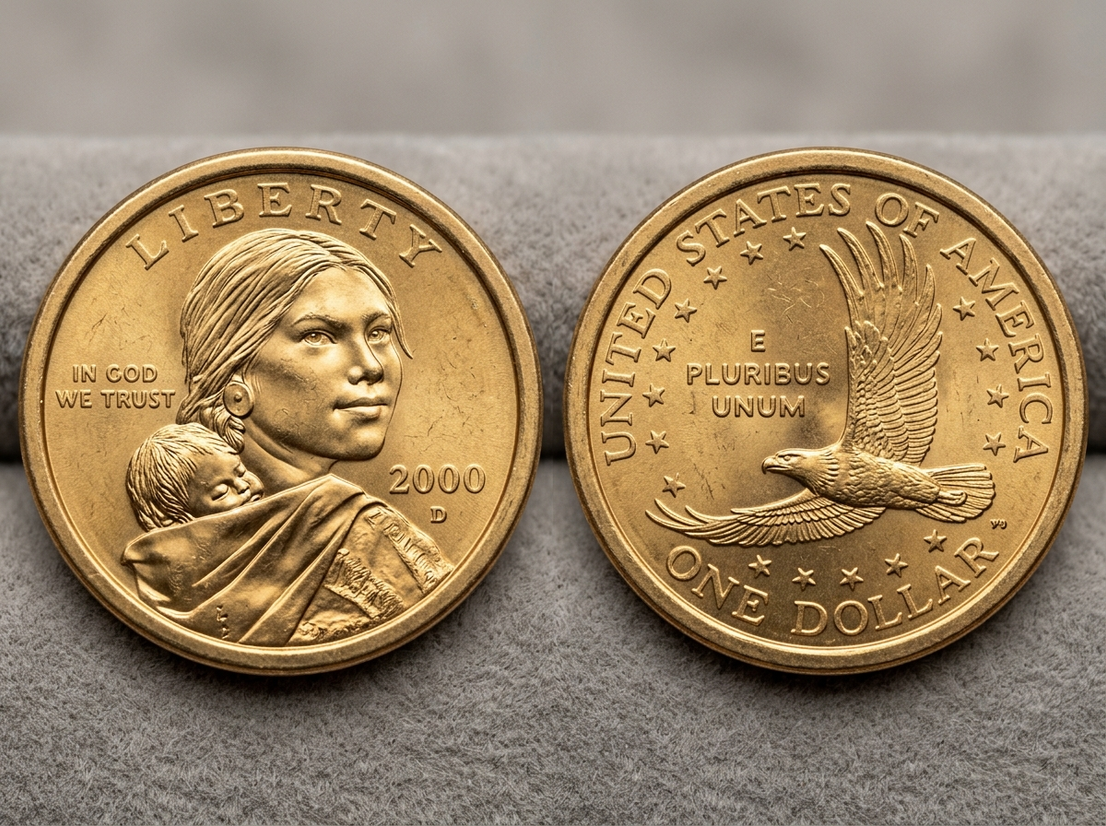
The Sacagawea dollar was introduced in 2000, designed by sculptor Glenna Goodacre. The obverse shows Sacagawea — the Shoshone guide who helped Lewis and Clark — carrying her infant son Jean Baptiste. The reverse, by Thomas D. Rogers, features a soaring bald eagle. The coin's distinctive golden color comes from its manganese-brass outer layer.
While nearly 800 million 2000-P Sacagawea dollars were struck for circulation, certain die varieties, production errors, and limited special issues slipped through the process in tiny numbers. Those are the ones collectors hunt for today.
This guide covers exactly which coins are worth finding, how to identify them, and what they're actually selling for right now.
The History and Design of the Golden Dollar
The journey of the Sacagawea dollar began with the Dollar Coin Act of 1997. The U.S. Mint was looking for a fresh start after the Susan B. Anthony dollar failed to gain traction with the public. To ensure this new coin didn't meet the same fate, the Mint gave it a distinct "golden" color and a smooth, plain edge to distinguish it from the reeded edge of a quarter.
The design process was a historic event. For the first time, the public played a major role in choosing the theme. After consulting with historians and Native American representatives, the Mint selected Sacagawea, the Shoshone woman who provided invaluable guidance to the Lewis and Clark expedition. Sculptor Glenna Goodacre used a Shoshone college student, Randy'L He-dow Teton, as her model for the portrait. On Sacagawea’s back is her infant son, Jean Baptiste, wrapped in a traditional Hidatsa sling.
The reverse, designed by Thomas D. Rogers Sr., features a soaring bald eagle surrounded by 17 stars. These stars aren't just for decoration—they represent the 17 states in the Union at the time of the Lewis and Clark expedition in 1804.
While the coins look like gold, they are actually a complex alloy. The core is pure copper, but the outer layers are manganese brass. This specific mix gives the coins their luster, but it also causes them to develop a dark, antique patina over time when they circulate.
Circulation vs. Proof: A Quick Comparison
When we look at rare sacagawea dollar coins, it is vital to understand the difference between standard business strikes and collectors' versions.
| Feature | Circulation (Business) Strike | Proof Finish |
|---|---|---|
| Purpose | Intended for daily spending | Created specifically for collectors |
| Appearance | Satin-like or matte luster | Mirror-like backgrounds with frosted details |
| Mintage | Often in the hundreds of millions | Usually limited to 2-3 million or less |
| Mint Marks | P (Philadelphia) or D (Denver) | S (San Francisco) |
What Makes Certain Rare Sacagawea Dollar Coins So Valuable?
If you find a Sacagawea dollar in your change today, the odds are high that it’s worth exactly one dollar. In the year 2000 alone, the Philadelphia mint struck a staggering 767,140,000 coins. With that many in existence, why are some worth a fortune?
Rarity in this series usually boils down to three things: mintage numbers, die varieties, and minting errors.
- Low Mintage Years: After the initial excitement in 2000 and 2001, demand plummeted. By 2002, the Mint stopped producing these for general circulation, making only enough for collector sets. Years like 2002 through 2008 have much lower survival estimates in high grades.
- Experimental Rinse: Early in the production of the 2000-P coins, the Mint experimented with an anti-tarnish rinse to keep the coins from turning brown. The experiment failed, often leaving the coins with a streaky, uneven appearance. These "experimental rinse" coins are now prized by error collectors as unique historical novelties.
- Condition Grading: Because these coins are made of a soft manganese-brass alloy, they scratch easily. Finding a coin in "Mint State 68" (MS68) or higher is incredibly difficult. For example, while a standard 2001-D is common, a certified MS68 example is very scarce, with fewer than 200 known to exist.
The Most Valuable rare sacagawea dollar coins in Existence
Now we get to the "treasure hunt" portion of our guide. There are a few specific varieties that have become legends in the coin-collecting community.
The 2000-P "Cheerios" Dollar
This is perhaps the most famous of all rare sacagawea dollar coins. In late 1999, the U.S. Mint partnered with General Mills to promote the new "Golden Dollar." They placed 5,500 Sacagawea dollars inside boxes of Cheerios cereal.
For years, people thought these were just standard coins. However, in 2005, a collector named Pat Braddick noticed a difference. The "Cheerios" coins were struck using a prototype reverse die. If you look at the eagle’s tail feathers on a Cheerios dollar, the detail is incredibly sharp and crisp, featuring 12 distinct tail feathers with heavy veins. Standard circulation coins have much softer detail. Today, a Cheerios dollar can sell for anywhere from $5,000 to over $25,000 depending on its condition.
Goodacre Presentation Specimens
When Glenna Goodacre won the competition to design the coin, she requested her $5,000 commission be paid in the coins she designed. The Mint complied but went the extra mile. They struck 5,000 Goodacre Presentation specimens on specially burnished (polished) planchets. These coins have a distinct, glossy, proof-like finish. Most were originally authenticated and "slabbed" by a grading service to preserve their pedigree. They are highly sought after, with top-tier examples reaching over $5,000 at auction.
The "Wounded Eagle" Variety
This is a "die variety" caused by a damaged coin die. On a small number of 2000-P coins, there are raised die gouges that look like a spear or arrow running through the eagle’s belly. It’s estimated that fewer than 200 of these exist. Because the lines are raised (meaning they were part of the die), they are easy to distinguish from simple scratches, which are always sunken into the metal. A high-grade "Wounded Eagle" sold in 2017 for an impressive $5,160.
The Millennium Set (2000-D)
In 2000, the Mint released a limited-edition Millennium Set (only 75,000 produced). It contained a 2000-D Sacagawea dollar, a silver eagle, and a dollar bill. Collectors later discovered that the Sacagawea dollars in these sets had a unique "Prooflike" finish, making them much more brilliant than the standard Denver-minted coins found in change.
The 2000-P/Washington Quarter Mule: A rare sacagawea dollar coins Holy Grail
In coin collecting, a "mule" is a coin struck with two dies that were never intended to be paired together. The Sacagawea/Washington Quarter Mule is the king of modern errors.
Discovered in 2000 by Frank Wallis, this coin features the obverse (front) of a Sacagawea dollar and the reverse (back) of a Washington Statehood quarter. It is a spectacular mistake that should never have left the Mint. One of these incredible errors sold for a record-breaking $144,000 in 2022. There is also a 2000-D version paired with a South Carolina quarter reverse, which sold for $66,000. These are the "Holy Grails" for anyone searching through rare sacagawea dollar coins.
The 2009-D Edge Lettering and Other rare sacagawea dollar coins Errors
In 2009, the series transitioned into the Native American $1 Coin Program, where the reverse design changes every year. A major change was that the date and mint mark were moved from the face of the coin to the edge.
However, some 2009 coins were released without edge lettering. These "blank edge" errors are very popular. Even more bizarre is the 2007 Sacagawea dollar found with edge lettering. Since edge lettering didn't officially start until 2009, this 2007 coin (of which only one is known) is a massive rarity that sold for over $17,000.
Other errors to watch for include:
- Wrong Planchet Strikes: Sacagawea dollars struck on Susan B. Anthony dollar planchets or even quarter planchets.
- Off-Metal Strikes: Coins struck on the wrong metal composition.
- Double Dies: Where the image appears doubled due to a mistake in the die-making process.
5 Steps to Identifying Rare Varieties in Your Change
Think you might have found one of these rare sacagawea dollar coins? Don't spend it just yet! Grab a magnifying glass and follow these five steps to verify your find.
- Count the Tail Feathers: If you have a 2000-P, look at the eagle’s tail. Are the feathers smooth (common), or do they have sharp, detailed veins? If they are detailed, you might have a "Cheerios" dollar.
- Inspect the Eagle’s Breast: Use a 10X loupe to look for a raised line (a "spear") running through the eagle. If the line is sunken into the coin, it’s just a scratch. If it's raised, it's a "Wounded Eagle."
- Check the Edge: For coins dated 2000–2008, the edge should be smooth. If you find a 2007 with lettering on the edge, you've hit the jackpot. For coins dated 2009 and later, check to see if the edge lettering is missing entirely.
- Look for "Mules": It sounds simple, but check both sides! Does the front look like Sacagawea but the back look like a Washington quarter? It’s rare, but it happens.
- Verify the Luster: Does the coin have a "prooflike" or "burnished" appearance that looks significantly better than other coins? It could be a Millennium Set coin or a Goodacre Presentation piece.
If your coin passes these tests, the next step is professional authentication. We always recommend having high-value errors certified by a third-party grading service like PCGS or NGC. If you're unsure where to start, contact our experts at Coins Online LLC for guidance.
Frequently Asked Questions about Rare Sacagawea Dollars
Is the 2009-D "No Date on Front" dollar a rare error?
We get this question a lot! If you see a 2009 Sacagawea dollar and notice there is no date on the front, don't worry—it’s not an error. Starting in 2009, the U.S. Mint moved the date, mint mark, and the motto "E Pluribus Unum" to the edge of the coin. This was part of the new design for the Native American $1 Coin Program. While these coins are beautiful, a standard 2009-D is generally worth only its face value unless it is in perfect, uncirculated condition.
What is the rarest Sacagawea dollar ever found?
In terms of coins available to the public, the 2000-P/Washington Quarter Mule and the 2007 Edge Lettering Error are among the rarest. However, the absolute "rarest" are the 2000-W Gold Proofs. The Mint struck 39 of these in 22-karat gold. Twelve of them actually flew on the Space Shuttle Columbia! After they returned to Earth, they were sent to Fort Knox for storage. These are not legal for public ownership, but they remain a fascinating piece of numismatic history.
How much is a 2000-P Wounded Eagle worth?
The value depends entirely on the grade (condition). A circulated "Wounded Eagle" might sell for a few hundred dollars. However, if the coin is in pristine condition, the price skydives upward. The auction record for an MS68 example is $5,160. Because there are fewer than 200 known, they rarely come up for sale. You can learn more about our collection and how we track these market trends to help our customers.
Conclusion
At Coins Online LLC, we’ve been immersed in numismatics since 1999. We’ve seen the excitement of the "Golden Dollar" launch and helped countless collectors navigate rare sacagawea dollar coins. Whether you are looking for a "Wounded Eagle" to complete your set or you're just starting out with US state quarters, we are here to help.
We pride ourselves on offering competitive prices, low shipping rates, and a 14-day return policy to ensure you are happy with every addition to your collection. We ship throughout the United States and Canada, bringing over 5,000 products right to your doorstep.
Ready to find your next treasure? Browse our rare sacagawea dollar coins inventory today and see what's in store! Happy hunting!
Recent Posts
-

Walking Liberty Half Dollar Value Guide: Key Dates, the 1921 Problem, and What Yours Is Really Worth
Ask a room full of collectors to name the most beautiful U.S. coin and the Walking Liberty half doll
-
The 2026 Semiquincentennial Proof Set: What's in It, Why It Costs $107, and Whether to Buy One
On October 6 at noon Eastern, the U.S. Mint puts the 2026 Semiquincentennial Proof Set on sale at $1