The Truth About the Sacagawea Silver Dollar Coin and Other Special Editions
The Cereal Box Coin That Became a Numismatic Legend
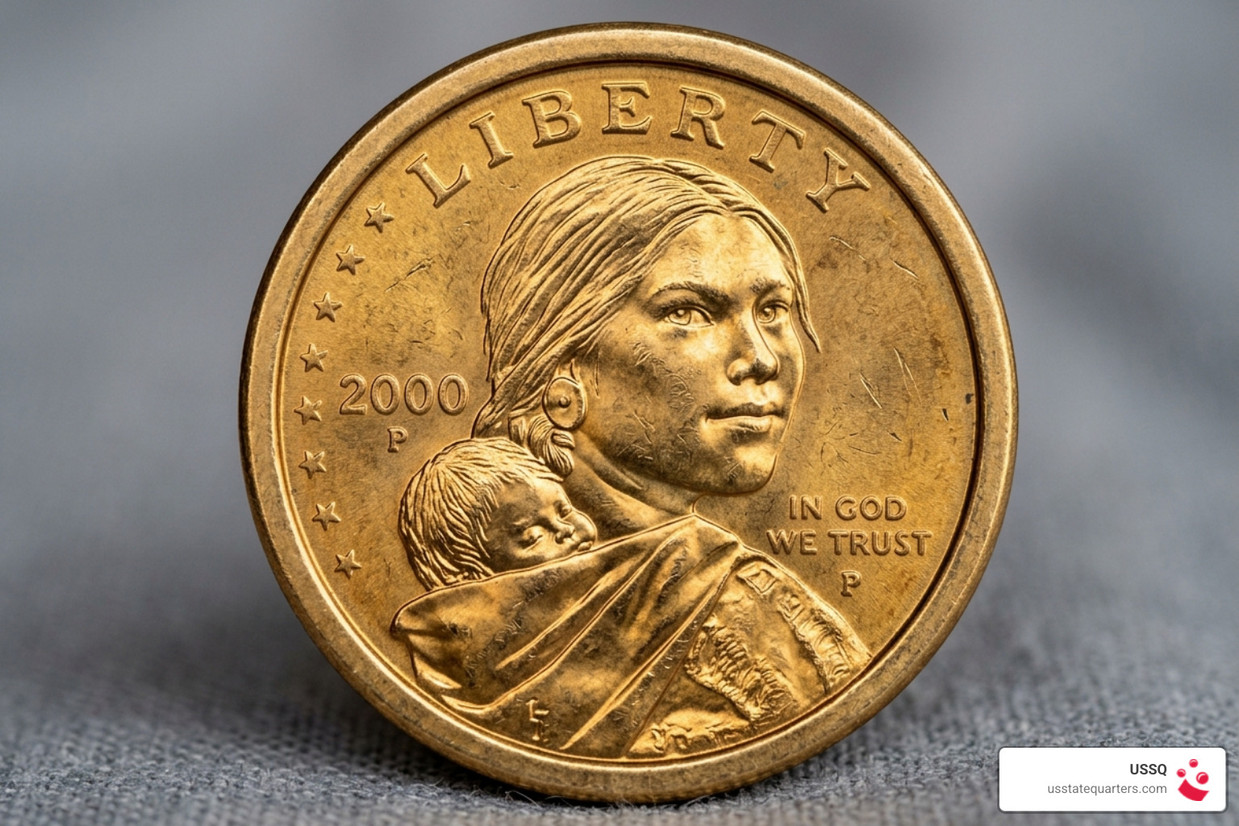
The sacagawea one dollar coin cheerios is one of the most exciting discoveries in modern coin collecting — a rare prototype dollar that was quietly slipped into boxes of breakfast cereal in early 2000, only for collectors to realize five years later that some of those coins were worth thousands of digits. At US State Quarters, we've helped collectors identify these rarities for decades.
Here's the quick answer:
- What it is: A 2000-P Sacagawea Dollar included in ~5,500 boxes of Cheerios cereal as a U.S. Mint promotion
- What makes it rare: Some coins were struck from prototype dies with sharply detailed eagle tail feathers — different from all regular circulation coins
- How rare: Only around 60–70 specimens with the enhanced "Reverse of 1999" design are known to exist
- What it's worth: Anywhere from $5,000 to over $25,000 depending on grade and condition
- How to spot it: Look for boldly detailed veins in the eagle's tail feathers on the reverse
Most people who found one of these coins in their cereal box in 2000 had no idea what they had. Many were spent, tossed in a jar, or forgotten in a drawer. The variety wasn't even discovered until 2005 — five full years after those cereal boxes hit store shelves.
This guide covers everything you need to know: what makes this coin different, how to identify it, and what it's worth today.
What is the Sacagawea One Dollar Coin Cheerios Variety?
At its core, the 2000 “Cheerios” Sacagawea Dollar is a product of a massive marketing campaign. In the late 1990s, the U.S. Mint was preparing to launch the new "Golden Dollar." To build public awareness, they partnered with General Mills to distribute 10 million boxes of Cheerios containing a special prize, a promotion we've documented in our Sacagawea Dollar category.
While every one of those 10 million boxes contained a newly minted 2000 Lincoln Cent, the Mint also provided 5,500 Sacagawea Dollars to be placed in every 2,000th box. At the time, these were simply seen as early release coins meant to get the new currency into the hands of the public before they officially hit banks.
However, numismatists eventually realized that these weren't just early releases; they were struck using different master dies. Specifically, the 10. 2000-P "Cheerios" Sacagawea Dollar is often classified as a "pattern" or prototype coin. This is because the design on the reverse (the eagle side) was modified before the coin went into mass production for general circulation. The coins found in those cereal boxes represent a design that was essentially "canceled" for the final run, making them a true numismatic rarity.
The Story Behind the Sacagawea One Dollar Coin Cheerios Discovery
The most incredible part of this story is that the rarity went unnoticed for five years. It wasn't until 2005 that noted numismatist Tom DeLorey made the discovery. DeLorey had noticed subtle differences in the tail feathers of Sacagawea Dollars shown in early Mint publicity photos compared to the coins he saw in his pocket change.
His hunch was confirmed when he examined a specimen owned by collector Pat Braddick. This "Discovery Specimen" was verified at the Long Beach Coin Expo, where experts realized the eagle's tail feathers on the Cheerios coins were far more detailed than the standard 2000-P dollars. You can read the technical breakdown of this discovery on Sacagawea Dollar Pattern/Cheerios Dollar. This discovery sent shockwaves through the community, as collectors realized a small fortune might be sitting in their kitchen cupboards or junk drawers.
Distribution and Survival Rates
The math behind the sacagawea one dollar coin cheerios explains why it is so difficult to find today. With 10 million boxes produced and only 5,500 dollars distributed, your odds of finding one in 2000 were about 1-in-1,818.
Because the variety wasn't identified until 2005, a vast majority of these 5,500 coins were likely spent or lost. Many children who found them in their cereal probably treated them like any other dollar, spending them on candy or toys. Currently, experts estimate the surviving population of the "Enhanced Tail Feather" variety to be extremely low—perhaps only 60 to 70 specimens have been officially accounted for. PCGS population reports have historically shown very low certification numbers, often in the double digits, making this one of the scarcest modern U.S. coins.
How to Identify a Genuine Cheerios Dollar
Identifying a genuine sacagawea one dollar coin cheerios requires a close look at the reverse of the coin. The difference lies entirely in the eagle’s tail feathers. On a standard 2000-P dollar, the feathers are relatively smooth and lack internal detail. On the Cheerios variety, the feathers feature "enhanced" details, which you can compare against the standard Sacagawea Dollars in our inventory.
To help you distinguish between the two, we've put together this comparison table based on the How to Identify the Sacajawea Cheerios Dollar Coin guide:
| Feature | Standard 2000-P (Reverse of 2000) | Cheerios Variety (Reverse of 1999) |
|---|---|---|
| Tail Feather Count | 12 Feathers | 12 Feathers |
| Feather Detail | Smooth, flat appearance | Detailed, raised veins within feathers |
| Central Shaft | Recessed or faint | Boldly defined and raised |
| Overall Strike | Softer, less defined | Sharp, high-relief prototype look |
The key is the "veining." If you see crisp, diagonal lines inside each of the eagle's tail feathers, you likely have the rare variety. If the feathers look like flat planks, it is a standard circulation strike.
Identifying the Sacagawea One Dollar Coin Cheerios Obverse Markers
What if the coin is still in its original, sealed plastic packaging from the cereal box? You don't necessarily have to open it (and potentially lower the value) to check the variety. Collectors have identified "obverse markers"—tiny clues on the front of the coin—that indicate it was struck with the same dies as the rare reverse.
According to resources like How to Tell If You Have a Cheerios Sacagawea Coin?, you should look for faint die polish lines located just below the "P" mintmark. These lines are very fine and usually require at least 5X magnification and a good light source to see. While the tail feathers are the only 100% confirmation, these obverse polish marks are a very strong indicator that the coin is the prototype variety.
Pattern vs. Non-Pattern Cheerios Dollars
Here is a bit of a "gotcha" for collectors: Not all coins found in Cheerios boxes are the rare variety.
Research and expert examinations (including opening sealed boxes) have proven that some Cheerios boxes contained standard 2000-P Sacagawea Dollars. It is theorized that the Mint initially provided the 5,500 prototype coins, but as those were exhausted or if some were damaged during the high-speed packaging process at General Mills, they were replaced with standard circulation strikes.
This means that even if you have a 2000-P dollar in the original "Cheerios" cardboard and plastic holder, it might still be a regular dollar worth only its face value. Professional grading services like NGC and PCGS use the designation "FS-902" for the enhanced variety to distinguish it from these non-pattern counterparts.
Rarity and Market Value of Special Edition Sacagawea Dollars
The market for the sacagawea one dollar coin cheerios exploded after the 2005 discovery. Because it is a necessary piece for any "complete" set of Sacagawea Dollars, demand from high-end collectors is incredibly high.
Auction records reflect this rarity. In May 2008, a specimen graded PCGS MS-68 sold at a Heritage Auction for a staggering $29,900. Even lower-grade examples or those with slight circulation marks can easily fetch between $5,000 and $10,000. Because so few are known to exist, they rarely come up for public sale, and when they do, they often set new records for modern coinage.
The Goodacre Finish and Other Key Varieties
While the Cheerios variety is the "King" of Sacagawea rarities, it isn't the only one. At USSQ, we often help collectors identify other "special editions" that look similar but have distinct histories.
- The Goodacre Finish: The Mint struck 5,000 coins specifically for the coin's designer, Glenna Goodacre, as payment for her work. These were struck on burnished planchets with a unique, proof-like finish. They are highly sought after and were originally authenticated by ICG before many crossed over to PCGS.
- The Wounded Eagle: This is a die error where a raised line (a die crack) runs through the eagle's belly, looking like a spear or arrow.
- The Speared Eagle: Similar to the wounded eagle, this features a prominent die gouge through the eagle's back.
You can find a complete list of these rarities on our Sacagawea & Native American Dollar Key Dates & Varieties page.
Frequently Asked Questions about the Cheerios Sacagawea Dollar
Are all coins found in Cheerios boxes valuable?
Unfortunately, no. As mentioned earlier, only the coins featuring the "Enhanced Tail Feathers" (Reverse of 1999) are the high-value rarities. Many boxes contained standard 2000-P dollars. While a standard dollar in its original Cheerios packaging might sell for a small premium ($50 to $100) to a novelty collector, it does not command the thousands of dollars that the prototype variety does.
Why is it often called a "Silver Dollar" when it's golden?
This is a common point of confusion! Many people refer to them as "Sacagawea Silver Dollars," but they contain no silver at all. They are actually composed of a pure copper core clad in manganese brass (a mix of copper, zinc, manganese, and nickel). This gives them their "golden" color. The "Golden Dollar" name was established by the United States $1 Coin Act of 1997 to help the public distinguish the new coins from the similarly sized Susan B. Anthony dollars.
What should I do if I think I found one?
If you find a 2000-P dollar with what looks like detailed tail feathers, the first step is to protect it. Do not clean the coin, as this can destroy its numismatic value. Place it in a protective archival-safe holder.
The next step is professional authentication. Because there are many regular 2000-P coins that can be confusing to the untrained eye, having the coin graded by PCGS or NGC is essential. A certified "Cheerios" designation on the holder is what truly unlocks the coin's market value. We recommend checking your local coin shops or contacting us at US State Quarters for guidance on the submission process.
Conclusion
The sacagawea one dollar coin cheerios remains a crown jewel of modern American numismatics. It represents a unique moment where a corporate promotion accidentally released a piece of Mint history into the wild. Whether you are a seasoned collector or someone who just found an old coin in a childhood keepsake box, the hunt for the "Enhanced Tail Feathers" is a reminder that treasures can still be found in the most ordinary places.
At USSQ, we are proud to be a part of the collector community, offering a massive selection of over 5,000 products since 1999. Whether you are looking for rare varieties or just want to complete your state quarter collection, we offer competitive prices and low shipping to our friends in the US and Canada.
Ready to find your next treasure? Shop Sacagawea Dollars and start building your collection today!
See our collector coins for current prices.
Recent Posts
-

Walking Liberty Half Dollar Value Guide: Key Dates, the 1921 Problem, and What Yours Is Really Worth
Ask a room full of collectors to name the most beautiful U.S. coin and the Walking Liberty half doll
-
The 2026 Semiquincentennial Proof Set: What's in It, Why It Costs $107, and Whether to Buy One
On October 6 at noon Eastern, the U.S. Mint puts the 2026 Semiquincentennial Proof Set on sale at $1