Shield Nickel Value Guide: Rays vs. No Rays, the 1880 Key, and the Proof-Only Years
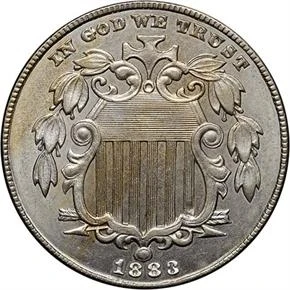
The Shield nickel was the first American five-cent coin made of nickel instead of silver, and it is the reason we call a five-cent piece a nickel at all. It was struck for only eighteen years, from 1866 to 1883, it has a design some collectors find clunky and others love, and it hides a short list of genuinely scarce dates, two years with no circulating coins at all, and a counterfeiting story most people never hear. Here is what a Shield nickel is worth and what to look for.

Why the Shield nickel exists
During the Civil War, Americans hoarded every silver and gold coin they could find, and small change all but disappeared. The government filled the gap with paper fractional currency and new base-metal coins, and in May 1866 Congress authorized a five-cent coin in a copper-nickel alloy. Chief Engraver James B. Longacre designed it: a shield topped by a cross on the obverse, and a large 5 surrounded by stars on the reverse. The alloy, 75% copper and 25% nickel at 5 grams, is the same one the nickel uses today. Every Shield nickel was struck at Philadelphia, so none carries a mint mark.
With Rays and No Rays
The first reverse had rays between the stars around the 5. Nickel alloy is hard, the design was busy, and dies cracked and failed quickly, so early in 1867 the Mint removed the rays. That gives the series two types:
- With Rays (1866 and early 1867): about 14.7 million dated 1866 and only about 2 million dated 1867.
- No Rays (1867 to 1883): the rest of the series, starting with more than 28 million 1867 No Rays coins.
The 1867 With Rays is the scarcer of the two Rays dates and carries a clear premium over the 1866 in every grade. If you are building a type set, an 1866 is the usual choice for the Rays type, and any common No Rays date fills the other hole.
The key dates
1880
The key of the series. Only 16,000 business strikes were made, the lowest of any regular Shield nickel, and they are rare in every grade. Even worn examples sell in the thousands of dollars, and uncirculated coins are major rarities. Proofs of 1880 survive in greater numbers than the business strikes, which is one reason buyers need to know exactly which they are getting.
1879 and 1881
By the late 1870s the country was awash in nickels, and the Mint struck very few. About 29,100 business strikes were made in 1879 and 68,800 in 1881. Both are scarce semi-keys, priced in the hundreds of dollars even in low grades.
1877 and 1878: proof only
So many nickels were already in circulation that the Mint struck no business-strike Shield nickels at all in 1877 or 1878, only proofs for collectors. The 1877 is the rarer of the two and typically sells for about twice the 1878. If you need one of these dates for a set, it has to be a proof.
Varieties worth checking
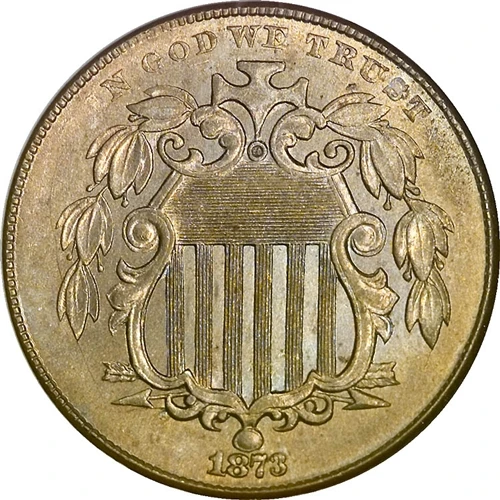
- 1873 Open 3 and Closed 3: the original date punch had a 3 whose ends nearly closed, so it could be misread as an 8. The Mint switched to an Open 3 partway through the year. Both are collected as separate varieties; proofs were made only with the Closed 3.
- 1883/2 overdate: traces of a 2 under the final 3. It carries a premium many times that of a regular 1883, so check every 1883 under magnification.
- 1879/8 overdate: found on proofs and a fun variety, though it does not usually bring much more than a regular 1879 proof.
You will also notice that many Shield nickels show die cracks, small raised lines running through the lettering and stars. They are a byproduct of that hard alloy and are normal for the series, not a reason to reject a coin.
The counterfeit story
Shield nickels were worth counterfeiting when they were new. Contemporary fakes of the early-to-mid 1870s dates circulated widely, especially around New York and New Jersey, and they still turn up in old accumulations. They are usually easy to spot once you know to look: the shield, cross and lettering differ noticeably in shape from those on genuine coins. Today they are collected as curiosities, but they are not genuine Shield nickels and should not be priced as one.
What a common-date Shield nickel is worth
Common dates such as the 1867 No Rays, 1868, 1869, 1872, 1882 and 1883 are affordable in circulated grades, generally tens of dollars in Very Good and more as detail returns. Mint-state coins of the common dates are realistic for most budgets through the middle grades, with prices rising sharply at Gem. Strike quality matters: many Shield nickels came from tired or cracked dies, so a coin with full stars and a sharp shield brings a premium over a mushy one in the same grade.
How to grade one
Look first at the shield on the obverse and the leaves around it. On a worn coin the horizontal lines inside the shield blur together and the leaf detail flattens; on a Very Fine or better coin the shield lines are distinct and the leaves have visible veins. On the reverse, check the stars for flat centers, keeping in mind that weak stars can be a strike issue rather than wear. As always, avoid cleaned coins; nickel shows harsh cleaning as a bright, hazy or scratched surface that never looks quite natural.
Building a set
A business-strike set is very achievable except for the 1880, and many collectors fill the 1877 and 1878 spaces with proofs. It pairs naturally with the Liberty Head V nickel that replaced it in 1883, the same year the Shield nickel ended, so an 1883 Shield and an 1883 No CENTS Liberty make a neat two-coin story.
Shop Shield nickels at USSQ
We carry Shield nickels by date and grade, including the 1866 With Rays, the scarcer 1867 With Rays, both 1873 varieties and the final 1883, plus the Liberty Head nickels that came next. For current values by date and grade, the price guides at PCGS and NGC are the references we trust.
Recent Posts
-

DC & U.S. Territories Quarters (2009): Complete Set Guide
If you collected 50 State Quarters and wondered what came next, the answer arrived in 2009: six quar
-
Are 2023 Coins Worth Money? What to Keep and What to Spend
Search for "2023 coins worth money" and you will find plenty of headlines promising a fortune in you