Two-Cent Piece Value Guide: Key Dates, the 1864 Small Motto, and the 1872 and 1873 Rarities
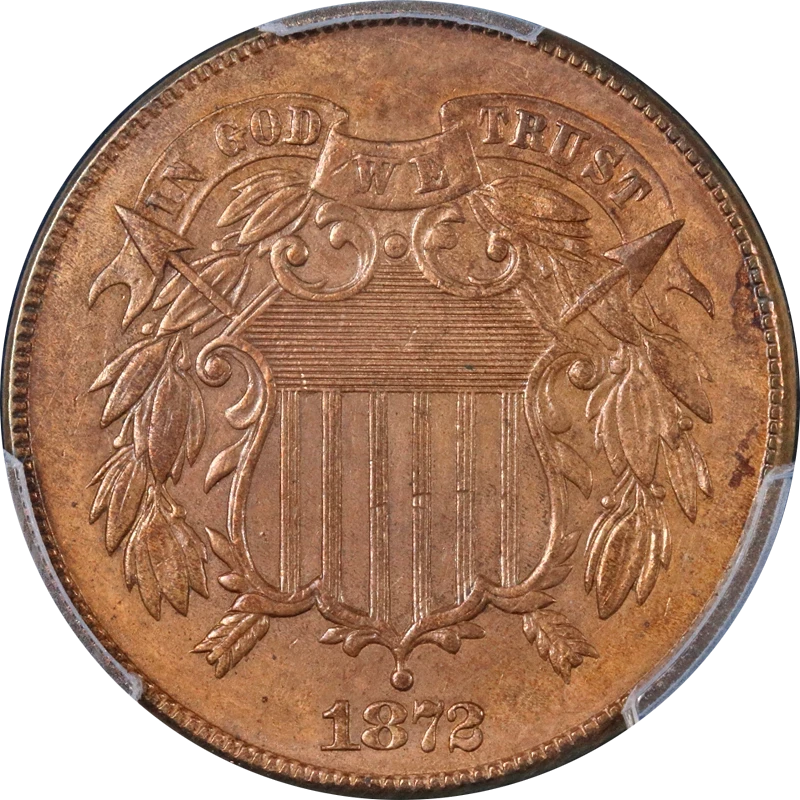
The two-cent piece is one of the shortest-lived coins the United States ever made. It ran from 1864 to 1873, it was the first American coin to carry the motto IN GOD WE TRUST, and almost every date is affordable. A few are not. Here is what separates a ten-dollar-range coin from a serious rarity, and what to check before you buy.

Why the two-cent piece exists
Like the Shield nickel, the two-cent piece is a Civil War coin. Small change had vanished from circulation, and the Mint wanted a heavier bronze coin to replace the hoarded silver and the paper fractional notes. Congress authorized it in April 1864, and the Mint struck it in bronze at roughly twice the weight of the small cent. The design shows a shield on the obverse with the motto IN GOD WE TRUST above it, and a wreath around the denomination on the reverse. Production was huge in the first two years and then fell off a cliff as the new nickel three-cent and five-cent pieces took over. The Coinage Act of 1873 ended the denomination.
What most two-cent pieces are worth
Here is the honest baseline. The 1864 and 1865 issues were struck by the million (nearly 20 million for 1864 and just under 14 million for 1865), and in worn grades they are inexpensive coins. A Fine or Very Fine 1864 Large Motto or 1865 is an entry-level piece. Check the grading-service price guides from PCGS or NGC for current ranges, because bronze coins with original color are priced very differently from cleaned or recolored ones. The color matters as much as the date: a brown coin with even surfaces is the normal, honest example, while a bright red one in a high grade carries a large premium.
The dates worth knowing
1864 Small Motto
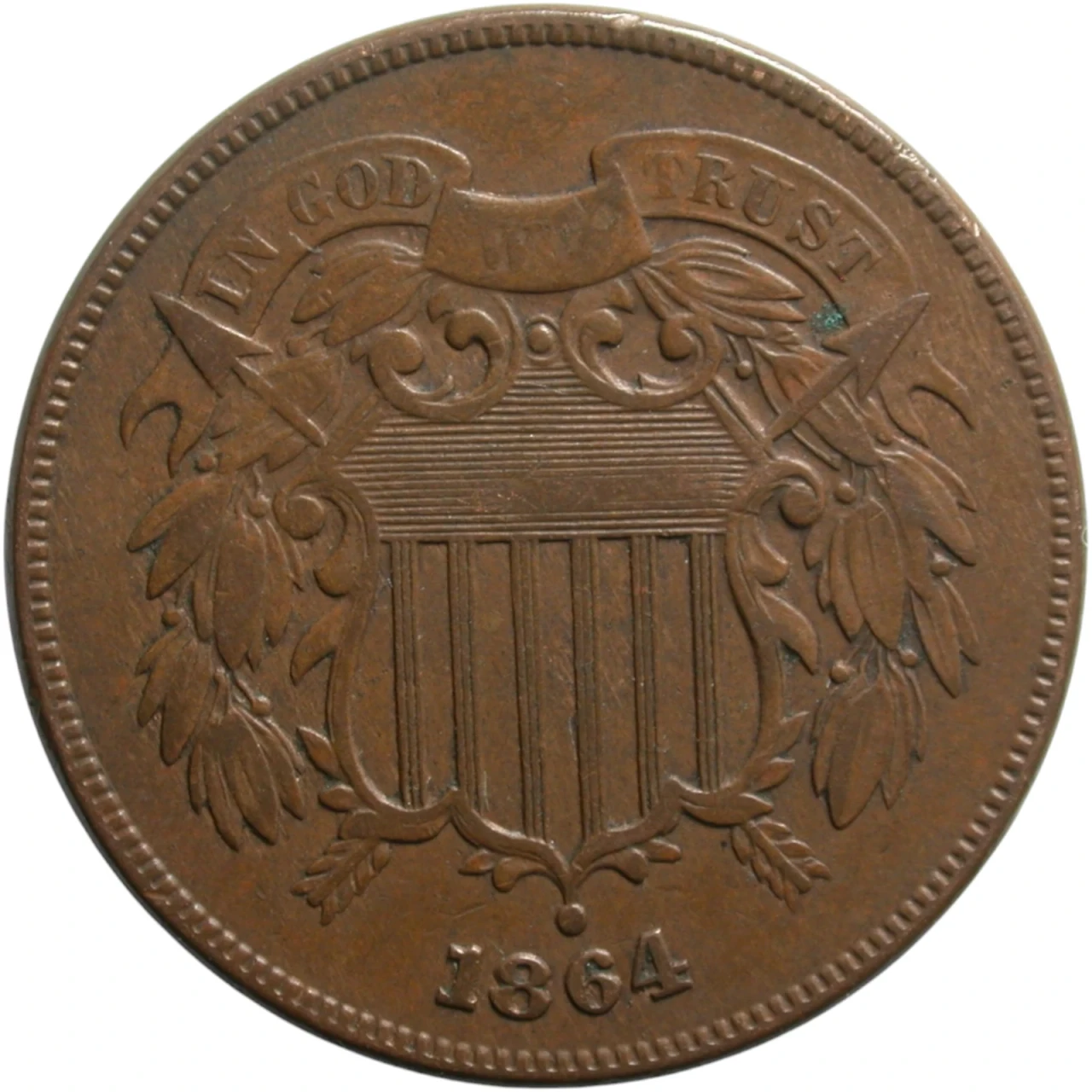
Early in 1864 the Mint changed the size of the motto. The Large Motto is the common one. The Small Motto is scarce even in circulated grades, and in Proof it is a rarity, with fewer than two dozen Small Motto Proofs believed to exist according to PCGS. If you are buying a Small Motto, buy it graded and attributed by a major service. A raw coin sold as a Small Motto is a coin to verify before you pay.
1872
Only 65,000 business strikes were made, the lowest of any regular two-cent issue, and it was the last year the Mint made them for circulation. The 1872 is the key to the circulation-strike series, and it is priced like one at every grade. Many surviving coins are cleaned or have problems, so a graded example is worth the extra money.
1873
The 1873 two-cent piece was a Proof-only issue. No business strikes were made, and roughly 600 Proofs are recorded. There are two kinds, Closed 3 and Open 3. The Closed 3 is the original, with the top and bottom of the 3 close together, and the Open 3 was added because the Closed 3 could be mistaken for an 8. Check which variety you are looking at, because they are priced separately. Any 1873 offered as a business strike is a red flag.
Lower mintage middle dates
The 1866 through 1871 dates fall between the early common years and the 1872. Mintages dropped from about three million in 1866 to under a million by 1870 and 1871 (861,250 and 721,250). They are not rare, but they are noticeably harder to find in choice condition than an 1864 or 1865. A few varieties, such as the disputed 1865/4 overdate and the 1867 doubled-letter motto, interest specialists, but treat any variety claim as something to confirm with a grading service.
Condition problems to watch for
Bronze two-cent pieces are prone to spotting, carbon streaks, and harsh cleaning. A coin that looks unnaturally bright usually has been dipped or polished, and that lowers the value. When you compare two coins of the same date and grade, the one with natural, even surface color is nearly always the better buy.
How to start a set
A date set from 1864 to 1872 is a manageable project, since the series is only nine business-strike dates. Most collectors begin with the 1864 Large Motto, the 1865, and the 1866 through 1870 dates, then decide whether the 1871, 1872, and the Small Motto belong in the budget. You can browse our current two-cent pieces and compare dates side by side. If this series draws you in, the neighboring coins from the same decade are the Shield nickels and the Indian Head cents, and our guides to the Shield nickel and the Flying Eagle cent cover the same era. For background on grading and population data, see PCGS's overview of two-cent pieces and the NGC site.
Recent Posts
-

DC & U.S. Territories Quarters (2009): Complete Set Guide
If you collected 50 State Quarters and wondered what came next, the answer arrived in 2009: six quar
-
Are 2023 Coins Worth Money? What to Keep and What to Spend
Search for "2023 coins worth money" and you will find plenty of headlines promising a fortune in you