Flying Eagle Cent Value Guide: 1856, 1857 and 1858, Large vs. Small Letters, and America's First Small Cent
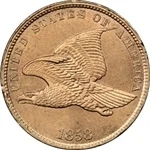
The Flying Eagle cent lasted barely two years in circulation, but it changed American money for good. It was the first small cent, the coin that replaced the big copper "large cent," and the first time ordinary Americans lined up around the block to get a new coin. Today it is one of the most affordable ways to own a coin from the 1850s, with one famous exception. Here is what Flying Eagle cents are worth, how to tell the varieties apart, and what to watch out for.

A new kind of cent
By the 1850s the old large cent, roughly the size of a modern half dollar, cost the Mint too much copper to make and was unpopular in commerce. The Coinage Act of February 21, 1857 abolished the large cent and the half cent and authorized a smaller cent in an alloy of 88% copper and 12% nickel. The same law ended the legal-tender status of the Spanish and Mexican silver coins that still circulated widely in the United States.
Chief Engraver James B. Longacre adapted the design from Christian Gobrecht's flying eagle, first used on pattern silver dollars in the 1830s. The new cents were released on May 25, 1857, and the Mint set up an exchange where people could trade old large cents, half cents and foreign silver for the new coins. The lines reportedly stretched around the block. Because of their light color, the public nicknamed them "nicks" or white cents.
The dates and what they are worth
1856: the famous one
The Flying Eagle cents dated 1856 were struck before the coin was authorized, as samples to show members of Congress and other officials. Estimates put the total at roughly 1,800, including pieces believed to have been restruck later for collectors, which is why the 1856 is technically a pattern even though nearly every collector treats it as part of the regular series. It is the key date by a wide margin and sells for many thousands of dollars even in low grades.
Because it is so valuable, the 1856 is one of the most frequently altered coins in American numismatics, usually by reshaping the last digit of an 1858. Never buy an 1856 that is not certified by PCGS or NGC.
1857
About 17.45 million were struck, and this is the most common Flying Eagle cent. Worn examples are very affordable, typically in the tens of dollars in lower grades, and the price rises steadily with detail. Choice uncirculated coins run into the hundreds and beyond. Some 1857 cents show faint clash marks left by dies of other denominations, and these clashed-die pieces are collected as separate varieties.
1858: Large Letters and Small Letters
The 1858 mintage was about 24.6 million, split between two varieties that differ in the lettering on the obverse. To tell them apart, look at the letters A and M in AMERICA:
- Large Letters: the A and M are joined at their bases.
- Small Letters: the A and M are clearly separated.
Both varieties are priced similarly in circulated grades, though the Large Letters is the scarcer of the two in Gem condition. Collectors usually want one of each. The 1858 also exists as an 1858/7 overdate, with traces of the 7 under the final 8; it is a scarce and valuable variety, so check any 1858 under magnification.
Why the design was dropped so quickly
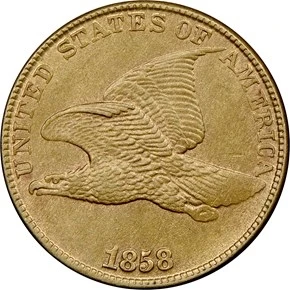
The Flying Eagle looked good on paper and struck badly in practice. The high-relief eagle sat directly opposite the thick wreath on the reverse, so the metal could not flow fully into both, and many coins came out soft in the eagle's head and wing tips and in the wreath. Dies also failed quickly in the hard copper-nickel alloy. The Mint tried adjustments, gave up, and replaced the design with the Indian Head cent in 1859. That weak strike is still the defining grading issue: a fully struck Flying Eagle cent is scarce and earns a real premium over a typical one in the same grade.
How to grade one
Check the high points of the eagle first: the head, the breast and the tips of the wings. On the reverse, look at the leaves and the ends of the wreath. Remember that weakness in these areas can be a strike problem rather than wear, so look at the surfaces too; a coin with full original luster and a soft eagle is uncirculated, just weakly struck. The copper-nickel alloy tones to a pale tan or gray over time, and coins that have been cleaned or polished look unnaturally bright and lose much of their value.
Building a set
A complete set of the circulating issues is just three coins, 1857, 1858 Large Letters and 1858 Small Letters, which makes it one of the easiest complete sets in American coinage and a natural first step into nineteenth-century coins. Adding the 1856 turns it into a serious project. Many collectors go on to the Indian Head cent that replaced it, which ran from 1859 to 1909, and our Indian Head penny value guide covers that series.
Shop Flying Eagle cents at USSQ
We carry the 1857 Flying Eagle cent, the 1858 Large Letters and the 1858 Small Letters in a range of grades, alongside our full run of Indian Head pennies. For the story of the cent's ending, nearly 170 years later, see our post on the penny being discontinued. For current values by grade, use the price guides at PCGS and NGC.
Recent Posts
-

Coin Gifts for Every Collector: A 2026 Holiday Gift Guide by Budget
Coins make unusually good gifts. They are small, they last forever, they carry real history, and unl
-
Flying Eagle Cent Value Guide: 1856, 1857 and 1858, Large vs. Small Letters, and America's First Small Cent
The Flying Eagle cent lasted barely two years in circulation, but it changed American money for good