Identifying Rare No-Date Washington Quarter Errors
Common Causes of Missing Dates on Washington Quarters
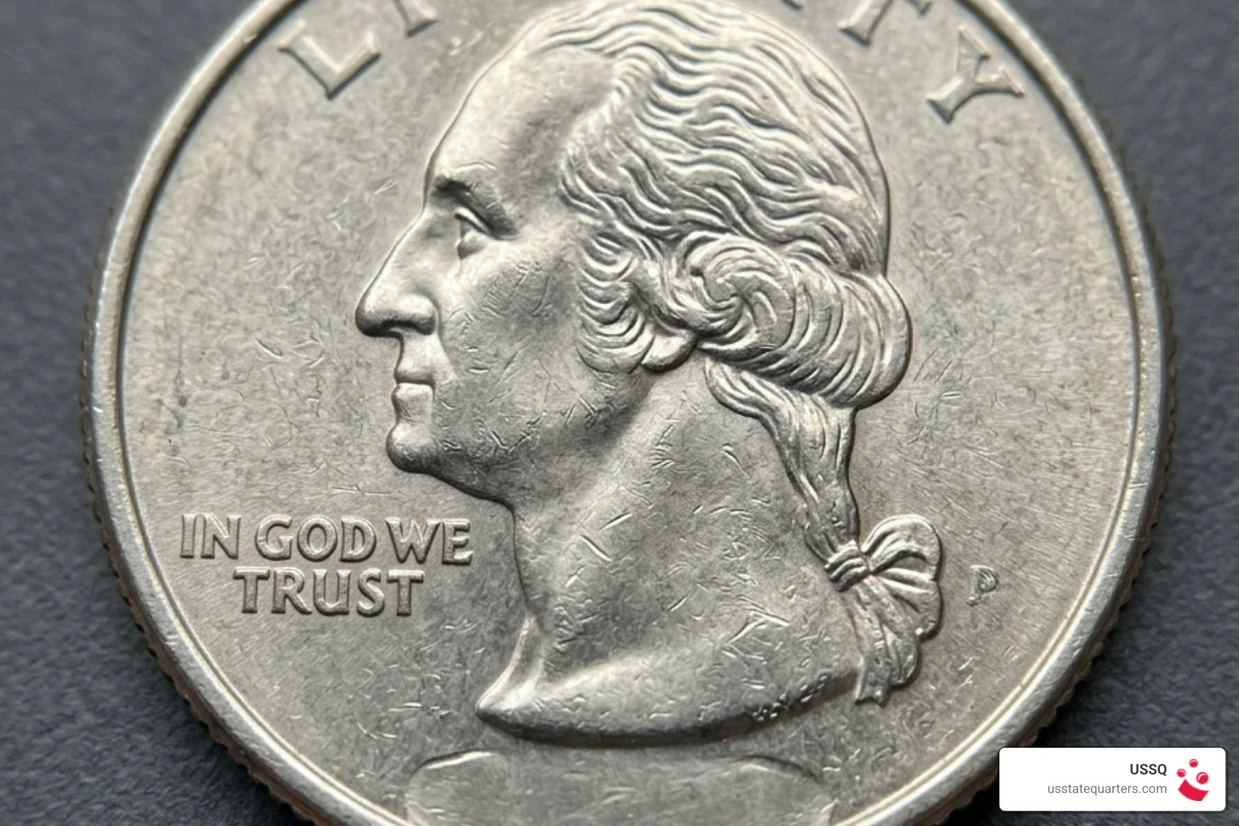
When you hold a washington quarter with no date, the first question is always: "How did this happen?" In numismatics, the answer usually lies in the high-pressure environment of the United States Mint. Since the Washington quarter began production in 1932, millions of coins have been struck, and occasionally, the machinery fails in spectacular ways.
Grease-Filled Dies and Struck-Through Grease
The most frequent culprit behind a missing date is a "grease-filled die." During the minting process, machinery is heavily lubricated. Occasionally, a mixture of grease, oil, and metal dust (often called "die goop") builds up in the recessed areas of the die. Since the date on a Washington quarter is incuse on the die, it is a prime target for this buildup.
When the die strikes a planchet, the grease acts as a hydraulic cushion, preventing the metal from flowing into the date's crevices. This results in a "struck-through grease" error. These can range from a "faint" date where you can just barely see the "19" to a completely "Year 1" quarter where the entire date area is as smooth as George Washington’s forehead.
Die Deterioration and Cuds
As dies strike hundreds of thousands of coins, they begin to fail. A "cud" occurs when a piece of the die’s edge breaks off completely. If the break happens at the bottom of the obverse die—where the date is located—the resulting coin will have a raised, unstamped blob of metal where the date should be. Unlike grease errors, which are flat or concave, a cud is always raised.
Planchet Defects and Design Evolution
Sometimes the issue starts before the strike. A "clipped planchet" occurs when the blanking machine overlaps a previously punched hole in the metal strip. If a significant portion of the coin is missing (like a 35% straight clip), the date may simply have never been part of the coin to begin with.
It is also important to note the Washington quarter - Wikipedia) history regarding the 1975–1976 period. During the Bicentennial, no quarters were struck with a "1975" date; they all bore the dual date "1776–1976." If you find a quarter that looks like it should be from that era but lacks a date, it might not be an error—it might just be a very worn Bicentennial reverse!
Identifying and Cataloging Mint Errors
Identifying a washington quarter with no date requires a keen eye and a bit of technical knowledge. Not every blank spot is a mint error. In fact, many coins found in pocket change are simply victims of "Post-Mint Damage" (PMD).
To truly categorize these coins, professional numismatists look at the specific mechanics of the strike. The Washington Quarter - PCGS CoinFacts database is an excellent resource for seeing how a perfect strike should look, which helps you spot when something has gone wrong at the Philadelphia, Denver, or San Francisco Mints.
Identifying a Genuine washington quarter with no date
Before you get excited about a potential windfall, we recommend a few "at-home" tests to ensure your coin wasn't just filed down by a prankster:
- Weight Verification: A standard clad Washington quarter (1965–present) should weigh 5.67 grams. A silver quarter (1932–1964) should weigh 6.25 grams. If your coin weighs significantly less, the date was likely removed through tooling or chemicals.
- Surface Texture: Genuine grease errors usually have a slightly "mushy" or orange-peel texture in the affected area. If you see fine scratches or "swirl" marks where the date used to be, it’s a sign of mechanical grinding (PMD).
- The "Ghost" Effect: Under high magnification, grease-filled die errors often reveal a "ghost" of the original numbers.
- Edge Check: For clipped planchets, look for the "Blakesley Effect"—a weakness in the rim directly opposite the clip. If the rim is perfectly strong opposite the missing chunk, it might be a "fake" clip made in a garage.
If you are unsure, More info about our authentication services can help you get on the right path toward professional grading. You can also compare your coin to the specimens in our Washington quarter collection.
Cataloging the washington quarter with no date Cud Series
For those who love the technical side of the hobby, there is a specialized catalog for undated Washington quarters. The Cuds on Coins project has documented at least 35 specific varieties, ranging from CU-25c-ND-01 through CU-25c-ND-35.
These are often categorized by:
- Location: For example, a "6:00" cud is one that sits directly over the date area.
- Stages: Some dies were used as they progressively broke further. You might find a "Stage A" (small break) or "Stage B" (large break) of the same variety.
- Retained Cuds: This is where the piece of the die broke but stayed "stuck" in place, creating a visible crack and a slight displacement of the metal.
Market Value and Grading for a washington quarter with no date
What is a washington quarter with no date actually worth in April 2026? The answer depends on two things: Certification and Error Intensity.
A raw (unauthenticated) grease-filled die quarter might sell for $5 to $20 on eBay as a "neat curiosity." However, once a coin is slabbed by a service like PCGS or NGC, the price jumps. PCGS uses the Industry Number 6000118 to classify these undated errors.
Auction Results and Real-World Data
Recent market data shows that collectors are willing to pay a premium for dramatic errors. For instance, a No Date Washington Quarter with a 35% Straight Clip and a partial collar was recently listed for $225.00.
In another instance, a PCGS-graded VF-30 example featuring an obverse cud at 6:00 (covering the date) and a retained cud on the reverse sold for a significant premium because it featured errors on both sides. We regularly update our error coin inventory with similar finds.
2026 Estimated Value Table
| Error Type | Estimated Value (Circulated) | Estimated Value (Certified/MS) |
|---|---|---|
| Minor Grease-Filled Die | $2 – $10 | $25 – $50 |
| Major "Year 1" Grease Error | $15 – $30 | $75 – $125 |
| Obverse Cud (Date Area) | $40 – $80 | $150 – $300+ |
| 25% - 35% Planchet Clip | $50 – $100 | $200 – $400 |
| 95% Off-Center Strike | $100 – $200 | $500+ |
Note: Values are estimates based on April 2026 market trends and auction house data from GreatCollections and Heritage Auctions.
Frequently Asked Questions about Undated Quarters
How can I tell if my no-date quarter is silver or clad?
The easiest way is to look at the edge. If you see a distinct copper-colored stripe, it is a modern clad coin (post-1965). If the edge is solid silver-white, it’s likely a 90% silver coin (1932–1964). You can also weigh them: 6.25g for silver vs. 5.67g for clad. Silver quarters with missing dates are significantly rarer and more valuable!
Are no-date Washington quarters rarer than Standing Liberty quarters?
Actually, no. Standing Liberty quarters (1916–1930) are famous for having "recessed" dates that wore off almost immediately in circulation. Finding an undated Standing Liberty quarter is very common and usually just means the coin is heavily worn. A washington quarter with no date is much more likely to be a genuine mint error, as the Washington design was modified to protect the date from premature wear. To see the difference in design strikes, browse our Washington quarters.
What is the most valuable type of no-date error?
Generally, the "Multi-Error" coins are the kings of the market. A no-date quarter that is also struck 95% off-center, or one that features a large "cud" combined with a "struck-through" error, will always command the highest prices.
Conclusion
At USSQ and Coins Online LLC, we’ve seen thousands of quarters pass through our hands since 1999. While the washington quarter with no date might seem like a mistake to the casual observer, to a numismatist, it is a fascinating window into the "chaos" of the minting process.
Whether you have a "Year 1" grease error or a major cud variety like the CU-25c-ND-01, protecting your find is essential. We always recommend using PVC-free archival holders to prevent any further damage to the coin's surface.
If you're looking to add a certified error to your collection or need the supplies to house your latest pocket-change find, Browse our full inventory of collectible quarters. With our 14-day return policy and competitive shipping, we make it easy to build a collection you can be proud of. Keep your eyes on your change—you never know when you might find a piece of history that the Mint "forgot" to date!
Recent Posts
-

Walking Liberty Half Dollar Value Guide: Key Dates, the 1921 Problem, and What Yours Is Really Worth
Ask a room full of collectors to name the most beautiful U.S. coin and the Walking Liberty half doll
-
The 2026 Semiquincentennial Proof Set: What's in It, Why It Costs $107, and Whether to Buy One
On October 6 at noon Eastern, the U.S. Mint puts the 2026 Semiquincentennial Proof Set on sale at $1