Penny Discontinued: What It Means for Your Pennies, and Where 2026 Cents Come From
On November 12, 2025, U.S. Treasurer Brandon Beach started the press at the Philadelphia Mint that struck the last Lincoln cent made for circulation. That ended a run that began with the Coinage Act of 1792, and since then we have fielded a steady stream of the same questions: Are my pennies still money? Are they worth more now? Should I be saving them? The short answers are yes, mostly no, and some of them. Here is the full picture, including the one place you can still get a brand-new 2026 cent.

Why the Mint stopped making pennies
It came down to cost. According to the U.S. Mint, each cent cost 3.69 cents to make in fiscal year 2024, up from 1.42 cents a decade earlier, and the Mint still produced about 3.2 billion of them that year, roughly 57% of all the circulating coins it struck. In February 2025 President Trump directed the Treasury to stop, and the Treasury concluded the penny was no longer needed to meet the country's needs. The Mint estimates the change saves about $56 million a year. With an estimated 300 billion pennies already out there in jars, drawers and bank vaults, the supply problem was never too few cents. It was too many sitting idle.
Are pennies still legal tender?
Yes. The Mint has been explicit that the penny remains legal tender and can still be used for any transaction. Nothing about your existing pennies changed on November 12. Card and electronic payments are still calculated to the cent.
Cash is where things got messy. With no new cents entering the system, banks and businesses in many areas have run short, and a growing number of retailers now round cash totals to the nearest five cents, often in the customer's favor. The rules vary by state and city, and some places require businesses to give exact change, so expect different practices from store to store. If you have a jar of pennies at home, now is a perfectly good time to roll them and take them to your bank, which will be glad to have them, or pick through them first.
Does this make my pennies valuable?
For the overwhelming majority, no. A coin becomes scarce when few survive, and 300 billion pennies are not going anywhere soon. History backs this up. The United States stopped making half cents and large cents in 1857, and common-date large cents are still affordable collector coins nearly 170 years later. Canada stopped distributing its cent in 2013, and ordinary Canadian pennies remain worth about what they were. An end date makes a coin interesting. It does not make a common one rare.
That said, a meaningful slice of the pennies in any old jar are worth more than a cent, and it pays to know which.
Copper pennies (1909–1982)
Cents dated 1982 and earlier are 95% copper and weigh 3.11 grams. Beginning partway through 1982, the Mint switched to a zinc core with thin copper plating, about 2.5 grams, so 1982 comes both ways and you need a scale to tell. At recent copper prices, the metal in a pre-1982 cent is worth more than one cent. Before you get ideas, though: melting pennies is still prohibited under Treasury regulations (31 C.F.R. Part 82), which the Mint reaffirmed when it ended production, and so is exporting them in bulk. Copper cents are worth setting aside, but think of them as a long-term curiosity, not a payday.
Wheat pennies (1909–1958)
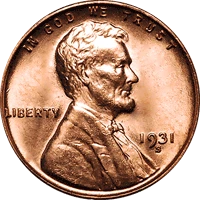
Any cent with the two wheat stalks on the back is worth more than face to collectors, even well worn, and a few dates are worth a great deal: the 1909-S VDB, 1914-D, 1922 No D and 1931-S are the classic keys, and the 1955 Doubled Die Obverse is one of the most famous error coins in American numismatics. Our wheat penny values guide covers them date by date.
Memorial-era errors and varieties
Newer cents can surprise you too. Collectors look for the 1972 Doubled Die Obverse, the 1983 Doubled Die Reverse, the 1984 "doubled ear" variety, the 1995 Doubled Die Obverse, and the 1992 Close AM and 1999 Wide AM reverse varieties, along with the great rarity of the series, the 1969-S Doubled Die Obverse. Values run from modest premiums for the more common of these to serious money for the rarities, depending on the variety and grade. Our penny values chart for 1959–2011 is a good place to start, and PCGS and NGC publish current values for each.
The 1943 copper and 1944 steel cents
In 1943 the Mint struck cents in zinc-coated steel to save copper for the war, and a handful were accidentally struck on leftover bronze blanks. In 1944 the reverse happened. Both errors are major rarities, and both are heavily faked, most often by copper-plating an ordinary 1943 steel cent. A simple first test: a genuine bronze cent will not stick to a magnet. Anything that passes still needs professional authentication.
The very last pennies: the Omega cents
The Mint marked the end with a special issue rather than a quiet stop. On December 11, 2025, Stack's Bowers Galleries auctioned 232 three-coin sets. Each set held a 2025 Philadelphia cent, a 2025-D cent and a 2025 cent struck in 24-karat gold, the first cent ever officially struck in gold, all carrying a small Omega (Ω) privy mark. The sale totaled more than $16.76 million, and the final set, No. 232, which included the canceled dies, brought $800,000. Those Omega-marked coins were struck for the auction sets. A 2025 cent from your change without the Ω mark is an ordinary 2025 cent.

2026 cents: they exist, just not in your change
The Mint has said it will keep making cents in limited numbers for collectors, and in 2026 that means three products, all dual-dated 1776~2026 for the nation's 250th anniversary:
- 2026 Semiquincentennial Silver Proof Set ($245), with a 2026-S proof cent. Released in June and sold out.
- 2026 Uncirculated Coin Set ($124.50), the only source for uncirculated 2026 Philadelphia and Denver cents. It sold about 292,000 of its 300,000-set limit in roughly the first day.
- 2026 Semiquincentennial Proof Set ($107), with a 2026-S proof cent, on sale since October 6.
If you want a 2026 cent, buy one of those sets and keep it intact. A loose cent pulled from a set is harder to sell and easier to question than one in its original Mint packaging. Our proof set vs. mint set guide explains the difference between the two, and our 2026 proof set guide covers every coin in this year's set.
What this means for collectors
Here is the part we find most interesting. For the first time since 1909, the circulating Lincoln cent has an end date. A complete collection of business-strike Lincoln cents, every date and mint mark from 1909 through 2025, is now a finite goal, the same way the Indian Head cent (1859–1909) and the Buffalo nickel (1913–1938) became closed series that collectors could finish. Closed series have historically drawn collectors in, and the Lincoln cent has more collectors than any other American coin to begin with.
If you want to get started, three practical moves:
- Sort your jar before you cash it in. Pull every wheat cent and every pre-1982 copper cent, and check the varieties above with a magnifier.
- Set aside a few uncirculated 2025 Philadelphia and Denver cents, or a roll of each, while they are still easy to find. They are the last business-strike Lincoln cents.
- Fill the hard dates with problem-free, ideally certified coins rather than hunting for them in change. The keys were scarce long before the penny ended.
Shop Lincoln and Indian Head cents at USSQ
We stock the classic 1909–1931 Lincoln cents, a wide run of wheat pennies by date and grade, and the cent that came before Lincoln, the Indian Head penny. For annual sets from past years, browse our U.S. mint sets. The Mint's own background on the end of cent production is on its penny media page.
Recent Posts
-

Coin Gifts for Every Collector: A 2026 Holiday Gift Guide by Budget
Coins make unusually good gifts. They are small, they last forever, they carry real history, and unl
-
Flying Eagle Cent Value Guide: 1856, 1857 and 1858, Large vs. Small Letters, and America's First Small Cent
The Flying Eagle cent lasted barely two years in circulation, but it changed American money for good