Which Kennedy 50 Cent Pieces Are Actually Silver?
Which Kennedy 50 Cent Pieces Contain Silver - And Which Don't
Not every kennedy 50 cent piece silver collector spots on a table or in a jar is actually silver. The year on the coin makes all the difference.
Quick answer - Kennedy half dollar silver content by year:
| Year Range | Silver Content | Pure Silver (troy oz) |
|---|---|---|
| 1964 | 90% silver | 0.3617 oz |
| 1965-1970 | 40% silver | 0.1479 oz |
| 1971-present | 0% silver (clad) | None |
| 1992-2018 silver proof (S) | 90% silver | 0.3617 oz |
| 2019-present silver proof (S) | 99.9% silver | About 0.407 oz |
The 1964 issues were the only 90% silver Kennedy halves struck for general circulation. From 1965 through 1970, the U.S. Mint reduced silver content to 40%. Starting in 1971, silver was removed entirely - regular Kennedy halves became copper-nickel clad coins, which is what you'll find in pocket change today.
There is one big exception: modern silver proof versions, sold only in collector sets from the San Francisco Mint, do contain silver - but they were never meant for circulation. For more collecting background, see our kennedy half dollars complete guide, browse Kennedy half dollar collecting options, or protect your coins with coin collecting supplies.
When the first 1964 Kennedy halves went on sale on March 24, 1964, a line stretched a full city block outside the Treasury Department. People weren't just buying coins - they were holding onto a piece of history after President Kennedy's assassination. That emotional connection, combined with the coin's real silver content, is why so many were saved rather than spent.
This guide will show you exactly how to identify which Kennedy half dollars are silver, what they're worth, and which dates and varieties collectors prize most.
Kennedy 50 Cent Piece Silver Content by Year
The metal composition of the Kennedy half dollar has undergone several dramatic changes since its debut in 1964. Understanding this timeline is the easiest way to know if your coin has precious metal value or is simply worth its fifty-cent face value.
To help you visualize the differences, we have compiled a quick reference table comparing the key eras of this historic coin.
Kennedy Half Dollar Composition and Specifications
| Year Range | Metal Composition | Pure Silver Weight (Troy oz) | Total Coin Weight | Typical Uncirculated Value |
|---|---|---|---|---|
| 1964 | 90% Silver, 10% Copper | 0.36169 oz | 12.50 grams | $15.00 - $25.00 |
| 1965-1970 | 40% Silver Clad | 0.14790 oz | 11.50 grams | $6.00 - $12.00 |
| 1971-Present | 75% Copper, 25% Nickel | 0.00000 oz | 11.34 grams | $0.50 (Face Value) |
| 1992-2018 (Silver Proofs) | 90% Silver, 10% Copper | 0.36169 oz | 12.50 grams | $18.00 - $35.00 |
| 2019-Present (Silver Proofs) | 99.9% Fine Silver | About 0.407 oz | 12.685 grams | $25.00 - $50.00 |
1964 Kennedy 50 Cent Piece Silver Content
The 1964 Kennedy half dollar remains a legendary coin because it was the first year of the series and the very last circulating half dollar struck in 90% silver. With a composition of 90% silver and 10% copper, each coin contains precisely 0.36169 troy ounces of pure silver.
Because of overwhelming public demand, the U.S. Mint struck an astonishing 430 million of these coins across the Philadelphia and Denver facilities. Additionally, the Mint struck nearly 4 million proof coins for collectors. Although they are incredibly common, their high silver content means they will always carry a healthy premium over face value. If you want to dive deeper into these early issues, check out our kennedy half dollars complete guide and browse related Kennedy half dollar collecting options.
1965-1970 Kennedy 50 Cent Piece Silver Content
As silver prices climbed in the mid-1960s, the U.S. government faced a massive coin shortage. To save silver while keeping the denomination alive, Congress authorized a transition to a silver clad composition. From 1965 to 1970, Kennedy half dollars were struck with outer layers of 80% silver and 20% copper bonded to an inner core of 21.5% silver and 78.5% copper.
This reduced the overall silver composition to 40%, giving each coin a total of 0.1479 troy ounces of pure silver and a total weight of 11.50 grams. During this era, the U.S. Mint suspended traditional proof sets, instead offering Special Mint Sets (SMS) from 1965 to 1967, which featured no mint marks. The absolute key to this era is the low-mintage 1970-D issue, which we will discuss in detail below. You can explore more about this transitional period at the NGC Coin Explorer.
1971-Present Kennedy Half Dollars: Clad, Not Silver
By 1971, rising silver costs forced the government to eliminate silver entirely from circulating coinage. Since then, standard business-strike Kennedy half dollars have been made of a copper-nickel clad composition: outer layers of 75% copper and 25% nickel bonded to a core of pure copper. These coins weigh 11.34 grams and contain absolutely zero silver.
Although they are clad, these modern issues still offer plenty of excitement. From 2002 to 2020, the U.S. Mint stopped producing half dollars for general circulation, striking them only in limited numbers for collectors (known as Not Intended for Circulation or NIFC issues). However, the Mint resumed striking Kennedy half dollars for circulation in 2021. Looking ahead, the coin is scheduled for a temporary design change to commemorate the 2026 Semiquincentennial. You can learn more about these official programs on the U.S. Mint Half Dollar Coins Page.
Modern Silver Proof Kennedy Half Dollars
While circulating halves went clad in 1971, the U.S. Mint didn't abandon silver collectors. Starting in 1992, they reintroduced special silver proof sets struck at the San Francisco Mint.
From 1992 to 2018, these proof coins were struck using the classic 90% silver composition. In 2019, the Mint upgraded the silver proof composition to 99.9% fine silver. These stunning, mirror-like coins are easily identified by their S mint mark and proof finish, but collectors should remember that not every S-mint proof is silver. Original silver proof set packaging, weight, and edge appearance are useful confirmation tools. If you store proof coins or raw silver halves, consider using proper coin collecting supplies to help protect the surfaces.
How to Tell If Your Kennedy Half Dollar Is Silver or Clad
If you have a handful of Kennedy half dollars, you don't need expensive scientific equipment to figure out if they are silver. You can easily identify them using three simple tests.
Fast Date-Based Identification
The absolute fastest way to check is by looking at the date:
- 1964: Always 90% silver.
- 1965–1970: Always 40% silver.
- 1971–Present: Almost always copper-nickel clad (with the exception of special collector-only silver proof sets).
- 1776–1976 (Bicentennial): Most are clad, but the Mint sold special 40% silver uncirculated and proof versions to collectors.
- Fun Fact: There are no half dollars dated 1975! The Mint began striking the dual-dated Bicentennial coins in 1975 to prepare for the massive national celebration.
Edge, Weight, and Color Tests
If you want to be 100% sure, or if you suspect you have a special collector coin, try these physical tests:
- The Edge Test: Hold the coin up and look closely at the reeded edge.
- If you see a bright, solid silver-white edge, it is 90% silver.
- If you see a greyish-silver edge with a very faint, light-copper line, it is likely a 40% silver coin.
- If you see a distinct, bold copper stripe running right through the middle, it is a standard copper-nickel clad coin.
- The Weight Test: Place your coin on a precise digital pocket scale.
- 90% Silver (1964): ~12.50 grams.
- 40% Silver (1965–1970): ~11.50 grams.
- Copper-Nickel Clad (1971–Present): ~11.34 grams.
- The Color and Sound: Silver has a bright, lustrous white sheen that clad coins cannot replicate. While a "ring test" (tapping the coin to hear its high-pitched silver chime) can help, we strongly caution against it because dropping or tapping coins can easily damage their surfaces and ruin their collector value.
Mint Mark Locations and What They Mean
Mint marks tell us exactly where your coin was struck. On Kennedy half dollars, the location of this mark changed over time:
- 1964: Located on the reverse (back) of the coin, just below the eagle's left claw (on the left side of the coin).
- 1968–Present: Located on the obverse (front) of the coin, just above the date and below Kennedy's bust.
- 1965–1967: The U.S. Mint temporarily removed all mint marks from U.S. coins to discourage hoarding.
The letters stand for:
- No Mint Mark (or "P"): Philadelphia Mint
- D: Denver Mint
- S: San Francisco Mint (primarily proof and collector issues)
- W: West Point Mint (rare, special commemorative issues)
For a deeper look into identifying these mint mark locations, visit our half dollar coin resource page.
History, Design, and Why Kennedy Halves Disappeared from Circulation
The story of the Kennedy half dollar is deeply intertwined with a moment of national mourning and the end of circulating silver coinage in America.
For a comprehensive historical deep dive, you can read the Wikipedia Kennedy half dollar history.
Creation After President Kennedy’s Assassination
Following the tragic assassination of President John F. Kennedy on November 22, 1963, the nation was gripped by grief. Within days, the Treasury and the U.S. Mint began discussing a coin to honor his legacy. Jacqueline Kennedy requested that her husband be placed on the half dollar, replacing Benjamin Franklin.
Congress rushed the legislation through, authorizing the new design in December 1963. To meet the aggressive deadline, Mint sculptors Gilroy Roberts and Frank Gasparro modified existing designs they had created for JFK's presidential medal, allowing production to begin on February 11, 1964.
Obverse and Reverse Design Elements
The obverse, designed by Chief Engraver Gilroy Roberts, features a powerful, left-facing profile portrait of President Kennedy. The word "LIBERTY" wraps around the upper rim, while the national motto "IN GOD WE TRUST" is inscribed directly below the bust.
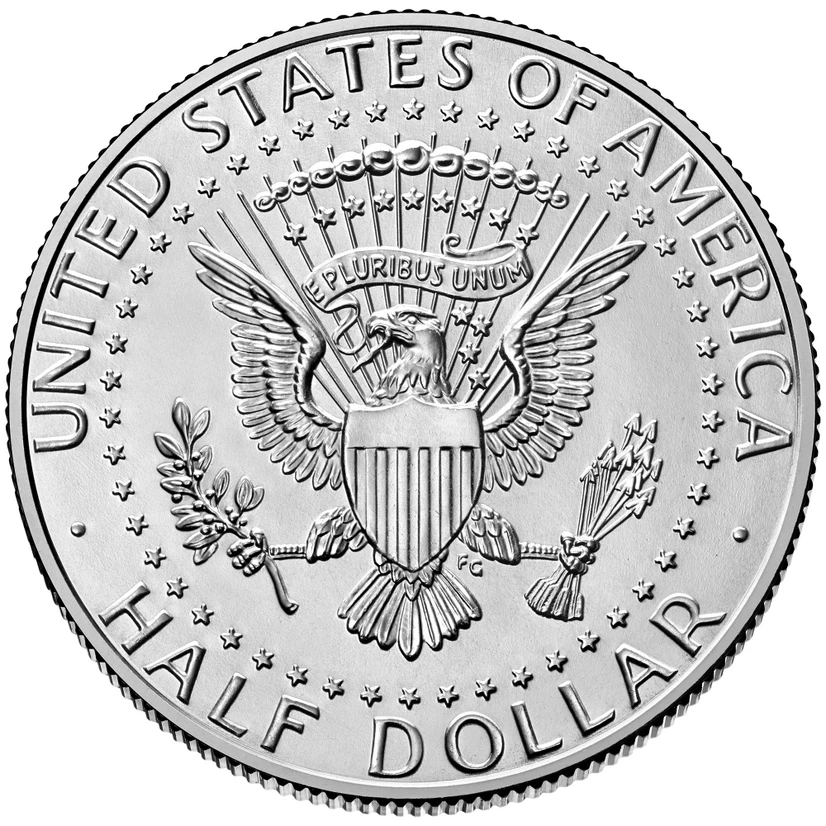
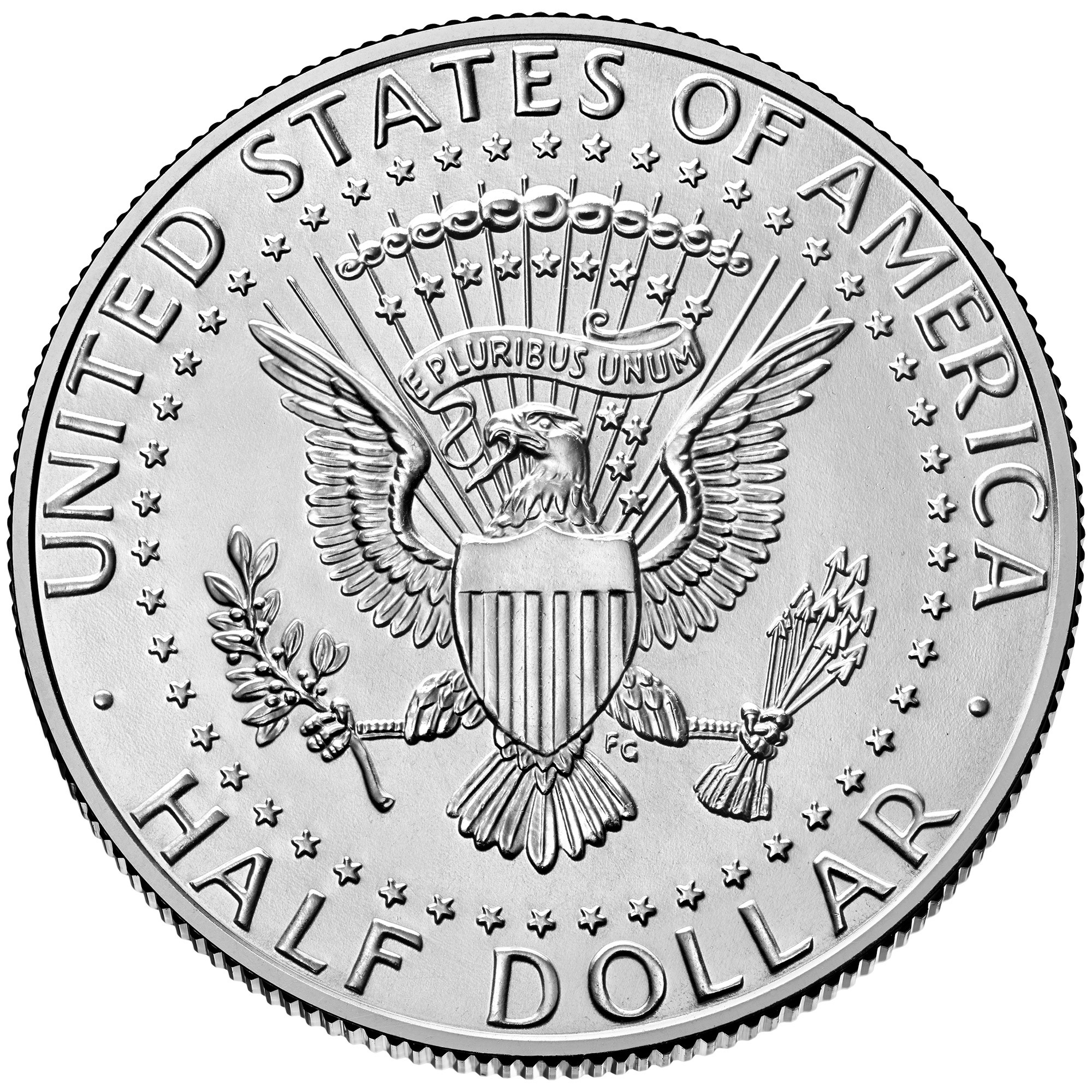
The reverse, designed by Frank Gasparro, is a highly detailed adaptation of the Presidential Seal.
It features a heraldic eagle clutching an olive branch (representing peace) in its right talon and a bundle of 13 arrows (representing defense) in its left. A shield is draped over the eagle's chest, and a circle of 50 stars surrounds the entire design, representing the unified states of America.
Silver Prices, Hoarding, and Production Changes
When the first coins were released in early 1964, banks were immediately overwhelmed. People stood in line for hours to buy their limit of two coins. Instead of spending them, citizens hoarded them as sentimental keepsakes.
At the same time, the global price of silver began to rise. People realized that the silver melt value of a 1964 half dollar was quickly exceeding its 50-cent face value, leading to even more hoarding. Even though the Mint struck hundreds of millions of coins, they completely vanished from circulation. This hoarding continued through the 40% silver era, and by the time the coin transitioned to base metals in 1971, the public had simply gotten out of the habit of using 50-cent pieces in daily transactions.
To read more about the historical context of silver coins during this transition, explore ClipArtHive's Kennedy Silver History.
Key Dates, Rarities, Varieties, and Current Market Values
While any silver Kennedy half dollar is worth at least its weight in silver, several specific dates and varieties carry massive collector premiums.
Must-Know Key Dates and Low-Mintage Issues
- 1970-D (40% Silver): This is the undisputed key date of the regular-issue series. Only 2.15 million were struck, and they were never released for circulation. They were sold exclusively in the 1970 Uncirculated Mint Sets, meaning you will only find them in collector collections.
- 1987-P and 1987-D (Clad): Only 2.89 million of each were struck. Like the 1970-D, they were only sold in official mint sets and are highly sought after by collectors trying to build complete date sets.
- 1998-S Matte Finish Proof: Struck as part of a special two-coin commemorative set honoring Robert F. Kennedy, this coin has an incredibly low mintage of just 62,350 coins, making it a modern rarity.
Valuable Varieties and Errors to Check
- 1964 Accented Hair Proof: This variety features much heavier, more pronounced hair strands above Kennedy's ear. Jacqueline Kennedy reportedly disliked this initial design, prompting the Mint to quickly modify the dies. This early variety represents only 1% to 3% of the 1964 proof mintage and commands a significant premium.
- 1974-D Doubled Die Obverse (DDO): Look closely at the words TRUST and IN GOD WE under magnification. A strong doubling error can make this coin worth hundreds of dollars in high grades.
- 1972-D and 1982-P No FG Varieties: Due to over-polished dies, the designer Frank Gasparro's initials (FG) are completely missing from the reverse, located near the eagle's right leg. Genuine No FG coins are highly prized.
Special Editions, Proof Sets, and Commemorative Versions
Beyond standard issues, several special editions stand out:
- 1776-1976 Bicentennial: Featuring a special reverse design of Independence Hall by Seth G. Huntington, over 521 million of these dual-dated coins were struck. While the clad versions in your pocket change are only worth face value, the special 40% silver versions sold in collector sets are highly collectible.
- 2014 50th Anniversary: To celebrate 50 years of the design, the U.S. Mint released special collector sets, including a stunning 0.999 fine gold proof version struck at the West Point Mint.
- 2026 Semiquincentennial Redesign: To celebrate America's 250th anniversary, the half dollar will receive a temporary, one-year-only redesign before returning to the classic Kennedy portrait in 2027.
If you are building a Kennedy half dollar set, compare recent sold prices, silver melt value, certification status, and grade before buying or selling. You can also browse USSQ's silver coin category for related U.S. silver collectibles. For those interested in comparing these with international coins of the same era, you can view the NGC Canada 50 Cents Price Guide.
Frequently Asked Questions About Kennedy 50 Cent Piece Silver Coins
Are All 1964 Kennedy Half Dollars Silver?
Yes, every single 1964 Kennedy half dollar struck for circulation or as a proof set is made of 90% silver and 10% copper. There are no clad 1964 half dollars. Each coin contains 0.36169 troy ounces of pure silver.
What Is the Most Valuable Kennedy Half Dollar?
Excluding ultra-rare prototype strikes like the 1964 Special Mint Set (SMS) coins (which have sold for over $100,000 at auction), the most valuable regular issues are the 1970-D in high grades, the 1998-S Matte Proof, and high-grade 1964 "Accented Hair" proof varieties.
Are Bicentennial Kennedy Half Dollars Silver?
The vast majority of 1776–1976 Bicentennial half dollars found in pocket change are copper-nickel clad and only worth face value. However, the U.S. Mint did strike special 40% silver uncirculated and proof versions for collector sets. You can easily identify these by checking the edge for a copper stripe or weighing them on a scale.
Conclusion
The kennedy 50 cent piece silver series is one of the most beloved and widely collected runs in American numismatic history. Whether you are searching through rolls of coins from the bank, inheriting a family collection, or purchasing high-grade specimens to complete a set, knowing the silver content of these coins is essential.
Remember the golden rules of the Kennedy half dollar:
- 1964 coins are always 90% silver.
- 1965 to 1970 coins are always 40% silver.
- 1971 and later coins are copper-nickel clad unless they are special S mint mark silver proofs.
- Always check the edge, weigh your coins, look out for key dates like the 1970-D and the 1964 Accented Hair variety, and avoid cleaning collectible coins.
At USSQ (Coins Online LLC), we have been helping collectors build their dream coin collections since 1999. We offer competitive prices, low shipping rates, and a worry-free 14-day return policy on over 5,000 products.
Whether you are looking for classic silver halves, rare errors, or protective coin supplies, we have everything you need. Continue learning with our half dollar coin guide, browse Kennedy half dollar collecting options, explore silver coins, or protect your collection with coin collecting supplies. Ready to add a piece of American history to your collection? Shop USSQ coin collecting resources today!
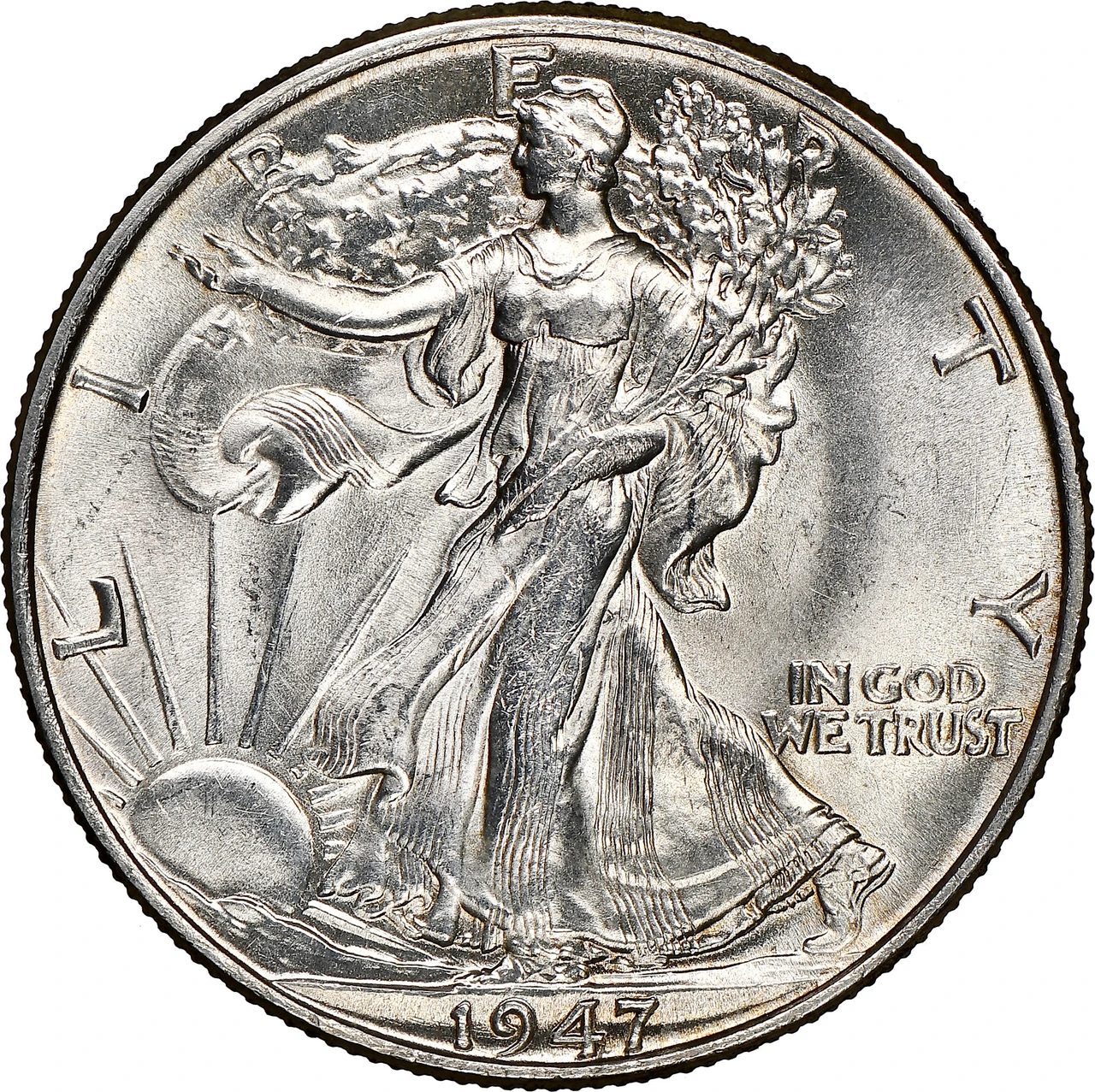
See our Walking Liberty half dollars for current prices.
Recent Posts
-

Walking Liberty Half Dollar Value Guide: Key Dates, the 1921 Problem, and What Yours Is Really Worth
Ask a room full of collectors to name the most beautiful U.S. coin and the Walking Liberty half doll
-
The 2026 Semiquincentennial Proof Set: What's in It, Why It Costs $107, and Whether to Buy One
On October 6 at noon Eastern, the U.S. Mint puts the 2026 Semiquincentennial Proof Set on sale at $1