1893 Indian Head Penny: The Ultimate Collector's Price Guide
What Is the 1893 Indian Head Penny Worth — and Why Do Collectors Love It?
The 1893 Indian Head penny is one of the most recognizable and collectible coins from America's Victorian era — and its value ranges more widely than most collectors expect.
Here's a quick answer if you just want the essentials:
| Condition | Approximate Value |
|---|---|
| Good (G-4) | ~$3 |
| Fine (F-12) | ~$5 |
| Extremely Fine (EF-40) | ~$20 |
| Uncirculated (MS-60) | ~$30 |
| Gem Red (MS-65 RD) | $900–$1,500+ |
| Superb Gem (MS-67 RD) | $25,000–$43,000+ |
| Proof (PR-66 BN) | $6,000–$12,000+ |
A few things make this coin stand out:
- High mintage, low survivors. Over 46.6 million were struck, but fewer than 4,000 are estimated to survive in all grades today.
- Condition is everything. Most survivors are heavily worn. High-grade red examples are extremely rare.
- History runs deep. The coin was minted during the year of the World's Columbian Exposition in Chicago and the devastating Panic of 1893.
Whether you found one in an old jar or you're actively hunting for collectible Indian Head cents, knowing what you have — and what it's worth — starts with understanding condition, color, and variety.
I'm Chris Sistrunk, owner of USSQ, and I've spent years helping collectors identify, grade, and source coins like the 1893 Indian Head penny through our marketplace of over 7,000 different U.S. coins. In this guide, I'll walk you through everything from mintage history and grading to current market values and notable varieties.
History and Mintage of the 1893 Indian Head Penny
To truly appreciate the 1893 Indian Head penny, we have to take a quick trip back to the late 19th century. In 1893, the United States was a place of extreme contrasts. On one hand, the grand World's Columbian Exposition opened in Chicago, celebrating progress, technology, and art. On the other hand, the nation was suddenly plunged into the devastating Panic of 1893. This economic collapse saw over 500 banks close, nearly 75 railroads go bankrupt, and more than 15,000 businesses shutter their doors.
During this tumultuous year, the Philadelphia Mint was busy striking pennies. The final mintage for the 1893 business strike cent reached 46,640,000 coins. While this was a massive number for the era, the economic panic meant that people clung tightly to every cent they could find. Pennies were worked hard in daily commerce, which is why the vast majority of surviving specimens are heavily worn.
Additionally, the United States Mint faced a supplier dispute regarding planchets (the blank metal discs used to strike coins) during this period. To keep up with production demands, the Mint resorted to melting down older, worn-out copper cents and obsolete two-cent pieces to manufacture new planchets.
Because of this recycled metal, many 1893 cents suffer from minor planchet quality issues, such as microscopic impurities or uneven metal flow. This historical quirk makes finding a pristine, flawless 1893 cent in a high grade incredibly difficult. You can learn more about the broader context of this fascinating coin series in our detailed guide on the History of Indian Pennies and explore further pricing trends in our resource on 1893 Cent Value: Mint Varieties, Rarity, And Current Prices - Coins Value . To view available inventory and add this piece to your collection, you can browse our Indian Head Pennies category page.
Design Features and Specifications
The design of the 1893 Indian Head penny is one of the most celebrated in American numismatic history. Created by Chief Engraver James B. Longacre, the design first debuted in 1859.
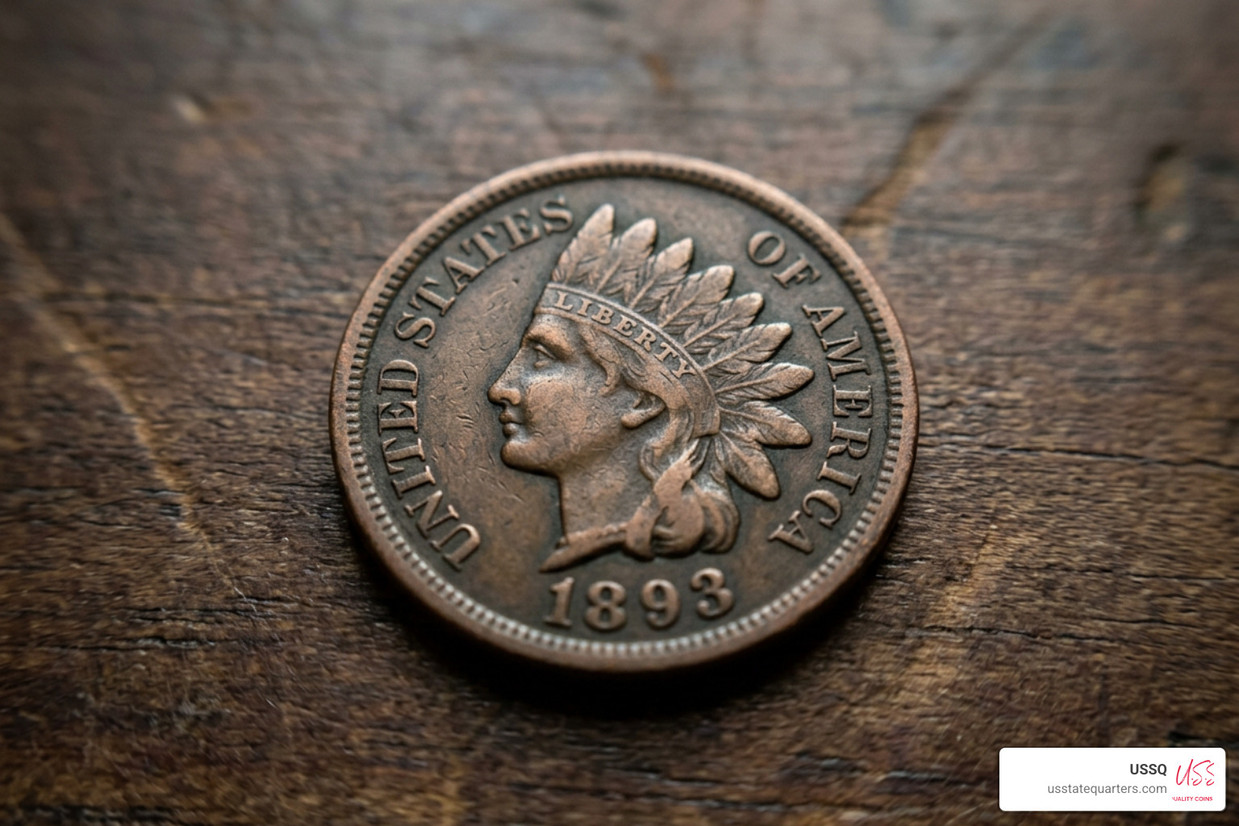
Despite its popular name, the obverse does not actually depict a Native American chief. Instead, it features Lady Liberty wearing a traditional Native American feathered headdress. Longacre’s design was intended to represent a uniquely American concept of Liberty, though the "Indian Head" nickname has stuck firmly for well over a century.
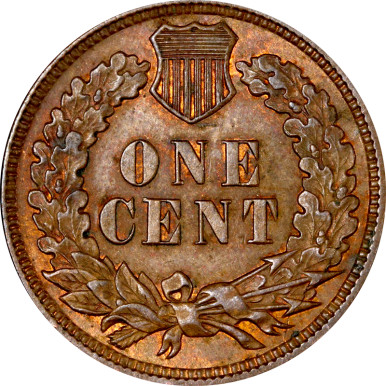
On the reverse, the coin features a robust oak wreath surrounding the denomination "ONE CENT," topped by a small federal shield. This reverse design is classified as the "Type 3" style, which was used from 1860 until the end of the series in 1909.
Coin Specifications:
- Designer: James B. Longacre
- Mint Location: Philadelphia (No mint mark)
- Composition: 95% Copper, 5% Tin and Zinc (Bronze)
- Weight: 3.11 grams
- Diameter: 19.00 mm
- Edge: Plain (Smooth)
Because all business strikes were minted at the Philadelphia Mint, you will not find a mint mark on any standard 1893 cent. If you want to dive deeper into the design evolution of these classic bronze pieces, check out our comprehensive overview of Indian Head Pennies.
Grading and Color Designations
When determining the value of your 1893 Indian Head penny, grading is the most critical step. Professional grading services like PCGS and NGC evaluate both the physical wear on the coin and its original color. Because copper is highly reactive to the environment, its surface changes color over time, which dramatically impacts its market value.
To learn the general steps of evaluating these coins yourself, you can read our guide on Grading Indian Head Pennies.
Grading the 1893 Indian Head Penny
To give you a better idea of what professional graders look for, we’ve put together a breakdown of the standard grades and their visual indicators:
| Grade | Technical Designation | Visual Indicators on the Coin |
|---|---|---|
| Good | G-4 | The coin is heavily worn. The main design outlines are visible, but the details in Liberty's feathers and hair are flat. The letters in "LIBERTY" on the headband are completely worn away. |
| Fine | F-12 | Moderate, even wear across the surfaces. The feathers show some separation, and at least a few letters of the word "LIBERTY" are readable on the headband. |
| Extremely Fine | EF-40 | Only light wear is present on the highest points of the design, such as Liberty's cheek, the tips of the feathers, and the ribbon. All letters in "LIBERTY" are sharp and fully separated. |
| Uncirculated | MS-60+ | The coin has never entered circulation. It retains its original details and displays a degree of original mint luster, though there may be minor bag marks or surface spots from storage. |
Color Classifications: BN, RB, and RD
Because copper oxidizes when exposed to oxygen and moisture, uncirculated copper coins are categorized into three distinct color designations:
- Brown (BN): Coins that have lost almost all of their original red color, retaining less than 10% of their original mint red luster. Most circulated coins and many old uncirculated coins fall into this category.
- Red-Brown (RB): Coins that retain between 10% and 90% of their original red mint luster. These coins show a beautiful mixture of warm copper-red and chocolate-brown tones.
- Red (RD): Coins that retain 90% or more of their brilliant, original orange-red mint luster. Finding an 1893 cent in this condition is incredibly rare because copper naturally darkens over time.
A "Red" designation on an uncirculated 1893 cent commands an enormous price premium because it represents a true condition rarity.
1893 Indian Head Penny Value and Market Prices
Because of the low survival rate of this coin in high grades, the price spectrum is massive. While a heavily worn penny from 1893 is highly affordable for casual collectors, a pristine, original mint-red specimen is a prize that only advanced collectors can afford.
To help you understand what your coin might be worth, let’s look at the current market values across different grades and strikes. You can cross-reference these with the 1893 Indian Head Penny Value | Discover Their Worth and the authoritative 1893 Indian Cent Values & Prices | Greysheet price guides.
Circulated and Uncirculated Price Guide
For standard business strikes (the coins made for daily spending), prices remain very accessible in circulated grades but rise rapidly in Mint State:
- Good (G-4): $2.00 – $3.00
- Fine (F-12): $4.00 – $5.00
- Extremely Fine (EF-40): $11.00 – $20.00
- About Uncirculated (AU-50): $16.50 – $45.00
- Mint State 63 Brown (MS-63 BN): $70.00 – $90.00
- Mint State 63 Red-Brown (MS-63 RB): $120.00 – $150.00
- Mint State 65 Red (MS-65 RD): $900.00 – $1,500.00
- Mint State 67 Red (MS-67 RD): $25,000.00 – $43,000.00+
The record for a business strike 1893 cent stands at an incredible $43,125, which was paid at an auction in 2009 for an immaculate specimen graded MS-67 Red by PCGS. PCGS population data shows that only three examples have ever achieved this grade, making it a legendary condition rarity.
If you are looking to add an affordable or mid-grade piece to your album, we invite you to browse our selection of Indian Head pennies.
Proof Strike Values
In addition to the millions of pennies made for circulation, the Philadelphia Mint struck a tiny run of 2,195 proof coins specifically for collectors. These coins were struck using polished dies and specially prepared planchets, resulting in mirror-like fields, sharp details, and squared-off rims.
Because proofs were sold directly to collectors and kept in protective envelopes, they survived in much better condition than business strikes. However, they are still highly sought after:
- Proof 63 Brown (PR-63 BN): ~$175 – $250
- Proof 65 Red-Brown (PR-65 RB): ~$350 – $500
- Proof 66 Red (PR-66 RD): ~$2,500 – $4,000+
- Proof 66 Brown (PR-66 BN): Can fetch up to $6,300+ depending on the eye appeal and toning.
Varieties, Errors, and Rarity Comparisons
Every year of the Indian Head cent series has its own unique personality. If you compare the 1893 to the 1892 Indian Head Penny or the Indian Head Penny 1898, you'll find that the 1893 is highly popular due to several distinct die varieties and striking errors.
Key Varieties and Errors of the 1893 Indian Head Penny
If you have a magnifying glass or a coin microscope, keep a close eye out for these valuable varieties:
- FS-301 (Snow-2) Repunched Date: This is the most famous and widely recognized variety for the year. It features clear doubling on the "8," "9," and "3" digits of the date. In Mint State grades, this variety can command a premium of 100% or more over a standard coin.
- RPD Snow-1 (FS-302 / RPD-003): This variety shows a bold repunching of the "189" digits to the south. It is relatively easy to spot even in lower, circulated grades. You can view detailed diagnostic photos of this variety on the 1893 RPD-003 | 1893 Snow-1 reference page.
- Double Strikes and Brockages: Occasionally, dramatic mint errors slipped out of the Philadelphia Mint. A double-struck 1893 cent can fetch between $1,000 and $3,000+ at auction. Even scarcer are reverse brockage errors (where a coin gets stuck to a die and presses its image into the next blank), which have sold for upwards of $2,500.
Rarity Comparison to Other Indian Head Cents
While the 1893 cent is a condition rarity in MS-65 Red or higher, it is considered a common date in circulated grades.
To put its rarity in perspective, let’s compare its mintage and survival rates to other key dates in the series:
- 1877 Indian Head Cent: The undisputed king of the series, with a tiny mintage of only 852,500 coins. It is incredibly rare in all grades.
- 1909-S Indian Head Cent: The lowest mintage of the entire series at just 309,000 coins.
- 1908-S Indian Head Cent: Notable as the very first mint-marked cent in U.S. history, with a mintage of 1,115,000.
- 1893 Indian Head Cent: With 46.6 million minted, it is easy to find in worn condition, but with fewer than 15 examples estimated to survive in grades of MS-65 Brown or better, it is a formidable challenge for registry-set collectors.
Frequently Asked Questions about the 1893 Indian Head Penny
Does the 1893 Indian Head penny have a mint mark?
No. All business strike and proof 1893 Indian Head pennies were struck at the Philadelphia Mint. During this era, the Philadelphia Mint did not use a mint mark on its coins. If you see an 1893 penny, it will have a plain field beneath the wreath on the reverse.
Why is the 1893 Indian Head penny considered a condition rarity?
Because of a supplier dispute in 1893, the Mint was forced to melt down older copper cents and obsolete two-cent pieces to make planchets. This recycled metal often contained minor impurities, which led to lower-quality strikes. Combined with the heavy circulation caused by the Panic of 1893, finding a pristine, original "Red" uncirculated coin today is incredibly difficult.
How can I tell if my 1893 Indian Head penny is a proof?
Proof coins have highly reflective, mirror-like fields, extremely sharp design details, and squared-off, sharp rims. Business strikes, even when uncirculated, have a satin-like luster and slightly rounded rims. If you suspect you have a proof, it is highly recommended to have it certified by PCGS or NGC.
Conclusion
The 1893 Indian Head penny is a beautiful piece of American history that bridges the gap between the artistic triumphs of the World's Columbian Exposition and the economic struggles of the Panic of 1893. Whether you are holding a heavily worn $3 pocket-change survivor or a sparkling, multi-thousand-dollar Gem Red specimen, this coin represents the resilience of American coinage.
At USSQ (operated by Coins Online LLC), we’ve been helping collectors build their dream coin collections since 1999. We carry thousands of products, offer competitive pricing, low shipping rates, and a hassle-free 14-day return policy.
If you're ready to add this historic coin or other beautiful collectible Indian Head cents to your collection, explore our inventory today! Happy collecting!
See our wheat pennies for current prices.
Recent Posts
-

Walking Liberty Half Dollar Value Guide: Key Dates, the 1921 Problem, and What Yours Is Really Worth
Ask a room full of collectors to name the most beautiful U.S. coin and the Walking Liberty half doll
-
The 2026 Semiquincentennial Proof Set: What's in It, Why It Costs $107, and Whether to Buy One
On October 6 at noon Eastern, the U.S. Mint puts the 2026 Semiquincentennial Proof Set on sale at $1