Grading Indian Head Pennies Without Getting Short-Changed
Why Grading Indian Head Pennies Can Make or Break a Sale
Grading Indian Head pennies accurately is the single most important skill you need before buying or selling one. Get the grade wrong, and you either leave money on the table or overpay for a coin that isn't worth what you thought.
Here's a quick-reference grading summary to get you oriented:
| Grade | What You'll See | Typical Common-Date Value |
|---|---|---|
| AG-3 (About Good) | No LIBERTY visible; devices blend into rim | $1-2 |
| G-4 (Good) | Outline clear; no LIBERTY; flat detail | $2-5 |
| VG-8 (Very Good) | Partial LIBERTY; some feather detail | $5-10 |
| F-12 (Fine) | Full LIBERTY readable; leaves outlined | $10-15 |
| VF-20/35 (Very Fine) | Bold LIBERTY; hair curls separated from ribbon | $15-30 |
| EF-40/45 (Extremely Fine) | Light wear on highest points only | $30-55 |
| AU-50/58 (About Uncirculated) | Trace wear; 25-75%+ mint luster remains | $50-100 |
| MS-60/63 (Mint State) | No wear; contact marks present | $75-200 |
| MS-65+ (Gem Mint State) | No wear; near-perfect surfaces; strong eye appeal | $200-800+ |
The stakes are real. A 1877 Indian Head penny — the most desirable key date in the series — is worth around $650 in G-4 but can climb past $149,500 in MS-66. That's not a typo. One or two grade points on a key date can mean thousands of dollars.
Indian Head cents were struck from 1859 to 1909, with a total mintage of nearly 1.85 billion coins. Most are common. But the condition of any of them — common or rare — determines almost everything about its value.
I'm Chris Sistrunk, owner of USSQ, where my team ships more than 80,000 authentic U.S. Mint coins annually, including Indian Head pennies and wheat pennies, to a community of over 60,000 collectors worldwide. I've spent years working with graded coins and studying the criteria that professional services like PCGS and NGC use, and in this guide I'll walk you through exactly how grading Indian Head pennies works — step by step.
The Anatomy of Wear: Design High Points and Composition
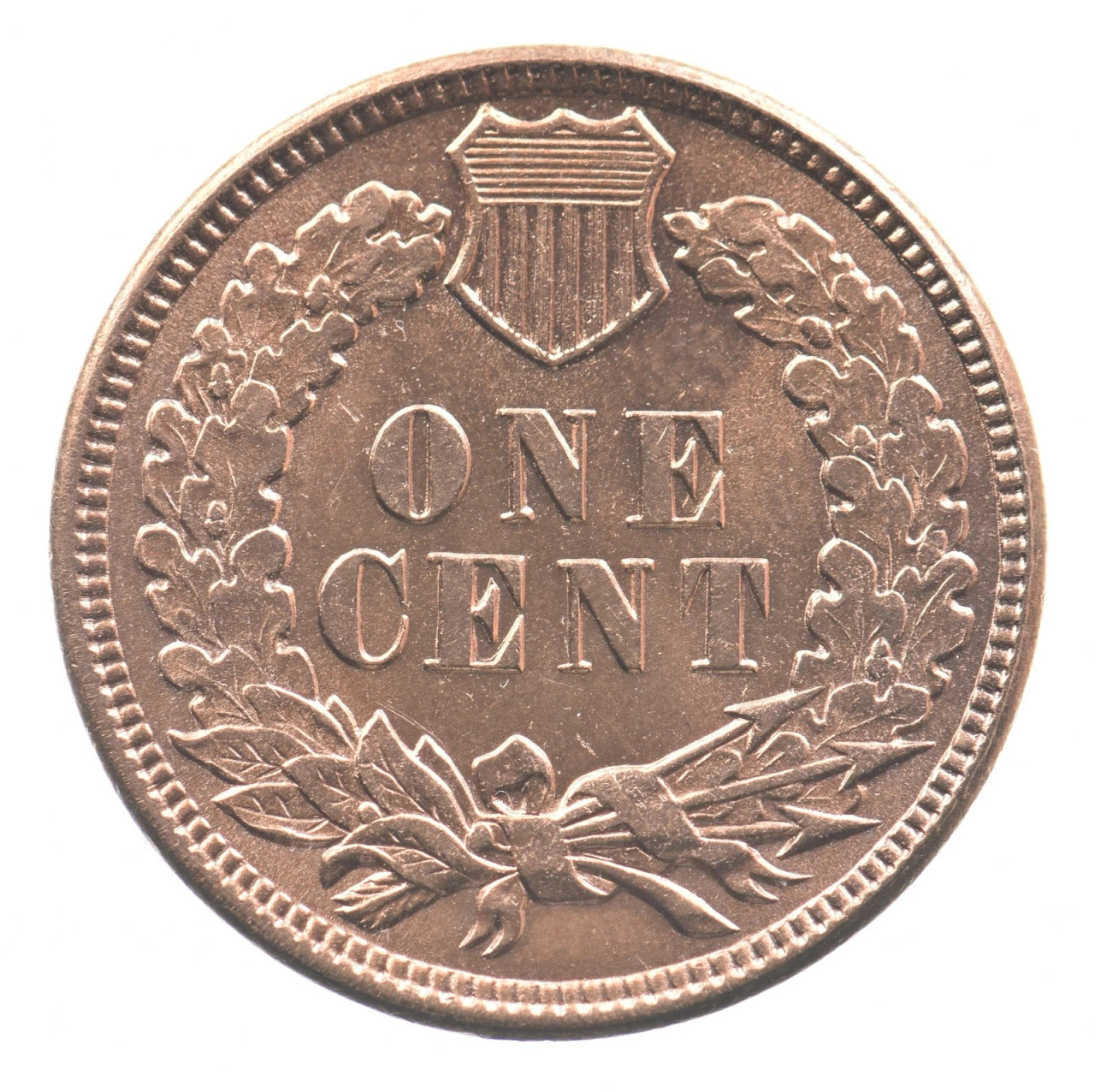
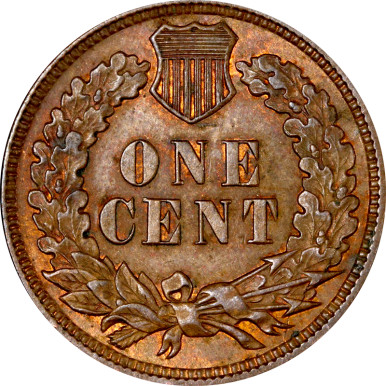
To accurately assess an Indian Head penny, we first need to understand its design anatomy and how its metal composition changed over time. Designed by Chief Engraver James B. Longacre, the obverse features Lady Liberty wearing a Native American feather headdress. The reverse features a simple laurel wreath on the 1859 issues, which was changed in 1860 to an oak wreath with a Union shield at the top.
Every coin has "design high points"—the raised elements that sit highest on the coin's surface. When a coin enters circulation, these high points rub against other coins, pockets, and cash drawers first.
On the obverse of the Indian Head cent, the key high points are:
- The tips of the headdress feathers
- The hair curls above the ear and draping down the neck
- The cheekbone and the tip of the nose
- The ribbon knot and the ribbon ends hanging down the back of the neck
On the reverse, the high points are:
- The leaf clusters on the oak wreath
- The bow at the bottom of the wreath
- The horizontal and vertical lines inside the Union shield (on 1860–1909 issues)
The Great Composition Shift: "Fatties" vs. Bronze
As we learn how to accurately grade Indian Head pennies, we must account for the physical composition of the coin. The series is split into two distinct eras:
- Copper-Nickel Era (1859–1864): These early cents consist of 88% copper and 12% nickel. They are thicker, heavier (weighing 4.67 grams), and have a distinct pale, silvery-gray hue. Collectors affectionately call these "fatty" pennies. Because nickel is a very hard metal, these coins were extremely difficult for the U.S. Mint to strike fully. Dies wore down quickly, meaning many copper-nickel pennies left the mint with flat details that look like wear but are actually just weak strikes.
- Bronze Era (1864–1909): In mid-1864, the composition changed to 95% copper and 5% tin and zinc. These bronze cents are thinner, lighter (3.11 grams), and have a warm copper-red color. The softer metal allowed for much sharper strikes, but copper is highly reactive, making these coins susceptible to toning, environmental damage, and corrosion.
When grading Indian Head pennies, always check the year first. A flat feather tip on an 1861 copper-nickel cent might be a strike deficiency, whereas the same flat tip on an 1888 bronze cent is almost certainly circulation wear.
Step-by-Step Guide to Grading Indian Head Pennies
Now let's dive into the systematic process of grading. When professional graders at third-party services like NGC or PCGS evaluate these pennies, they look at specific focal points in a precise order. To get a feel for how they operate, you can study the Grading Indian Cents (1859-1909) - NGC guidelines.
We recommend evaluating your coins using these five key focal areas:
- The LIBERTY Headband: This is the ultimate "cheat code" for quick-grading. The word "LIBERTY" is incused into the headband across Liberty's forehead. Because it is highly prone to wear, the number of visible letters tells you almost instantly where your coin sits on the grading scale.
- The Feather Tips: Look at the top-left portion of the headdress. Are the tips of the feathers distinct, or have they merged into a solid flat block?
- The Ribbon Diamonds: On the ribbon hanging down the back of the neck, there is a diamond-shaped pattern. These diamonds are incredibly fragile and only appear on higher-grade circulated coins (Very Fine and up) or uncirculated pieces.
- The Shield Lines: On the reverse, check the Union shield. Look for the fine vertical and horizontal lines. In lower grades, these lines wear away completely, leaving a flat, smooth shield outline.
- The Wreath Details: Look at the oak leaves and the bow at the bottom. Are the leaf veins visible? Is the bow clearly defined, or does it look like a flat blob?
Grading Indian Head Pennies in Circulated Grades (AG-3 to VF-35)
For the vast majority of Indian Head pennies found in old jars or inherited collections, the grade will fall somewhere between About Good and Very Fine. Here is how to distinguish between them:
About Good (AG-3)
The coin is heavily worn. The rims (the raised outer borders) are worn flat and have started to blend directly into the fields or the lettering. The portrait of Liberty is a flat silhouette, and no letters of "LIBERTY" are visible.
Good (G-4)
The rim is complete and fully separated from the fields on both sides. The lettering and date are clear, but the inner details are completely flat. The feathers show no internal lines, and "LIBERTY" is entirely unreadable, though you might see a faint, ghostly outline of a letter or two.
Very Good (VG-8)
At least three letters of "LIBERTY" must be clearly readable (typically the "L", "I", and "B"). The feather tips show very slight separation, and the hair over the ear begins to show a little definition. The rims are sharp and complete. If you want to check your coin's headband quickly, you can compare it against known grading guides.
Fine (F-12)
All seven letters of "LIBERTY" must be fully visible and readable. They may be worn flat, but there are no breaks in the letters. The hairline is now clearly separated from the forehead, and the tips of the feathers show clear, individual outlines. On the reverse, the leaves in the wreath are flat but fully outlined. Learn more about how this grade affects market values in our guide on Indian Head Pennies Value.
Very Fine (VF-20 to VF-35)
"LIBERTY" is bold, sharp, and deeply defined. The hair curls near the neck are completely separated from the ribbon. The ribbon diamonds are beginning to show, though they may be slightly flat. On the reverse, the leaves in the wreath show clear internal veins, and the lines in the shield are distinct.
Grading Indian Head Pennies in About Uncirculated and Mint State Grades (AU-50 to MS-67)
Once a coin crosses into the About Uncirculated (AU) and Mint State (MS) categories, standard wear descriptions take a backseat to mint luster, surface marks, and eye appeal. You can read a deep-dive on these advanced grades in professional grading guides.
About Uncirculated (AU-50 to AU-58)
About Uncirculated coins look uncirculated at first glance, but close inspection under a light reveals trace wear (friction) on the highest design points, such as the cheekbone and the tips of the feathers.
- AU-50: Features trace wear on all high points, but at least 25% of the original mint luster must remain in the protected areas around the lettering.
- AU-55: Excellent eye appeal with wear restricted only to the very tips of the high points. More than 50% of the original mint luster remains.
- AU-58: This is the "slider" grade. The coin has nearly full mint luster (75%+), but a tiny break in the luster on the cheek or hair indicates it was briefly in circulation.
Mint State (MS-60 to MS-67)
Mint State coins have zero circulation wear. Every detail is exactly as it was when the coin left the coining press.
- MS-60: No wear, but the coin may look dull, have poor eye appeal, or be covered in heavy bag marks and scratches from being shipped in canvas bags.
- MS-63: A solid, attractive uncirculated coin. It features bright mint luster but allows for 5 to 10 moderate contact marks on the cheek or fields.
- MS-65: A gorgeous "Gem" coin. It has blazing mint luster, a strong strike, and only a few tiny, microscopic marks that are invisible without magnification.
- MS-67: A virtually perfect coin. It exhibits incredible eye appeal, a full strike, and only two or three minuscule marks under a 10x magnifying glass.
If you are lucky enough to have a high-grade specimen, check out our resource on Indian Head Penny Value to see how these grades trade in the open market.
Color Designations, Proofs, and Key Dates
When dealing with bronze Indian Head cents (1864–1909), the numerical grade is only half the story. The color of the copper surfaces plays a massive role in the coin's final value. Professional grading services assign one of three color designations:
- Red (RD): The coin retains 95% or more of its original bright orange-red mint color. These are highly coveted and command massive premiums.
- Red-Brown (RB): The coin shows a mixture of original red and brown toning, with between 5% and 95% of the original red color remaining.
- Brown (BN): The coin has fully toned over time, leaving less than 5% of its original red color. Most circulated coins are BN.
| Color Designation | Percentage of Original Red | Visual Appearance | Premium Level |
|---|---|---|---|
| Brown (BN) | Less than 5% | Chocolate brown, sometimes with blue/green hues | Baseline Value |
| Red-Brown (RB) | 5% to 95% | Mixed brown and orange-red luster | 2X to 3X over BN |
| Red (RD) | 95% or More | Bright, original fiery orange-red copper | 5X to 10X+ over BN |
Proof Indian Head Cents and Toned Proofs
The Philadelphia Mint struck highly polished "Proof" coins every year for collectors, averaging about 2,000 pieces annually. Proofs were struck on specially polished planchets using polished dies, resulting in mirror-like fields and razor-sharp details.
Over decades of storage in original paper envelopes or leather presentation cases, some proof bronze pennies developed breathtaking, iridescent toning. These toned proofs can exhibit shades of violet, emerald green, magenta, and electric blue. Because green and rainbow-toned proofs are highly sought after by advanced collectors, they often command massive premiums—sometimes double or triple the standard proof value!
Key Dates and Varieties to Watch For
While grading common dates from the early 1900s is fun, grading key dates can be life-changing. Here are the most critical dates to search for in your collection:
- 1877: The king of the series. With a low mintage of only 852,500, very few were saved in high grades. Even a heavily worn G-4 specimen is worth about $650, while an MS-66 example can fetch $149,500.
- 1909-S: Struck at the San Francisco Mint (indicated by an "S" mint mark on the reverse under the wreath), this coin has the lowest mintage of the entire series at just 309,000 pieces. It ranges from $376 in G-4 to nearly $100,000 in Gem condition.
- 1908-S: The second San Francisco issue, with a mintage of 1,115,000. It is highly prized in all grades.
- 1864-L on Ribbon: Late in 1864, James Longacre added a tiny letter "L" (for his last name) to the ribbon behind Liberty's neck. To find it, look at the ribbon hanging down from the last feather. If you see a sharp "L", you have a highly valuable variety!
If you are sorting through older dates, you might also want to read up on the 1881 Indian Head Penny, the 1892 Indian Head Penny, or the Indian Head Penny 1898 to see how their specific values stack up.
Frequently Asked Questions about Grading Indian Head Pennies
How can I grade my Indian Head pennies at home?
To grade your coins at home, you will need a 10x magnifying glass (a jeweler's loupe) and a single, strong light source (such as a desk lamp). Hold the coin under the light and slowly tilt and rotate it. Look for unbroken mint luster in the fields and check the key high points—especially the "LIBERTY" headband and the feather tips. You can use the comparison method by studying high-resolution images of certified coins to match your coin against certified specimens.
Why is the 1877 Indian Head penny so valuable even in low grades?
The 1877 penny is valuable because of a perfect storm of low mintage (852,500) and low survival rate. In 1877, the United States was suffering through an economic depression, so very few people could afford to save brand-new pennies. Most went straight into heavy circulation and were worn down to nothing. Today, the demand from collectors trying to complete an Indian Head set far exceeds the number of surviving 1877 coins.
Does cleaning an Indian Head penny ruin its grade and value?
Yes, absolutely! Never clean your coins. Harsh cleaning using chemicals, baking soda, pencil erasers, or metal polish strips away the original mint luster and leaves microscopic scratches on the copper. Professional grading services can easily spot a cleaned coin and will refuse to assign it a numeric grade, labeling it instead as "Cleaned" or "Altered Color." This can instantly slash the coin's market value by 50% to 80%. For more on how copper coin preservation affects value, take a look at our Wheat Penny Condition Census guide.
Conclusion
Grading Indian Head pennies is a skill that takes patience, a sharp eye, and practice, but it is incredibly rewarding. By learning to identify the design high points, understanding how copper-nickel and bronze compositions wear, and carefully assessing the "LIBERTY" headband, you can confidently determine whether your penny is a common $2 pocket piece or a multi-thousand-dollar gem.
For rare key dates like the 1877 or the 1909-S, we always recommend submitting your coins to professional third-party grading services like PCGS or NGC for official authentication and grading.
If you are ready to expand your collection or want to find a beautifully preserved piece of history, explore our extensive inventory of Indian Head pennies at USSQ. Happy collecting from Chris Sistrunk and the USSQ Numismatics Team!
See our wheat pennies for current prices.
Recent Posts
-

Walking Liberty Half Dollar Value Guide: Key Dates, the 1921 Problem, and What Yours Is Really Worth
Ask a room full of collectors to name the most beautiful U.S. coin and the Walking Liberty half doll
-
The 2026 Semiquincentennial Proof Set: What's in It, Why It Costs $107, and Whether to Buy One
On October 6 at noon Eastern, the U.S. Mint puts the 2026 Semiquincentennial Proof Set on sale at $1