How Much Are Your Indian Head Pennies Really Worth
How Much Are Indian Head Pennies Really Worth? Here's What to Know First
Indian Head pennies value spans an enormous range - from under $2 for a worn common date to well over $100,000 for a top-grade rarity. Here's a quick snapshot before we dive in:
| Coin Type | Circulated (Good) | Uncirculated (MS) |
|---|---|---|
| Common dates (1880-1907) | $2 - $15 | $20 - $50 |
| Late dates (1900-1909) | $1.80 - $5 | $20 - $50 |
| 1908-S | $120 - $132 | $250 - $556 |
| 1909-S | $350 - $450 | $850 - $1,000+ |
| 1877 (key date) | $900 - $959 | $3,000 - $5,000+ |
| 1873 Doubled Liberty | $400+ | $8,000 - $16,500 |
| 1888/7 Overdate | $1,500+ | $77,000 - $89,000+ |
These coins were struck from 1859 to 1909 - a full 50 years. They passed through the Civil War, Reconstruction, and the rise of American industry. That history alone drives strong collector demand. For the full series overview, start with our Indian Head pennies pillar guide, or browse collectible examples in the Indian Head Pennies category.
But not all Indian Head cents are created equal. The date, mint mark, metal composition, condition, and variety all combine to set the price. A coin that looks like a simple old penny could be worth hundreds - or almost nothing - depending on those factors.
This guide breaks it all down so you know exactly what you have and what it's worth.
- The USSQ Numismatics Team, experienced numismatists at US State Quarters (Coins Online LLC), serving collectors since 1999
1. Start With This Indian Head Cent Value Snapshot
If you have just inherited an old jar of copper coins or finally decided to sort through your childhood collection, you are probably wondering where to start. The value of these classic American pennies depends heavily on where they fall in the rarity spectrum.
Common dates from the twilight of the series, specifically 1900 to 1909, are highly abundant. They serve as fantastic, affordable starter coins for young numismatists. However, if you happen to find a key date or an elusive error variety in your hands, you could be looking at a serious payday.
The market spread between a heavily circulated, well-worn Good coin and an uncirculated Mint State (MS) gem is immense. Additionally, because these are copper coins, the color of the metal - ranging from dark brown to original mint-red - plays a massive role in the final price tag.
Here is a quick-reference table to help you compare general value ranges across different collector tiers:
| Rarity Category | Date / Variety | Good (G-4) Value | Fine (F-12) Value | Uncirculated (MS-63+) Value |
|---|---|---|---|---|
| Common Dates | 1900-1909 | $1.80 - $3.00 | $4.00 - $8.00 | $25.00 - $60.00 |
| Common Dates | 1880-1899 | $2.00 - $5.00 | $6.00 - $15.00 | $30.00 - $85.00 |
| Semi-Key Dates | 1908-S | $120 - $132 | $160 - $210 | $250 - $556 |
| Semi-Key Dates | 1872 | $80 - $100 | $150 - $220 | $800 - $1,500+ |
| Key Dates | 1909-S | $350 - $450 | $500 - $600 | $850 - $1,000+ |
| Key Dates | 1877 | $900 - $959 | $1,500 - $1,788 | $3,000 - $7,214+ |
| Major Variety | 1873 Doubled Liberty | $400+ | $800+ | $8,000 - $16,500 |
| Major Variety | 1888/7 Overdate | $1,526+ | $6,785+ | $69,000 - $89,000+ |
How to Read Value Ranges Without Overpaying
When researching coin values, it is easy to get caught up in the astronomical prices seen in record-breaking auction archives. To keep your expectations realistic, you must understand the difference between retail value (what a collector may pay to buy the coin), dealer offer (a lower wholesale-style offer), and actual auction results (the hammer price at major sales).
Generally, raw (uncertified) coins sell for less because their grade and authenticity are not guaranteed. Certified coins - those encapsulated in plastic holders by respected third-party grading services - command a premium.
Furthermore, eye appeal is everything. If a coin has a readable date but is covered in ugly dark spots, it will trade at the low end of the spectrum. If a coin has been harshly cleaned, its value can instantly crash by 30% to 50% or more, even if the details are sharp.
Common Indian Head Cent Values From 1880-1909
For most casual collectors, the pennies found in old family collections will be common dates struck between 1880 and 1909.
- Late-Date Pennies (1900-1909): These are the most common of all. In heavily circulated Good condition, they typically trade for $1.80 to $5. If you manage to find an uncirculated specimen that still looks like it was minted yesterday, the value jumps to a respectable $20 to $50.
- Late 19th-Century Pennies (1880-1897): These are also highly accessible, with most circulated examples trading between $2 and $15.
Because these are so budget-friendly, they make excellent starter pieces for anyone looking to build a complete date set. You can browse available Indian Head pennies or compare additional background in our comprehensive Indian Head Penny Value guide.
Why Some Indian Head Cents Jump From Dollars to Thousands
How does a one-cent piece transition from a $2 pocket-change relic to a five-figure treasure? It boils down to a perfect storm of three factors: scarcity, condition, and color.
First, look at the mintage figures. In the late 1860s and 1870s, economic depressions and post-Civil War hoarding led the U.S. Mint to produce far fewer pennies. Many of those that did enter circulation were melted down or heavily worn.
Second, condition rarity refers to coins that are common in worn condition but practically nonexistent in pristine, uncirculated grades. For example, while a standard 1899 penny is only worth a few dollars in circulated condition, an ultra-gem MS-68 Red specimen shattered records when it sold at auction for $108,000 in 2019.
Finally, major minting errors - like overdates and dramatic doubled dies - add an irresistible layer of intrigue that advanced collectors will battle over.
2. Identify What You Have: Date, Design, Composition, and Mint Mark
Before you can accurately price your coin, you must identify its physical characteristics. The Indian Head cent underwent several design and composition shifts during its half-century run.
Indian Head Penny Minting Years and Design Basics
Designed by Chief Engraver James B. Longacre, the Indian Head penny debuted in 1859 as a replacement for the short-lived Flying Eagle cent. It was struck every year until 1909, when it was replaced by the iconic Lincoln cent.
Interestingly, the obverse of the coin does not depict an actual Native American chief. Instead, it features Lady Liberty wearing a traditional Native American feather headdress. According to popular legend, Longacre used his young daughter Sarah as the model, though historians have largely debunked this, noting Sarah was 30 years old at the time. Longacre himself stated that he chose the headdress as a unique, distinctly American symbol of liberty.
The reverse design evolved quickly:
- 1859: Features a laurel wreath surrounding the words
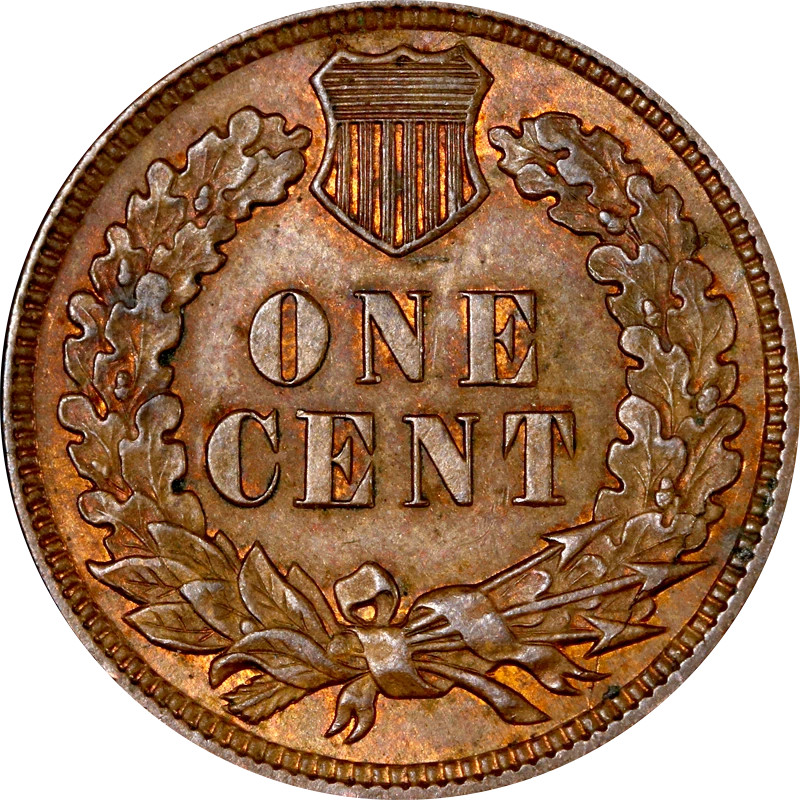
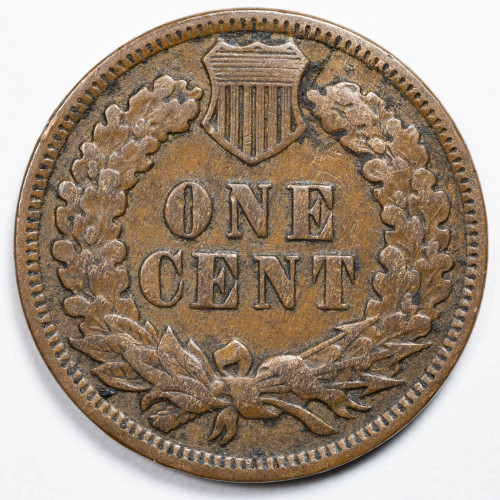
ONE CENTwith a plain, flat top. - 1860-1909: The reverse was updated to feature a broader oak wreath with a Union Shield added to the top, symbolizing national unity during and after the Civil War.
For broader historical context on official U.S. circulating coinage, the U.S. Mint maintains a helpful overview of circulating coins. For a deep dive into the history of these designs, you can read our series history, or browse collectible Indian Head pennies available from USSQ.
Copper-Nickel vs. Bronze Indian Head Pennies
One of the most important distinctions in this series is the metal composition.
- Copper-Nickel White Cents (1859-1864): The earliest Indian Head pennies were made of 88% copper and 12% nickel. These coins are thicker, heavier, weighing 4.67 grams, and have a distinct pale, silvery-gray color. Because of their light hue, people of the Civil War era nicknamed them white cents.
- Bronze Cents (1864-1909): In 1864, rising metal costs forced the Mint to transition to a thinner bronze composition, 95% copper and 5% tin and zinc, weighing 3.11 grams. These display the familiar reddish-brown copper patina.
An 1864 penny can be found in both copper-nickel and bronze, so keeping a digital scale handy is a smart move.
Where to Find Mint Marks on Indian Head Cents
For 49 of its 50 years of production, the Indian Head penny was struck exclusively at the Philadelphia Mint. Because Philadelphia did not use mint marks at the time, the vast majority of these pennies have no mint mark at all.
However, in 1908 and 1909, the San Francisco Mint joined in. To find the mint mark on a 1908-S or 1909-S penny, flip the coin to the reverse side. Look closely at the very bottom of the coin, in the space directly below the ribbon bow that ties the oak wreath together. If you see a tiny, distinct letter S, you have found a rare San Francisco issue.
Be extremely careful: because these S mint mark coins are highly valuable, counterfeiters sometimes glue fake S marks onto common Philadelphia coins. Always inspect this area under strong magnification or buy certified examples to protect yourself.
3. Grade the Coin Before You Guess the Price
Once you have identified the date and composition, you must determine its grade. In the coin collecting world, condition is king, and a single grade step can mean a difference of thousands of dollars.
Why Condition Changes the Price So Much
Professional numismatists use the Sheldon Grading Scale, which ranges from 1 (nearly smooth) to 70 (perfect, flawless coin). For circulated Indian Head pennies, the grading process is highly visual and relies on specific wear points:
- Good (G-4): The coin is heavily worn. The date is readable, but the details on the feathers are flat. The rim is mostly intact, but the letters of the word LIBERTY on Lady Liberty's headband are completely worn away.
- Fine (F-12): Moderate wear is visible. The ribbon and hair are worn, but all seven letters of the word LIBERTY on the headband are clearly readable. This is the primary focal point for grading circulated pieces.
- Extremely Fine (EF-40): The coin has very light wear. The tips of the feathers are sharp, the headband has clear edges, and the diamonds in the ribbon are visible.
- Mint State (MS-60 to MS-70): The coin has zero wear from circulation. It retains its original, reflective mint luster, though it may have tiny scratches or bag marks from the minting process.
Brown, Red-Brown, and Red Color Designations
When bronze pennies are graded in Mint State, they receive an official color designation that heavily influences their price:
- Brown (BN): The coin has fully oxidized. It has lost its original mint luster and turned a chocolate-brown color.
- Red-Brown (RB): The coin retains between 5% and 95% of its original copper-red luster, with the rest showing brown toning.
- Red (RD): The holy grail for copper collectors. The coin retains 95% or more of its brilliant, original orange-red mint luster.
A Red designation can easily double or triple the price of a Red-Brown or Brown coin of the exact same numerical grade.
Damage, Cleaning, and Environmental Problems That Lower Value
We cannot stress this enough: never clean your old coins.
Many beginners make the mistake of using baking soda, metal polish, or vinegar to make their old pennies look shiny and new. To an experienced collector or dealer, a cleaned coin is instantly recognizable. Under a magnifying loupe, a cleaned coin will show fine parallel scratches (called hairlines) and have an unnatural, dull pinkish-orange color.
Cleaning strips away the original surface patina and can instantly slash a coin's value by 50% or more. Other environmental issues to watch out for include:
- PVC Damage: Caused by storing coins in cheap, soft plastic flips. It leaves a gooey green residue that eats into the copper.
- Verdigris: A bright green, crusty oxidation that permanently damages the metal surface.
- Rim Bumps and Scratches: Physical damage from being dropped or mixed in jars with other metals.
4. Look for the Key Dates and Major Varieties Collectors Pay For
Now for the fun part: searching for the rare treasures. While billions of these pennies were struck, a handful of dates and varieties are highly prized by collectors.
If you are sorting through a collection, keep this handy checklist of the top Indian Head pennies to look for:
- 1877 Key Date: The undisputed king of the regular issues.
- 1909-S Key Date: The lowest mintage regular-issue coin in the series.
- 1908-S Semi-Key: The first branch-mint penny.
- 1873 Doubled Liberty: A dramatic doubled die error on the obverse.
- 1888/7 Overdate: A rare and highly valuable die variety.
- 1864 L on Ribbon: The first year featuring Longacre's initial.
- 1869/9 Doubled Date: A clear doubled-date error.
The 1877 Indian Head Penny
The 1877 Indian Head Penny is the most famous key-date coin in the entire series. Due to a severe economic depression, the Mint produced only 852,500 pieces this year. Because few collectors saved them, they are incredibly scarce today in all conditions.
Even in heavily worn Good condition, a genuine 1877 penny commands $900 to $959. If you find one in Extremely Fine (EF-40) condition, the value climbs to around $2,500, while uncirculated examples easily bring $3,000 to $5,000+. Gem-quality MS-65 Red examples are legendary, with auction records routinely eclipsing the $100,000 mark.
Because of its extreme value, the 1877 is the most heavily counterfeited date in the series. Never buy a raw 1877 penny unless it has been certified by a top-tier grading service.
The 1909-S and 1908-S Indian Head Pennies
The final years of the series brought the only two branch-mint issues, both struck at the San Francisco Mint:
- 1909-S: This coin has the lowest mintage of any regular-issue Indian Head penny, with only 309,000 pieces struck. Values range from $350 to $450 in Good condition, and quickly climb to $850 to $1,000+ for uncirculated specimens. It was struck in the same year as the famous 1909-S VDB Lincoln cent, making it a legendary crossover piece.
- 1908-S: With a slightly higher mintage of 1,115,000, the 1908-S is a highly sought-after semi-key date. It typically ranges from $120 to $132 in Good condition, up to $250 to $556 in uncirculated grades.
The 1864 L on Ribbon and 1864 Transition Varieties
The year 1864 was a chaotic one at the U.S. Mint. As they transitioned from copper-nickel to bronze, Chief Engraver James Longacre made a subtle change: he added a tiny letter "L" (his last initial) to the ribbon behind Lady Liberty's neck.
To find the "L," look at the lower ribbon that drapes down the back of Liberty's neck, just behind her ear. On the "L on Ribbon" variety, the tip of the ribbon is pointed, and a tiny, sharp "L" is visible under magnification.
An 1864 penny without the L is a common coin worth about $10 to $15 in circulated condition. However, an 1864 with the L on Ribbon starts at around $60 in Good condition, and can easily fetch $3,600 to $26,000+ in top-tier, red uncirculated grades!
The Big Error and Variety Coins: 1888/7, 1873 Doubled Liberty, and 1869/9
If you love errors, keep your magnifying glass close for these three legendary varieties:
- 1888/7 Overdate: On this rare variety, a 1887 die was punched over with an 1888 date. Look closely at the last "8" in the date—you will see the clear, distinct corner of a "7" protruding from the top-left side of the digit. This is an incredibly rare variety that can reach values of $77,125 to $89,000 in higher grades!
- 1873 Doubled Liberty: Often called the "King of Indians," this variety features dramatic doubled-die doubling on the obverse. Look at the word "LIBERTY" on the headband and the feathers—you will see clear, prominent double outlines. This error starts at over $400 in Good condition and can exceed $8,000 to $16,500 in higher grades.
- 1869/9 Doubled Date: This variety shows a clear, shifted doubling on the date digits. It is valued at $175 to $281 in Good condition and can reach $1,522 to $2,033 in uncirculated grades.
5. Buy, Sell, and Protect Indian Head Pennies the Smart Way
Whether you are looking to add new pieces to your collection or want to organize an old family stash, doing so safely requires a bit of numismatic know-how.
Where Collectors Buy Indian Head Pennies
If you are looking to buy, start with sources that clearly describe the coin's date, grade, color, and return policy:
- USSQ Online Selection: Established online coin sellers give collectors a convenient way to compare dates, grades, and prices. If you are ready to add history-rich cents to your album, browse our Indian Head Pennies category. For background reading on the series, you can also review our Indian Head Pennies overview.
- Date-Specific References: For specific-date comparisons, review current listings and date guides when available, such as an 1898 Indian Head Penny, and compare the described grade, color, and surfaces before buying.
- Certified vs. Raw: For common dates under $50, buying raw (uncertified) coins can be economical. However, for key dates like the 1877 or 1909-S, certified examples provide stronger authentication and grade confidence.
While you are exploring early small cents, you might also enjoy branching out into other historic U.S. series. Many collectors pair their cents with Wheat pennies, use our Wheat pennies background guide for context, or add classic Morgan dollars to build a diverse, multi-era collection.
How to Prepare Indian Head Pennies Before You Sell
Before discussing a sale, take time to identify and document what you have:
- Sort by Date and Mint Mark: Separate 1877, 1908-S, 1909-S, 1864 L on Ribbon, and major varieties from common dates.
- Check for Damage: Note cleaning, corrosion, rim bumps, scratches, or green residue. These issues affect value even when the date is scarce.
- Compare Recent Results Carefully: Use certified auction records and current retail listings as reference points, but condition, color, and eye appeal can create large price differences.
- Consider Certification for Better Coins: If a coin appears to be a key date, major variety, or worth several hundred dollars or more, professional authentication can make future resale much easier.
To get a feel for how one common-date coin can vary by condition and eye appeal, read our detailed 1898 date guide.
What to Watch Out For Before You Buy or Sell
The rare coin market can be tricky for beginners. Always keep these protective rules in mind:
- Watch Out for Added Mint Marks: Scammers sometimes take a common 1909 Philadelphia penny and solder a fake S onto the reverse. Always inspect the mint mark area under a high-power loupe to make sure there are no seams or glue residues.
- Beware of Altered Dates: An 1897 penny can be altered to look like an 1877 by shaving down the first 9. Professional certification is your best shield against fraud on expensive dates.
- Avoid Vague Grading: If a listing calls a coin Uncirculated but it has obvious wear on Lady Liberty's cheek, trust your eyes over the label.
- Be Skeptical of Unsearched Lots: Many online listings describe old rolls or estate groups as unsearched. In many cases, the best dates have already been removed.
Frequently Asked Questions About Indian Head Penny Values
Are Indian Head pennies still found in circulation?
While it is technically possible to find an Indian Head penny in pocket change, it is incredibly rare today. Most surviving examples were pulled from circulation by the mid-20th century. Today, your best bet for finding them in the wild is searching through old jars of change in estate sales, inherited collections, or metal detecting around historic properties.
If you do find one, the most important first step is checking if the date is readable. A coin with a completely worn-away date is worth only a few cents as a novelty.
Should I get my Indian Head penny professionally graded?
We highly recommend professional third-party grading for any key dates (1877, 1909-S), major varieties (1888/7, 1873 Doubled Liberty), or any coin you suspect is worth more than $500. Professional grading serves two vital purposes: it helps confirm the coin is authentic, and it assigns an official, widely understood grade. This gives future buyers more confidence and helps support stronger resale value.
What is the best way to start collecting Indian Head cents?
The best way to start is by focusing on common, affordable dates from the 1880s, 1890s, and 1900s. You can browse collectible Indian Head pennies and purchase many common dates for just a few dollars each in decent, circulated condition.
As you learn the series and get better at visual grading, you can gradually work your way backward into the scarcer Civil War-era dates. For example, reading about the 1881 date guide or the 1892 date guide is a wonderful, low-cost way to build a fascinating historical collection.
Conclusion
Determining what your Indian Head cents are worth does not have to be a guessing game. By following our simple, step-by-step checklist, you can easily narrow down what your old copper coins may bring:
- Check the Date First: Look for key years like 1877 and 1909-S.
- Look for the Mint Mark Second: Flip the coin over and check below the wreath ribbon for the San Francisco S.
- Evaluate the Grade Third: Check if the letters of LIBERTY are fully visible on the headband.
- Inspect for Varieties Fourth: Use a magnifying glass to check for doubled dies, overdates, or the 1864 L on the ribbon.
Remember: never clean your coins, store them in safe, non-PVC Mylar holders to protect their copper surfaces, and always compare your coins to recent certified sales.
Whether you are holding a single family heirloom or looking to build a magnificent collection, these beautiful pennies are a stunning piece of American history. If you are ready to take the next step on your collecting journey, review our Indian Head Pennies overview or browse the Indian Head Pennies category at US State Quarters today.
Recent Posts
-

Walking Liberty Half Dollar Value Guide: Key Dates, the 1921 Problem, and What Yours Is Really Worth
Ask a room full of collectors to name the most beautiful U.S. coin and the Walking Liberty half doll
-
The 2026 Semiquincentennial Proof Set: What's in It, Why It Costs $107, and Whether to Buy One
On October 6 at noon Eastern, the U.S. Mint puts the 2026 Semiquincentennial Proof Set on sale at $1