19th-Century U.S. Minor Coins: A Collector's Map of Cents, Two-Cent Pieces, and Nickels (1857-1912)
Between the Civil War and the First World War, the United States changed almost every small coin in your pocket. Half cents and large cents disappeared, a new small cent arrived, two-cent and three-cent pieces came and went, and the nickel was invented. If you collect old pennies and nickels, it helps to see the whole timeline in one place. This is the map, with links to the detailed guides.

1857: the big copper cents go away
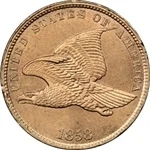
The Act of February 21, 1857 ended the half cent and the large cent. Large cents were expensive to make and clumsy to carry. The replacement was the small cent, introduced in 1856 as a pattern and issued for circulation from 1857, in an alloy of 88% copper and 12% nickel. The first design, the Flying Eagle cent, lasted only 1857 and 1858 because the eagle was hard to strike cleanly and wore quickly.
1859 to 1909: the Indian Head cent
James Longacre's Indian Head design replaced the eagle in 1859. For the first years it was still copper-nickel, and in 1864 the Mint switched to bronze, a copper alloy with tin and zinc, which is why many Civil War era cents are darker. The Indian Head ran until 1909, when the Lincoln cent took over. It is the most collectible of these series, with both cheap dates and serious keys such as the 1877 and the 1909-S. Browse the Indian Head pennies or read our Indian Head penny value guide.
1864 to 1873: the two-cent piece
The two-cent piece was a wartime coin that carried IN GOD WE TRUST for the first time. It had a short life: nearly 20 million were made in 1864, but only 65,000 in 1872, and 1873 was a Proof-only year. See our two-cent piece value guide and the available two-cent pieces.
1865 to 1889: the nickel three-cent piece
In 1865 the Mint added a three-cent coin in copper-nickel, partly because the earlier silver three-cent piece was so small and thin. It was struck until 1889. Later dates have small mintages and are tougher to find than the early ones, and collectors often chase the proof issues.
1866 to 1883: the Shield nickel
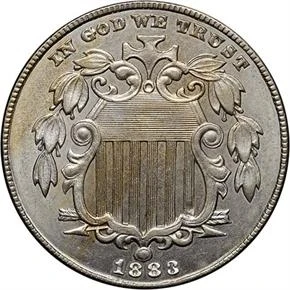
The Shield nickel was the first five-cent coin made of copper-nickel, and it stayed in production for 18 years. It has the With Rays and No Rays types, the scarce 1880, and a proof-only pair in 1877 and 1878. Read the full Shield nickel value guide or browse Shield nickels.
1883 to 1912: the Liberty Head V nickel
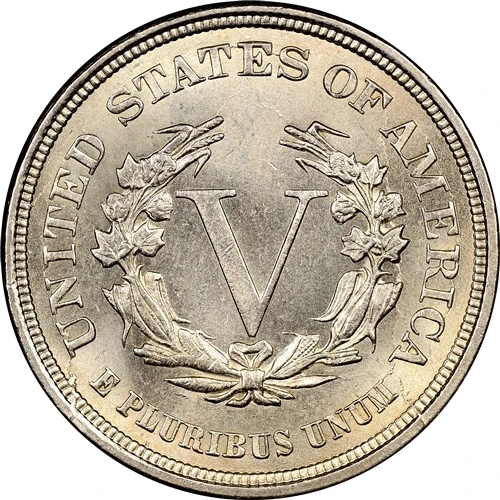
Charles Barber's Liberty Head replaced the Shield in 1883. The first 1883 coins show a large V and no word CENTS, and some were gold-plated and passed off as five-dollar gold pieces. The Mint added CENTS in the same year. The 1885 and the 1912-S are the keys. Our Liberty Head V nickel guide covers the dates, and you can shop Liberty Head nickels.
How to use this timeline
If you are new to the period, a practical starter set is one coin per type: a Flying Eagle or Indian Head cent, a two-cent piece, a Shield nickel, and a Liberty Head nickel. That gives you four different designs from the same 50 years without needing a key date budget. When you are ready to add a key, read the series guide first, since each series has its own problem dates and condition traps. A few of these coins, such as the 1883 No CENTS nickel, are known for later alterations, so favor graded coins from PCGS or NGC for expensive dates, and see money.org for general collecting resources.
Recent Posts
-

DC & U.S. Territories Quarters (2009): Complete Set Guide
If you collected 50 State Quarters and wondered what came next, the answer arrived in 2009: six quar
-
Are 2023 Coins Worth Money? What to Keep and What to Spend
Search for "2023 coins worth money" and you will find plenty of headlines promising a fortune in you