How to Spot a Rare Sacagawea Cheerios Dollar in Your Coin Jar
The Sacagawea Dollar Cheerios Coin: What It Is and What It's Worth
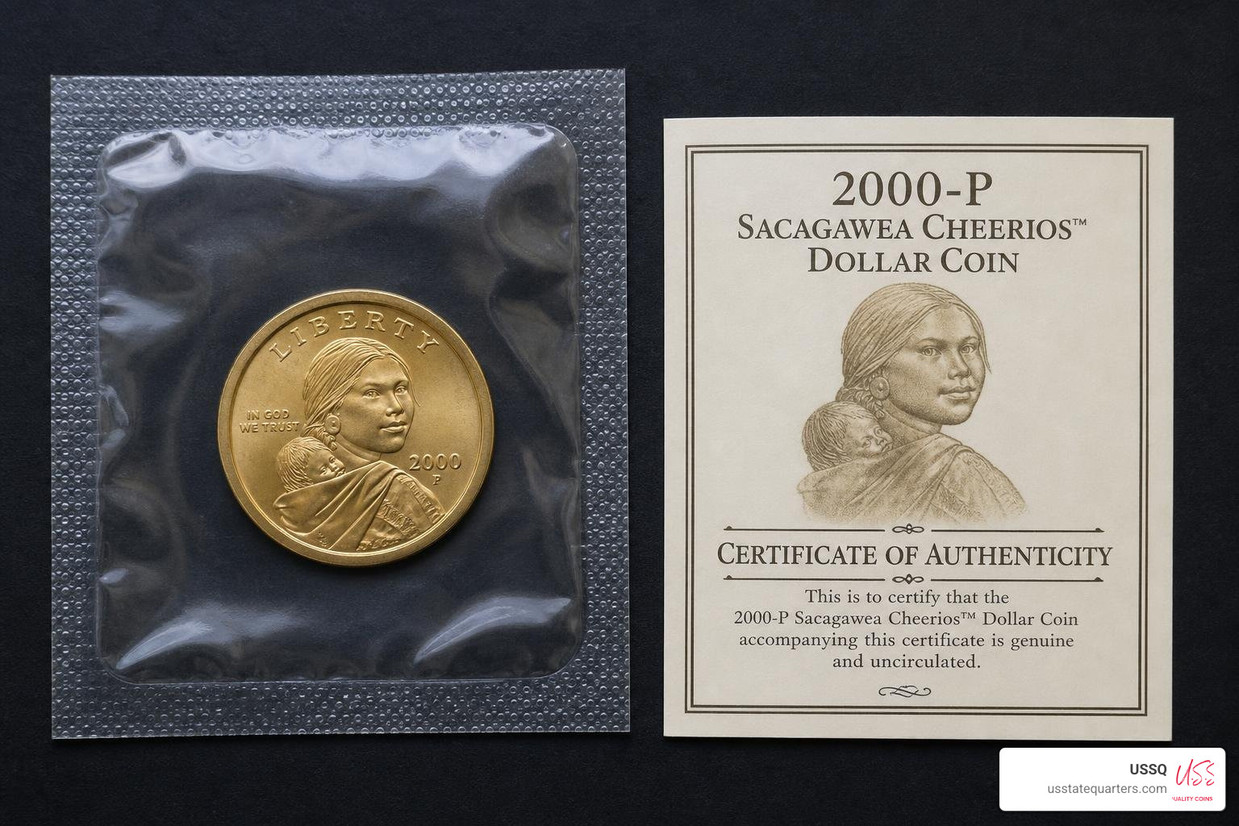
The Sacagawea dollar Cheerios coin is one of the most surprising finds in modern American numismatics — a rare prototype coin that was quietly slipped into breakfast cereal boxes in early 2000 and largely forgotten for five years.
Here's the quick answer for collectors who want to know right away:
| Feature | Details |
|---|---|
| What it is | A 2000-P Sacagawea dollar struck from a prototype die with enhanced eagle tail feathers |
| How to spot it | More defined tail feathers with visible veins and a raised central shaft on the reverse |
| How rare is it | Only 60–70 examples are known to exist |
| What it's worth | Roughly $2,500 (MS63) up to $29,900+ (MS68) depending on grade |
| Who certifies it | PCGS (107 certified) and NGC (2 certified) |
| Key designation | Listed as FS-902 in the Cherrypickers' Guide |
Most people who received one of these coins in a Cheerios box back in 2000 simply spent it — not knowing it was struck from a special prototype die that the U.S. Mint never used for regular circulation. The design difference wasn't even discovered until 2005, a full five years after the promotion ended.
That's what makes this coin so fascinating. It wasn't a deliberate rarity created for collectors. It was an accidental one — hiding in plain sight in coin jars, junk boxes, and dresser drawers across America.
History of the Sacagawea Dollar Cheerios Promotion
To understand how this modern treasure hunt began, we have to travel back to the turn of the millennium. The year 2000 was a massive milestone. While some people were busy worrying about the Y2K computer bug, the United States Mint was preparing to launch its highly anticipated golden dollar coin featuring Sacagawea.
To build public excitement for this new manganese-brass coin, the U.S. Mint partnered with cereal giant General Mills in a massive national marketing campaign.
In January 2000, General Mills distributed 10 million specially marked boxes of Cheerios containing a free coin prize. The vast majority of these boxes—exactly 10 million of them—contained a newly minted 2000-P Lincoln cent.
However, to make the promotion truly thrilling, the U.S. Mint supplied General Mills with a limited batch of the new Sacagawea golden dollars. Specifically:
- Every 2,000th box of Cheerios contained a brand-new 2000-P Sacagawea dollar.
- Every 4,400th box contained a penny, a dollar, and a certificate redeemable for $100.
- A total of 5,500 Sacagawea dollars were struck and shipped to General Mills in October 1999 for this cereal box promotion.
When families sat down for breakfast and opened their cereal, many found these golden dollars sealed in original plastic wrap on a colorful cardboard insert. If you want to dive deeper into the promotion's logistics, you can read our detailed article on the Sacagawea One Dollar Coin Cheerios history.
Because the golden dollar was entirely new, most people viewed it as a fun novelty or spent it at the local grocery store. Little did they know, a small portion of these promotional coins held a massive secret. For more on the general history of the coin series, browse our full selection of Sacagawea golden dollars.
The Prototype Design and the 1999 Striking
The 5,500 golden dollars struck for the General Mills promotion in October 1999 were produced before mass production for general circulation began.
The reverse of the coin, designed by Thomas D. Rogers Sr., features a soaring bald eagle. When Rogers originally sculpted the eagle, he created an incredibly detailed design featuring 12 tail feathers with highly defined, raised veins and a prominent, raised central shaft.
These early promotional coins were struck using these highly detailed prototype dies. However, before the U.S. Mint began churning out hundreds of millions of coins for general circulation, they ran into a practical manufacturing issue.
The high-relief details of the eagle's tail feathers were causing the coin dies to wear out too quickly under high-speed minting conditions. To solve this problem, the Mint modified the master hub. They softened the tail feather details, smoothing them out to extend die life. This modification also slightly changed the visual alignment, making the eagle look like it had 13 tail feathers instead of the original 12.
As a result, the 5,500 coins shipped to General Mills became a distinct "pattern" variety, while the 767 million Sacagawea dollars minted for circulation in 2000 featured the simplified, lower-detail reverse.
The 2005 Discovery Timeline
For five years, these coins circulated or sat in coin jars unnoticed. Then, in early 2005, collector Tom DeLorey and numismatist Pat Braddick made a shocking discovery. While studying Sacagawea dollars distributed through the Cheerios promotion, they noticed the eagle's tail feathers looked remarkably different.
Braddick submitted an example to a third-party grading service, which officially authenticated it as a distinct pattern variety. The coin was given the official designation FS-902 in the Cherrypickers' Guide and is widely referred to as the "Reverse of 1999" pattern.
Before this discovery, these promotional coins sold among collectors for a modest $50 to $175, primarily as a packaging novelty. Once the word got out that these were actually rare prototype strikes, prices skyrocketed overnight into the thousands of dollars. You can read the original technical breakdown of this event in the numismatic study The Cheerios™ Dollar .
How to Identify the Rare Pattern Variety
If you have a 2000-P Sacagawea dollar, how do you know if you are holding a regular pocket-change coin or a multi-thousand-dollar prototype?
The key is to ignore the front (obverse) of the coin for a moment and flip it over to look at the eagle on the back (reverse).
To help you tell them apart, we have put together a comparison of the key visual differences between the rare sacagawea dollar cheerios pattern and the standard 2000-P dollar. For a broader look at the series, check out our guide to Sacagawea Dollar Coins.
| Design Feature | Cheerios Dollar (FS-902 / Reverse of 1999) | Regular Sacagawea Dollar (Reverse of 2000) |
|---|---|---|
| Tail Feather Count | 12 highly detailed feathers | 13 smoothed-out feathers |
| Feather Veins | Highly defined, raised, and clearly visible | Smooth, flat, and lacking internal detail |
| Central Shaft (Quill) | Raised and highly prominent on all feathers | Incused (recessed) or completely flat |
| Upper Wing Feathers | Sharp, high-relief details with distinct lines | Softened, lower-relief details |
| Rarity | Extremely rare (60–70 known) | Common (Over 767 million minted) |
To explore coin values for both standard and rare versions, see our resource on Sacagawea Dollar Coin Values.
Identifying a Genuine Sacagawea Dollar Cheerios Variety
To perform a successful identification, you will need a 5x or 10x magnifying glass (or a high-quality macro lens on your smartphone) and a good light source.
Follow these steps to inspect the reverse design:
- Examine the Tail Feathers: Look closely at the tail feathers of the soaring eagle. On a genuine Cheerios pattern coin, you will see incredibly crisp, raised horizontal lines (veins) running through the feathers.
- Check the Central Shaft: The central shaft (the quill) of each tail feather on the prototype coin stands out in bold, raised relief. On a regular coin, this line is either flat or recessed (incused) into the feather.
- Inspect the Wing Feathers: The high-detail strike of the prototype also extends to the eagle’s upper wings. The feathers above the tail will show sharp, raised striations, whereas the regular strike features much softer, blended lines.
If you want a step-by-step visual walkthrough to help you inspect your coin, you can refer to Cheerios Dollar: How to Tell If You Have This Rare Coin or How to Identify the Sacajawea Cheerios Dollar Coin .
Obverse Die Markers and Original Packaging
What if your coin is still sealed inside its original Cheerios cardboard packaging? Can you identify it without opening the plastic? Yes, you can!
Numismatists have identified a specific obverse die marker that is unique to the dies used for the Cheerios strikes. If you look closely at the front of the coin, immediately below the "P" mint mark (for Philadelphia), look for faint, horizontal die polish lines coming out of Sacagawea's coat into the right-hand field.
These polish lines are incredibly helpful because they allow you to verify the coin's variety without having to break the original plastic seal.
A Word of Warning on Packaging: Just because a 2000-P Sacagawea dollar is sealed in original Cheerios packaging does not automatically mean it is the rare prototype variety.
During the promotion, the U.S. Mint ran out of the prototype coins but still had to fulfill their contract with General Mills. To finish the packaging run, they began using regular, standard-strike 2000-P Sacagawea dollars.
In fact, grading services have opened original, sealed Cheerios boxes only to find a standard, regular-strike dollar inside. Always inspect the tail feathers to confirm what you have! For more details on this phenomenon, read the expert analysis on Sacagawea Dollar Pattern/Cheerios Dollar - Dollar Coins .
Rarity, Grading, and Market Value
Because of its accidental release and unique history, the Cheerios Dollar is considered one of the holy grails of modern American coin collecting.
Out of the 5,500 golden dollars originally distributed in cereal boxes, only a tiny fraction have been found and authenticated.
- PCGS Population: PCGS has certified only 107 examples of the Cheerios Dollar.
- NGC Population: NGC has certified a mere 2 specimens.
- Estimated Survival: Experts estimate that only 60 to 70 highly pristine, uncirculated specimens are actively known to exist in the collector community, though more may be sitting unrecognized in private collections.
Because these coins are so scarce, having them professionally graded and certified by a service like PCGS or NGC is absolutely essential. It is the only way to guarantee authenticity and secure its true market value. You can check the official registry information directly on the 2000-P SAC$1 "Cheerios" Dollar (Regular Strike) page.
Current Market Value of the Sacagawea Dollar Cheerios
As we look at the market in 2026, the value of a genuine Cheerios Dollar remains incredibly strong. Because very few of these coins ever enter the market, documented sales tend to bring premium prices.
- High-Grade Record: The highest price ever paid for a Cheerios Dollar was $29,900 for a flawless PCGS MS-68 specimen.
- Reported Market Results: Over the years, documented sales of authenticated Cheerios Dollars have ranged from under $1,000 for lower-grade or worn specimens up to more than $11,000 for high-grade uncirculated examples.
- Value by Grade:
- MS-63: Around $2,500
- MS-65: Around $3,000
- MS-67: Around $5,750
- MS-68: $8,000 to $11,000+
Even if a specimen is found in circulated condition, it can still easily fetch $1,000 to $2,000 because collectors need this specific die variety to complete their master sets of Sacagawea dollars. To see how these values compare to other issues, check our guide on Sacagawea Dollar Coin Values or browse our list of Rare Sacagawea Dollar Coins.
Other Valuable Sacagawea Varieties to Watch For
While you are searching your coin jars for the Cheerios Dollar, keep your eyes peeled for other highly valuable Sacagawea dollar varieties and errors:
- The Goodacre Finish (2000-P): The U.S. Mint struck 5,000 special burnished Sacagawea dollars on polished planchets to pay coin designer Glenna Goodacre for her work. These have a distinct proof-like, semi-reflective finish.
- The "Wounded Eagle" Die Error (2000-P): This variety features three raised, parallel die cracks that run directly across the eagle's belly and wing, making it look like the eagle has been wounded by an arrow. High-grade specimens can fetch $300 to $2,000.
- The "Speared Eagle" Die Error (2000-P): Similar to the Wounded Eagle, this error features a long, vertical die gouge that runs straight through the eagle's body.
- The 2007-D Edge Lettering Error: A highly rare error where a Denver-minted Sacagawea dollar was accidentally struck with the edge lettering intended for Presidential Dollars. One reported sale exceeded $17,000.
To learn more about identifying these specific errors, check out our dedicated guide on Valuable Sacagawea Dollar Coin and discover other treasures in Rare Sacagawea Dollar Coins.
Frequently Asked Questions About the Cheerios Dollar
How many Cheerios Dollars actually exist today?
While 5,500 Sacagawea dollars were originally shipped to General Mills for the promotion, it is impossible to know exactly how many of those were the detailed prototype variety. Because many boxes were packed with standard-strike coins, and many of the prototype coins were spent or lost in circulation, only about 60 to 70 authenticated specimens are known to exist today.
Can you find a Cheerios Dollar in pocket change?
It is highly unlikely, but not impossible! Several genuine specimens have been discovered in mixed bulk lots and in general circulation by eagle-eyed collectors who knew what to look for. Because the front of the coin looks identical to a standard 2000-P dollar, most people would never notice the difference without looking closely at the tail feathers.
What is the difference between a pattern and a non-pattern Cheerios Dollar?
A "pattern" (or prototype) Cheerios Dollar features the detailed 12 tail feathers with raised veins and a raised central shaft. A "non-pattern" Cheerios Dollar is a standard-strike 2000-P dollar that was inserted into the cereal boxes late in the promotion. While non-pattern coins still hold some value if they are sealed in their original packaging, they do not command the thousands of dollars that the true prototype variety does.
Conclusion
The sacagawea dollar cheerios variety is a perfect example of why coin collecting is so exciting. It is a true modern treasure hunt where a coin worth thousands of dollars could be sitting quietly in your piggy bank, drawer, or mixed dollar-coin lot.
Now that you know exactly how to identify the enhanced tail feathers and the obverse die markers, we highly recommend checking every single 2000-P Sacagawea dollar you come across.
At Coins Online LLC, we have been helping collectors find rare treasures, key dates, and beautiful additions to their collections since 1999. Based in New Orleans, LA, we offer competitive prices, low shipping rates across the United States and Canada, and a worry-free 14-day return policy on our massive inventory of over 5,000 products.
Whether you are looking to buy, sell, or simply learn more about the fascinating world of numismatics, we invite you to explore our Native American dollar coins and let us help you on your collecting journey. Happy hunting!
Recent Posts
-

Walking Liberty Half Dollar Value Guide: Key Dates, the 1921 Problem, and What Yours Is Really Worth
Ask a room full of collectors to name the most beautiful U.S. coin and the Walking Liberty half doll
-
The 2026 Semiquincentennial Proof Set: What's in It, Why It Costs $107, and Whether to Buy One
On October 6 at noon Eastern, the U.S. Mint puts the 2026 Semiquincentennial Proof Set on sale at $1